

The investor offering the most money may not be the one best suited to your company’s future. When deciding when to choose strategic vs financial capital, look beyond the funding: a strategic investor may bring commercial synergies or integration, while a financial investor generally assesses the business on its standalone performance and potential return. Both can support growth, but they can shape it in different ways.
Valuation matters, especially when capital could accelerate your company’s next stage. But the right fit also depends on your long-term objectives, desired exit timeline, and operational needs. This guide explains what financial buyers are, how strategic and financial capital differ, and how each can affect value creation and day-to-day independence, so you can assess the trade-offs more clearly.
Key Takeaways
- Choose capital based on the future you’re building, not valuation alone. Consider how an investor’s goals and influence fit your long-term objectives.
- Assess whether you want a partner focused on standalone financial performance or one seeking operational integration and synergies.
- Align the investor’s expected value-creation approach and exit timeline with your company’s growth plans and ownership goals.
- Strategic capital is most compelling when it brings tangible advantages, while financial capital may better suit businesses prioritizing flexibility and operational independence.
Keeping investments aligned with long-term objectives
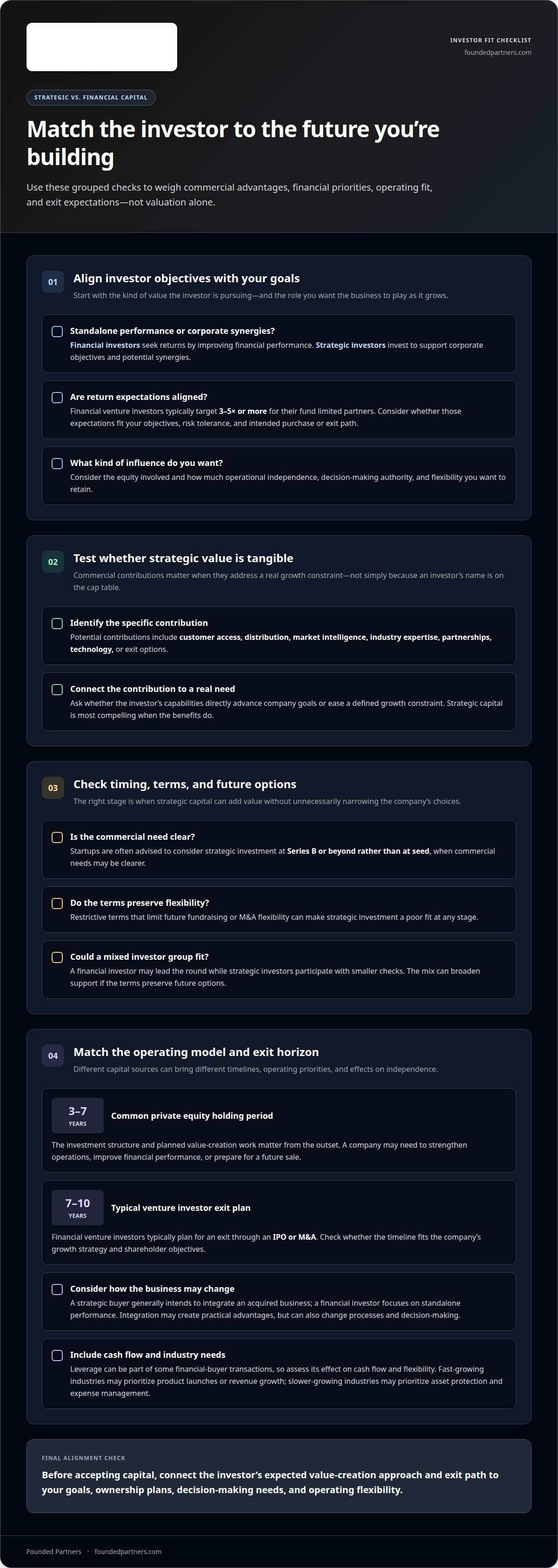
Choose a strategic investor when its commercial capabilities directly advance your company’s goals. Choose a financial investor when standalone growth and financial performance better match your plans. Consider each investor’s motivations, the equity involved, and the role you want your business to play as it grows.
Investor Objectives and Returns
Financial investors seek returns by improving a company’s financial performance, while strategic investors invest to support corporate objectives and potential synergies. Financial venture investors typically target returns of 3-5x or more for their fund limited partners, so their assessment centers on growth and eventual value realization. Understanding these differences helps you judge whether an investor’s return expectations align with your business objectives, risk tolerance, and intended purchase or exit path.
Strategic Investor Contributions
Strategic capital combines equity with a potential commercial contribution, such as customer access, distribution, market intelligence, or exit options. A strategic investor may also offer relevant industry expertise, partnerships, or technology. These advantages matter when they address a real growth constraint, not simply because an investor’s name appears on the cap table. Strategic investment makes sense when those contributions advance your long-term objectives.
Funding-Stage Timing
The right funding stage is when strategic capital can add value without narrowing your future choices. Startups are often advised to consider strategic investment at Series B or beyond rather than at seed, when commercial needs may be clearer. This can help founders assess whether a corporate partner’s distribution, customers, or expertise fit the company’s direction. Restrictive terms that limit future fundraising or M&A flexibility can make strategic investment a poor fit at any stage.
Choosing Between Investor Types
Choosing between investor types means weighing strategic benefits against financial independence and return priorities. Strategic capital may suit a business that needs a partner’s customers, distribution, industry knowledge, or another tangible advantage. Financial capital may suit a company seeking investment focused on standalone performance. A company can raise from both: a financial investor may lead the round while strategic investors participate with smaller checks. This mix can broaden support, provided the terms preserve future options.
Financial buyer value creation and exit timelines
Private equity and venture capital firms can provide growth funding, financial and governance expertise, and access to investor networks. Their value-creation approach typically focuses on improving operational performance and building shareholder value, rather than integrating the business into a corporate parent. This can suit owners seeking a financially focused partner and a clear framework for evaluating growth, profitability, and an eventual exit.
Private equity buyers commonly hold acquired companies for three to seven years. That horizon makes the investment structure and planned value-creation work important from the outset. During the holding period, a company may need to strengthen operations, improve financial performance, or prepare for a future sale. Leverage can be part of some financial-buyer transactions, so its effect on cash flow and flexibility belongs in the assessment.
Financial venture investors typically plan for an exit through an IPO or M&A within seven to ten years. That timeline can clarify whether the company’s growth strategy and shareholder objectives align with the fund’s expectations. Financial investors may also contribute board governance, operational discipline, and a network without a strategic agenda. These advantages matter when the business can use that expertise while retaining its independent direction.
Shareholder value depends on more than a future purchase price. For example, an equipment decision can affect operating costs and the value retained in an asset. Evaluating both figures alongside the company’s broader investment plans shows why owners should consider ongoing costs, asset value, and growth needs together.
Before accepting capital, connect the investor’s expected exit path to the company’s long-term goals. Consider how the proposed structure affects ownership, decision-making, operating flexibility, and shareholder value. A disciplined funding strategy can help bring those considerations into one view.
Operational and strategic considerations
Capital choices influence operating priorities, asset use, and the direction of growth. A strategic buyer generally intends to integrate an acquired business, while a financial investor focuses on its standalone performance. Integration, for example, may connect a company’s product or team with the buyer’s existing operations. This can create practical advantages, but it may also change processes and decision-making. Consider whether those changes support the company’s purpose. The question of when to choose strategic vs financial capital becomes especially important when investment may reshape how the business operates.
Industry conditions also shape priorities. Companies in fast-growing industries may pursue product launches or revenue growth, even if that means accepting short-term losses or adjusting near-term goals. In slower-growing industries, protecting assets and managing expenses may take priority. An investor’s interests should fit the company’s operating needs. Growth capital is more useful when it supports a defined plan than when it accelerates activity without addressing a real constraint.
Assess how the proposed growth path affects cash flow. A business launching a product may need to fund development, distribution, and customer acquisition before generating revenue from that effort. A strategic partner could offer relevant market intelligence or distribution, while a financial investor may focus on operating improvements and financial performance. Compare not just the amount of capital, but how each investor’s contribution affects execution, resource demands, and the company’s ability to meet its objectives.
Preserving flexibility matters, too. Strategic terms that restrict future fundraising or M&A can limit the company’s options, even when the investor brings commercial advantages. For example, a startup expecting another funding round should weigh those restrictions against immediate access to customers or distribution. Review how the arrangement affects control, operating independence, and future transactions. A sound decision about when to choose strategic vs financial capital weighs the company’s intended direction against the investor’s interests and the flexibility needed to pursue it.
What is the difference between strategic and financial capital?
Strategic capital comes from an operating company seeking business alignment; financial capital comes from an investor focused on financial returns. This difference shapes what an investor values, how it may influence the company, and what it expects after investing. A corporate investor, for example, may assess how a company’s product fits its existing operations, while a financial buyer evaluates the business on its standalone performance.
A strategic buyer may value synergies from combining the acquired business with its own. Those synergies may support a higher purchase price than a financial buyer would offer, because the strategic buyer can account for value beyond the target’s standalone results. Integration can also bring operational change. Company leaders should consider whether shared systems, customers, or processes support the business’s direction.
A financial buyer generally seeks to improve operational performance and financial results without integrating the business into its existing operations. It may contribute capital, finance expertise, governance, and process improvements while the company continues to operate independently. For an owner, that distinction matters: a financial investor’s value case depends on strengthening the company as a standalone business, rather than combining it with another organization.
The two forms of capital can also appear in the same funding round. A financial investor, for example, can lead while strategic corporate investors participate with smaller investments. This structure can pair financial oversight with selected commercial relationships. It works well only when the strategic participants’ terms preserve future fundraising and M&A flexibility. Compare each investor’s contribution, expected involvement, and objectives before deciding how to structure the round.
In practical terms, choose strategic capital when corporate alignment and integration can create value for your business. Consider financial capital when you want investment centered on standalone performance and financial returns. If you’re preparing to assess investor fit and funding structure, explore capital raising support.
Founded Partners: Capital raising support
Founded Partners provides capital raising support for founder-led businesses weighing investor fit against growth objectives. Turn to this service when preparing to raise capital and clarifying how the funding choice aligns with your company’s direction, operational priorities, and future plans.
Start with the business’s objectives: what growth needs funding, what investor contribution would be useful, and how ownership and decision-making fit the company’s plans. This creates a clearer basis for assessing potential investment against strategic priorities, rather than treating capital as an isolated transaction. If the business also needs to strengthen its foundations for growth, Founded Partners’ Business Transformation Consulting can address that related work.
For founders considering a raise, a thoughtful capital strategy connects funding needs with the kind of investor relationship the business is prepared to build. Contact Founded Partners to discuss your capital-raising needs.
Build a capital plan that supports what comes next
Deciding when to choose strategic vs financial capital is also an opportunity to define the company you intend to build. Set out the capabilities, relationships, and independence your next stage requires. Then use those priorities to shape an investment approach that supports the business beyond the funding transaction.
Founded Partners offers capital raising support to help align funding with growth objectives. Business Transformation Consulting can address organizational changes that support the next stage, while Exit planning can connect today’s decisions with future ownership goals. Each offering fits a different point in the company’s development, from preparing for investment to strengthening operations or planning a transition.
If you’re ready to discuss how capital could support your company’s direction, contact Founded Partners to discuss capital. A considered next step can help you move forward with greater clarity and purpose.
Frequently Asked Questions
What Is a Financial Buyer?
A financial buyer invests primarily to earn a return, rather than to combine a business with its own operations. Private equity firms and venture capital investors are examples. For founders, the distinction matters when considering what a prospective investor will emphasize: the company’s standalone performance, growth prospects, and potential route to an eventual sale or public offering.
What Is a Strategic Buyer?
A strategic buyer is an operating company that invests in or acquires another business to advance its corporate objectives. For example, a company may see a product or capability as a complement to its existing operations. Its interest can extend beyond the target’s standalone financial results, so founders should consider how the proposed relationship could shape the business after investment.
How do strategic and financial investors differ in valuation and deal terms?
Strategic investors may account for synergies with their existing business, while financial investors typically evaluate standalone performance and expected returns. This can affect the value each assigns to the company. Deal structures can differ, too: strategic buyers may prefer to pay with their own shares, while financial buyers often use leveraged buyouts or other debt-financed transactions. The structure influences ownership and future obligations.
How do strategic investors affect a company’s control, governance, and independence?
The effect depends on the investment terms and the investor’s role. A strategic investor may seek closer coordination because its corporate objectives are connected to the company’s operations. Before agreeing, founders should understand how governance participation, decision rights, information access, and integration plans could affect independent decisions. For instance, a company prioritizing a separate product roadmap may weigh proposed operating influence against that goal.
What risks come with taking capital from a strategic investor, including exclusivity or conflicts of interest?
Strategic capital can create tension if the investor’s commercial priorities differ from the company’s broader plans. Exclusivity or other restrictive terms may limit future fundraising or M&A flexibility. A startup that hopes to work with multiple industry partners, for example, should consider whether a proposed arrangement could narrow those options. Assess the commercial benefit alongside the constraints the terms could create.
How do financial investors support growth, operations, and future fundraising?
Financial investors can support growth through capital, board governance, finance expertise, process improvement, and networks. A company preparing for another funding round, for example, may benefit from stronger financial reporting and a clearer operating plan. Investors’ startup pattern recognition can also inform planning, while their networks may help broaden business connections. The value depends on how those resources address the company’s needs.