
When It’s Not Human Error: Why Founders Should Design Systems, Not Blame People
Most founders believe they have a hiring problem.
Deadlines are missed.
Customers are frustrated.
Sales data is wrong.
Invoices are delayed.
Operations break down.
The reflex is almost always the same.
“We hired the wrong person.”
“They are not detail oriented.”
“They just do not think ahead.”
“We need better people.”
But in most scaling companies, the problem is not bad hires.
It is bad system design.
And the research on human error makes that painfully clear.
Human Error Is Often a System Problem
James Reason, a British psychologist known for his work on human error and organizational accidents, fundamentally changed how we understand mistakes in complex systems.
If you are not familiar with his work, start here:
Reason made several critical distinctions that every founder should understand.
1. Slips vs. Mistakes
A slip is when someone knows what to do but fails in execution.
Example:
A finance manager intends to transfer $50,000 but types an extra zero.
A mistake is when the decision itself is flawed because the mental model is wrong.
Example:
A sales leader forecasts revenue using assumptions that are fundamentally incorrect.
Slips are execution failures.
Mistakes are thinking failures.
Neither is usually about intelligence.
Both are heavily influenced by system design.
2. Active Failures vs. Latent Conditions
Reason also distinguished between:
Active failures: the visible error made by an individual.
Latent conditions: the hidden system weaknesses that made the error likely.
Founders often see only the active failure.
The wrong number in the spreadsheet.
The contract clause missed.
The shipment delayed.
But they do not see the latent conditions:
No checklist.
No second review.
Unclear ownership.
Conflicting KPIs.
Poor handoffs.
Cognitive overload.
The visible mistake is usually the final domino.
The real problem is upstream.
The Swiss Cheese Model and Scaling Companies
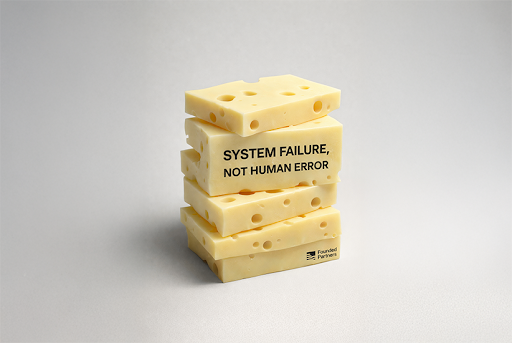
Reason’s most famous contribution is the Swiss Cheese Model.

The Swiss Cheese Model: Failure occurs when weaknesses align across multiple system layers.
In complex systems, multiple layers of defense exist:
Policies.
Processes.
Training.
Technology.
Supervision.
Each layer has holes.
Those holes represent weaknesses.
When the holes align across layers, failure occurs.
Here is the founder translation.
In a small startup, you are the system.
You catch errors instinctively.
You double check contracts.
You clarify decisions in real time.
As the company grows, you are no longer the control layer.
If the systems are weak, the holes align.
Then you blame the person closest to the error.
But the person is rarely the root cause.
How This Shows Up in Growing Companies
Let’s make this concrete.
1. Missed Deadlines
Common founder reaction:
“They just are not accountable.”
System reality:
No clear definition of done.
No intermediate checkpoints.
Competing priorities.
No visible task tracking.
This is not laziness.
It is ambiguity.
Ambiguity creates failure.
2. Sales Errors
Common founder reaction:
“The rep keeps entering data wrong.”
System reality:
CRM fields unclear.
No required fields.
Incentives misaligned.
Manual data entry across multiple tools.
Blaming the rep ignores the cognitive load imposed by poor system design.
If your CRM is confusing, errors are predictable.
See research on cognitive overload here
3. Finance Mistakes
Common founder reaction:
“Finance needs to be more detail oriented.”
System reality:
No dual approval controls.
No automated validation.
Spreadsheet dependence.
Informal handoffs.
In safety critical industries, redundancy is standard.
In scaling companies, redundancy is often treated as inefficiency.
Until something breaks.
4. Operational Breakdowns
Common founder reaction:
“We need stronger operators.”
System reality:
No standardized operating procedures.
Inconsistent documentation.
Tacit knowledge trapped in senior staff.
No escalation protocol.
You are not experiencing incompetence.
You are experiencing system entropy.
Why Founders Default to Blame
Blame is psychologically convenient.
Attribution theory tells us that humans over attribute failures to personal traits and under attribute them to situational factors.
This is called the fundamental attribution error.
Overview here:
https://www.simplypsychology.org/fundamental-attribution.html
When something breaks, it feels emotionally satisfying to identify a person.
It feels harder to redesign a system.
But the latter scales.
The former does not.
Systems Thinking for Founders
Systems thinking shifts the question from:
“Who messed this up?”
to
“What in our design made this outcome likely?”
Peter Senge’s work in The Fifth Discipline is foundational reading
Systems thinking requires:
Looking for patterns, not events.
Studying feedback loops.
Identifying structural drivers.
Designing constraints intentionally.
In growing companies, recurring mistakes are rarely random.
They are signals.
Actionable Steps for Founders
Here is how to apply this immediately.
1. Audit Recurring Errors
Do not focus on dramatic one off mistakes.
Focus on patterns.
Ask:
What error has happened more than once?
Where do we consistently experience friction?
Where does leadership repeatedly intervene?
Recurring errors are system design clues.
2. Map Signal Clarity
Errors increase when signals are weak or ambiguous.
Ask:
Is ownership clear?
Are priorities ranked?
Is “done” defined?
Are metrics visible?
If a smart person is confused, the system is unclear.
3. Add Redundancy in Critical Processes
High reliability organizations assume humans will err.
They design around that reality.
Examples:
Dual approval for payments.
Checklist for contracts.
Required CRM fields.
Pre mortem meetings before launches.
Redundancy is not bureaucracy.
It is resilience.
For more on high reliability organizations:
https://hbr.org/2011/05/creating-a-culture-of-reliab
4. Design for Recoverability, Not Perfection
Perfection is unrealistic.
Recoverability is strategic.
Ask:
How quickly can we detect an error?
How quickly can we reverse it?
What is the cost of recovery?
Good systems limit blast radius.
5. Shift from Blame Culture to Learning Culture
Research in organizational psychology consistently shows that psychological safety improves performance.
When people fear punishment, they hide errors.
When they feel safe, they surface them early.
If your team hides mistakes, your system will degrade silently.
The Founder’s Real Job
In early stage companies, founders solve problems.
In scaling companies, founders design systems that prevent recurring problems.
That shift is uncomfortable.
It requires humility.
It requires letting go of the idea that better people solve structural flaws.
Better design solves structural flaws.
If you are repeatedly frustrated with “human error,” it may be time to examine the architecture of your organization.
Because in most growing companies, the error is not human.
It is systemic.
Founder Reflection Questions
If you are leading a company between $5M and $50M in revenue, consider:
What mistake has happened three times in the past six months?
What process relies on tribal knowledge?
Where are we assuming attention instead of designing clarity?
Where are we expecting perfection instead of building safeguards?
These questions reveal inflection points.
And inflection points are where structure determines trajectory.
If you are repeatedly frustrated with recurring mistakes in your company and want to shift from blaming people to designing better systems, book a call with Founded Partners today. We help founders between five million and fifty million in revenue build operational structures that reduce errors, strengthen teams, and create sustainable growth through system design rather than hiring pressure.