
McKinsey vs. Boutique Startup Consulting: Which Is Right for Your Company?

The most prestigious advisor may be the wrong fit for the decision in front of your company. In the McKinsey vs boutique startup consulting comparison, the real question isn’t which name carries more weight. It’s whether the proposed team, its day-to-day involvement, and its ability to support execution match what your business needs next. If you’re concerned that a large firm could be too broad or costly, or unsure how closely a boutique partner will work with your team, these are practical questions to answer before you commit.
Both models can bring value, but the right choice depends on the challenge, your company’s stage, and the work required after recommendations are made. This article offers a practical way to assess fit, weigh trade-offs, and prepare clear questions for prospective advisors.
We’ll compare team structure, founder involvement, and execution needs, then consider when consulting may not be the answer, such as when product-market fit still depends on direct customer learning. We’ll also look at where a founder-focused boutique such as Founded Partners may be relevant, including business transformation, operations optimization, capital raising support, exit planning, and leadership advisory.
Key Takeaways
- Compare the actual proposed teams: who leads the work, who does the analysis, and who presents recommendations.
- McKinsey vs boutique startup consulting isn’t a choice between a universal winner and a weaker alternative. Assess each proposal against your scope, internal bandwidth, and need for implementation support.
- Before evaluating advisors, align internally on the outcome you want, who will make decisions, and who will own the work after recommendations are delivered.
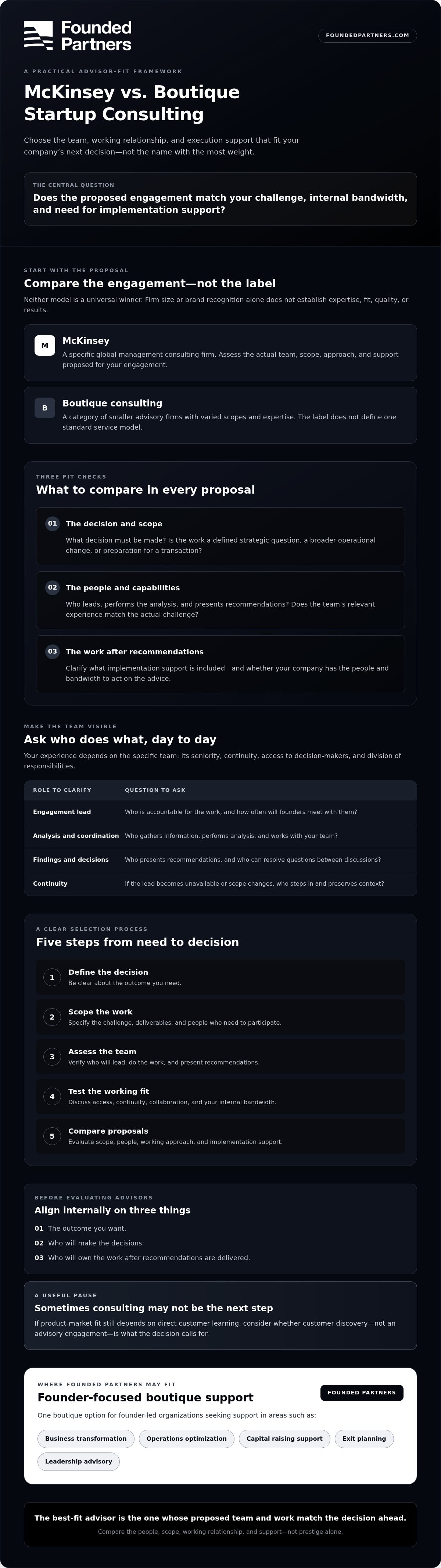
- Use a clear selection process: define the decision, scope the work, assess the team, test the working fit, and compare proposals.
- Founded Partners is one boutique option for founder-led organizations seeking support with business transformation, operations optimization, capital raising, or exit planning.
McKinsey vs. boutique startup consulting: what are you actually comparing?
It’s reasonable to feel uncertain when a consequential company decision comes with very different advisor options. The useful question isn’t which model wins in every situation. It’s which one fits the decision, the people who need to make it, and the work that follows. Start with the engagement being proposed, not assumptions based on a firm’s name or size.
In brief: McKinsey is a specific global management consulting firm; a boutique is a category of smaller advisory firms with varied scopes and expertise. The label describes the firm, not the quality or likely outcome of a particular engagement. For a neutral overview of the field, see Management consulting.
What founders usually mean by McKinsey versus boutique consulting
McKinsey names one firm. “Boutique” describes a type of firm, not a single company or standard service model. One boutique may focus on a particular sector or business challenge; another may have a different remit. Likewise, don’t assume every large firm proposes the same team or approach.
Separate brand recognition from the actual proposal. Ask who will lead the work, what the team will deliver, how it will work with your people, and what support is included after recommendations are made. Those details give you a more useful basis for comparison than the firm label alone.
Why company stage and decision matter more than labels
Start with the decision you need to make. A defined strategic question, such as whether to enter a new market, differs from a broader need to reshape operations or prepare for a transaction. The scope affects the expertise required, the people who need to participate, and the internal capacity you’ll need to commit.
Consider organizational complexity, too. A company with several business units and multiple decision-makers may need a different advisory approach from a founder-led team working through a focused growth question. Neither situation automatically points to a global firm or a boutique. The fit depends on the challenge, relevant experience, and proposed working relationship.
In the McKinsey vs boutique startup consulting decision, firm size alone doesn’t establish expertise, fit, quality, or results. Define the work first, then assess whether the proposed team can address it and whether your company has the bandwidth to act on its advice. For a broader advisor-selection framework, read the growth consulting buying guide.
How consulting team structure changes the founder’s experience
A firm’s reputation doesn’t tell you who will be in the room once the work begins. Your experience depends on the proposed team: its seniority, continuity, access to decision-makers, and division of responsibilities. In the McKinsey vs boutique startup consulting comparison, assess the people assigned to your engagement rather than relying on assumptions about how large or small firms typically operate.
The proposal’s named team is more useful than a firm-size stereotype. Ask each advisor to identify the person accountable for the work, the people performing it, and who will present findings. Confirm that those individuals are available for the proposed engagement, and ask what happens if team members change.
Who will founders work with day to day?
Get specific about access and accountability. Which partner or senior advisor leads the work? How often will founders meet with them, and who can resolve questions between scheduled discussions? Clarify who gathers information, analyzes it, coordinates with your team, and owns key decisions. These are proposal-specific details to verify, not assumptions to make based on a firm’s category.
Ask about continuity, too. If the lead advisor becomes unavailable or the project scope shifts, who steps in, and how will context be preserved? A clear answer helps you understand whether the proposed structure can sustain momentum without requiring your team to repeatedly explain the business.
Breadth, specialization, and context
Some challenges call for input across several disciplines; others depend on deep experience in a focused area. Match the proposed team’s capabilities to the actual problem. A broad network can be useful, but only if the people assigned to your work bring relevant expertise and understand your company’s operating context, decision process, and constraints.
Consider whether the advisors can work with founder-led decision-making and the capacity your organization can contribute. Consulting can involve more than recommendations. Harvard Business Review’s discussion of the fundamental purposes of consulting is a useful reminder to clarify the advisor’s role and what your team must own.
Compare proposals side by side using a simple role map:
- Engagement lead: Who is accountable for direction and decisions?
- Working team: Who performs the analysis and collaborates with your staff?
- Continuity and access: Who will founders reach, and how will changes be handled?
- Recommendations: Who presents conclusions, and who supports the next steps?
If your assessment points to a need for founder-focused perspective on transformation, operations, or leadership, you can learn more about Founded Partners’ advisory work as one option to consider.
Is McKinsey always better for a startup? Compare fit, not prestige
No. A well-known name can signal recognition, but it doesn’t establish that a specific team has the right experience, capacity, or approach for your company. The same is true in reverse: boutique status alone doesn’t prove an advisor understands startups or can deliver the work you need. In the McKinsey vs boutique startup consulting decision, judge the proposal against the challenge, not the label.
Rankings such as Forbes’ list of top-tier consulting firms can offer context about reputation. They can’t tell you who will lead your engagement, how much senior oversight it includes, or whether the proposed team’s experience matches your situation. Resolve those questions directly with each firm.
When a large consulting firm may be a stronger fit
A larger firm may merit consideration if your mandate spans several functions, involves substantial organizational complexity, or requires coordination across multiple workstreams. The deciding factor is whether the firm can show that the specific team it proposes is equipped and available to handle that scope, not simply whether the organization is large.
Ask for evidence tied to the engagement: relevant experience of the proposed team, who will provide senior oversight, and which deliverables are included. Clarify whether the work ends with recommendations or includes implementation support, and which responsibilities remain with your company. Even a broad mandate needs clear ownership.
When a boutique advisor may be a stronger fit
A boutique may be worth considering when your priority is focused counsel on a defined strategic challenge or close engagement with experienced advisors. Test the firm’s actual capabilities. Ask for examples relevant to your sector, stage, and decision, and establish who will do the work and how the advisor will account for your company’s context.
Specialization should be demonstrated, not inferred from firm size. A boutique can have a broad remit, just as a large firm may have relevant expertise in a specific area. For a closer look at how to assess this distinction, explore the boutique consulting specialization guide.
Compare both proposals against the same questions:
- Scope: Does the plan address the full challenge without adding unnecessary work?
- Access: Who will advise your leadership team, and how will you work together?
- Capacity: Can your team support the engagement while keeping core operations moving?
- Execution: Who owns implementation, and what support is explicitly included?
Choose the model whose proposed people, responsibilities, and work match your company’s needs. Prestige and boutique status are context, not a verdict.
How to choose between McKinsey and boutique startup consulting
A sound selection process begins before you review credentials or proposals. Agree internally on what needs to change, who has authority to make decisions, and who will own implementation. That shared understanding gives you a consistent basis for comparing advisors and reduces the risk of hiring a firm to solve a problem your team hasn’t defined.
- Define the decision. State the choice or challenge the engagement must address. Separate the core question from symptoms and secondary concerns.
- Scope the work. Identify the expected deliverables, the people and information your team can provide, and whether you need recommendations, implementation support, or both.
- Assess the proposed team. Confirm who leads the work, who handles each major responsibility, and what relevant experience those people bring.
- Test the working fit. Discuss how the advisor will engage with founders, handle disagreement, and adapt if priorities change. Notice whether they ask thoughtful questions about your context.
- Compare proposals. Use the same criteria for each: scope, team, access, responsibilities, measures of progress, and assumptions. Resolve gaps before selecting a partner.
This framework makes the McKinsey vs boutique startup consulting choice more concrete. Instead of comparing brand impressions, you’re evaluating each advisor against the same decision and expectations.
Questions to ask every consulting firm
Use direct questions to surface what a polished proposal might leave implicit:
- Who will lead the work, and who will perform each major part of it? How much of the proposed team’s time is committed?
- What specific deliverables should we expect, and which tasks or decisions remain our responsibility?
- How will we track progress, make decisions, and handle a change in priorities or scope?
- What assumptions does your recommendation depend on, and how will you test them with our team?
- How will we know the engagement is advancing, and what evidence will we review along the way?
Listen for precise answers. If an advisor describes an outcome but can’t explain how progress will be assessed, ask for a clearer definition before signing. Align internally on who can approve decisions and who will carry the work forward once advice is delivered.
Match the advisor to the work ahead
For operating bottlenecks, examine the team’s capabilities in business transformation and operations optimization. For financing or an ownership transition, ask about relevant capital raising support or exit-planning experience. These needs call for distinct expertise, so don’t assume one advisor covers every requirement.
If you’re still weighing which kind of advisory support fits your situation, review Founded Partners’ advisory services as you compare options for your founder-led organization.
Where Founded Partners fits in the boutique startup consulting decision
Once you’ve clarified the challenge, scope, and support your team needs, assess specific firms against that brief. Founded Partners is a privately owned boutique consultancy to consider for founder-led organizations. Led by Adam and Matt, the firm’s advisory areas include business transformation, operations optimization, capital raising support, and exit planning.
That range may be relevant if your next stage involves strengthening how the business operates, addressing organizational challenges, considering capital options, or preparing for an ownership transition. It isn’t a universal fit. The same discipline applies here as in any McKinsey vs boutique startup consulting decision: match the firm’s stated capabilities to the work you need, then clarify the proposed scope and team before deciding.
Which founder-led challenges align with Founded Partners’ services?
If growth is exposing operational bottlenecks or the business needs to refine how it works, ask whether business transformation and operations optimization advisory align with the issues you’re facing. Be ready to describe where execution is getting stuck, which decisions remain unresolved, and which leaders need to be involved.
If the question concerns financing or a potential ownership transition, explore whether capital raising support or exit planning is relevant to your priorities. Capital raising support is advisory, not venture capital funding. Founded Partners does not provide investment capital. Clarify the boundaries of any proposed work, including what it covers and what remains outside the engagement.
A practical next step before choosing an advisor
Before an initial discussion, prepare three things: a concise description of the business challenge, the outcome you want to work toward, and your decision timeline. You don’t need every answer. A clear starting point helps you assess whether the conversation addresses your actual priorities.
Then compare the scope and proposed team with those of other firms you’re considering. Look for a clear connection between the challenge and the advisor’s capabilities, along with defined responsibilities and expectations. If the fit isn’t clear, keep evaluating. A familiar name or boutique model shouldn’t replace your judgment.
If Founded Partners’ advisory areas appear relevant to your situation, review the firm’s services and consider whether they align with your priorities.
Choose the advisory fit that moves your next decision forward
The right advisor isn’t necessarily the most recognizable or the smallest. In the McKinsey vs boutique startup consulting decision, focus on the people proposed for your engagement, how well their experience matches the challenge, and who will carry the work forward. Define the outcome, clarify decision rights, and compare scope and responsibilities before committing.
Founded Partners is a privately owned boutique consultancy led by partners Adam and Matt. Its services include business transformation, operations optimization, capital raising support, and exit planning. Whether those capabilities fit depends on your company’s priorities and the support you need.
If you’re assessing advisory options for a strategic decision, contact Founded Partners to discuss your company’s priorities and assess whether its services fit your needs.
Frequently Asked Questions
Is McKinsey always better than a boutique startup consulting firm?
No. Neither global reach nor boutique status proves that a firm is the right advisor for your company. Compare the proposed team’s relevant experience, responsibilities, and availability, then assess whether its scope matches your challenge and internal capacity. For a focused operating issue, broad resources may not be necessary. For a complex mandate, a boutique may still be suitable if it can demonstrate the expertise and capacity the work requires.
What is the difference between McKinsey and boutique startup consulting?
McKinsey is a specific global management consulting firm, while “boutique” describes a category of smaller advisory firms with varied areas of focus. That distinction alone doesn’t tell you who will do the work or how an engagement will run. In McKinsey vs boutique startup consulting, compare the actual proposed team, its relevant expertise, founder access, deliverables, and responsibilities rather than assuming a firm’s approach from its label.
Can a boutique consulting firm handle a complex startup challenge?
It can, if the firm has the relevant expertise, available capacity, and a clear plan for the challenge. Complexity may require multiple disciplines, coordination across teams, or sustained implementation support. Ask the boutique to explain who will lead each workstream, what experience those people bring, and how they’ll manage dependencies. If the proposal doesn’t cover essential capabilities, ask how those gaps will be addressed before deciding whether the firm is equipped for the mandate.
How do I choose a consulting firm for my startup?
Start by defining the decision you need help with and the outcome you want. Then scope the work, identify who in your company will make decisions and implement recommendations, and assess each proposed team’s experience and availability. Ask firms to specify deliverables, assumptions, responsibilities, and how progress will be reviewed. Compare proposals against the same criteria, including whether your team has enough capacity to participate and act on the advice.
Does McKinsey work with startups?
Whether McKinsey is a fit or available for a particular startup depends on the company and the proposed mandate. Don’t assume that a firm’s global reputation means it regularly serves companies at your stage or has the right experience for your sector. Ask directly about relevant engagements, the proposed team’s background, availability, scope, and responsibilities. Evaluate those details alongside your company’s needs before treating the firm as a viable option.
What should founders ask before hiring a boutique consultant?
Ask who will lead the engagement, who will perform the work, and how much access founders will have to the lead advisor. Clarify the deliverables, your company’s responsibilities, and how the team will handle changing priorities or decisions. Request examples tied to your challenge, not just general credentials. Also ask how progress will be assessed and what implementation support is included, so expectations are clear before you commit.
Does Founded Partners provide startup funding?
No. Founded Partners provides capital raising support and advisory for founder-led organizations, but it does not provide venture capital funding or investment capital. If you’re assessing support for a financing decision, clarify the advisory scope and what remains your responsibility. Founded Partners also offers business transformation, operations optimization, exit planning, leadership advisory, and scalability strategy. Match any service to your specific priorities and confirm the proposed scope directly with the firm.