
Business Sale Prep: Strategic Checklist for Founders

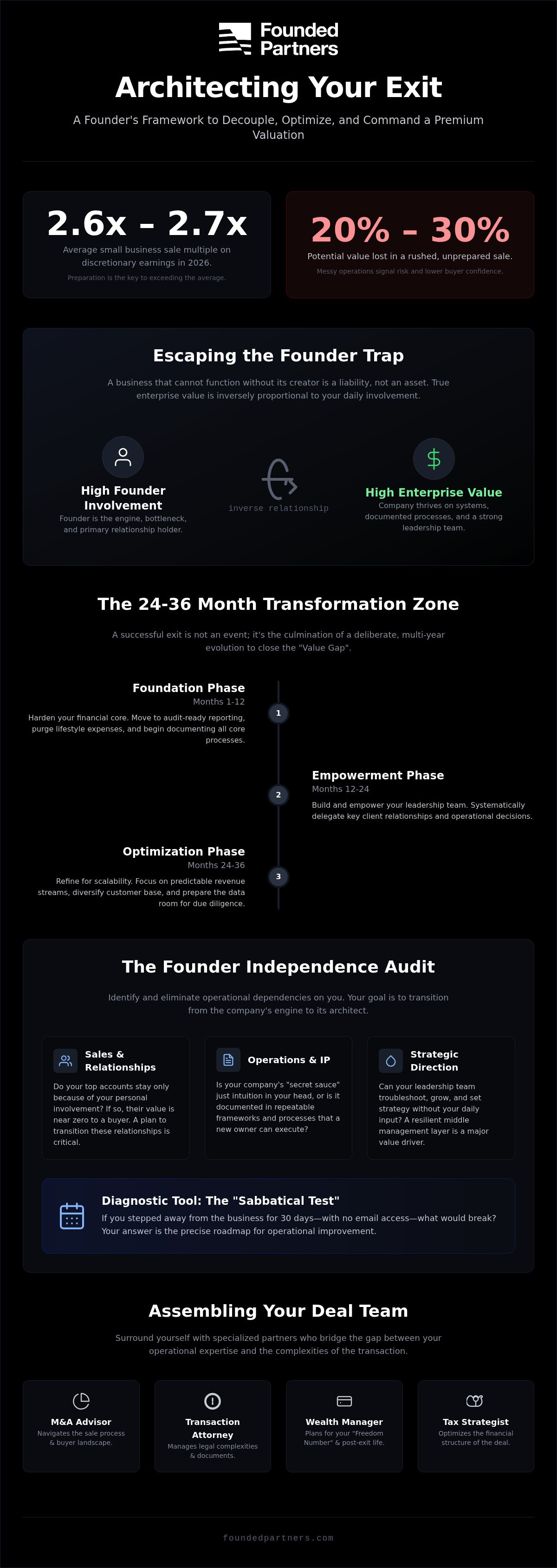
The most valuable businesses are the ones that don't need their founders to survive. It's a hard truth to accept, but your enterprise value is often inversely proportional to your daily involvement. You've likely spent years as the primary engine of growth, yet you now face the quiet anxiety that your internal operations won't survive the scrutiny of a buyer. Learning how to prepare a business for sale is not just about the transaction; it's about the transformation of your life's work into a standalone asset. In 2026, where the average small business sells for 2.6x to 2.7x its discretionary earnings, preparation is the only way to command a premium.
We believe your exit should reflect the character and commitment you've invested. This article provides a strategic architectural framework to decouple your personal output from the company's performance. By refining your operations, strengthening your leadership layer, and documenting your processes, you can move toward a high-multiple exit that rewards your legacy. We'll walk through a methodical checklist to optimize your organizational health, ensure you're transaction-ready, and transform your business into a scalable asset that operates with disciplined independence.
Key Takeaways
- Reframe exit planning as a strategic transformation that begins years before the transaction to bridge the gap between current and potential value.
- Audit your operational dependencies to eliminate the "Founder Trap," ensuring the enterprise can thrive and scale without your daily involvement.
- Harden your financial core by moving toward audit-ready reporting and purging lifestyle expenses that can complicate due diligence.
- Prioritize scalability and predictable revenue streams to maximize enterprise value and attract sophisticated buyers seeking high-multiple acquisitions.
- Discover how to prepare a business for sale by assembling a deal team of specialized partners who bridge the gap between operations and the final transaction.
Defining the Horizon: Why Preparation Starts Years Before the Sale
A successful exit is rarely the result of a sudden decision. It's the culmination of a deliberate, multi-year evolution. Many founders view an exit strategy as a legal finality, something to be handled by attorneys in the final months. In reality, true exit planning is a strategic transformation of the business entity itself. It requires moving from a company that relies on your personal brilliance to one that thrives on institutional systems. This shift ensures the business is an attractive, low-risk asset for a successor.
Understanding how to prepare a business for sale involves identifying the "Value Gap." This is the distance between what your business would fetch on the open market today and what it could be worth if its operations were optimized for a buyer. Closing this gap isn't an overnight task. We define the 24-to-36-month window as the transformation zone. This period allows enough time to clean the balance sheet, diversify the customer base, and build a leadership team that can carry the torch without you. Without this runway, you're often forced to accept terms that don't reflect your company's true potential.
Setting Your Strategic Objectives
Clarity precedes strategy. You must first determine if your ideal partner is a strategic acquirer looking for synergy, a private equity firm seeking a platform, or an internal successor preserving your culture. This choice dictates how you build. Simultaneously, you must calculate your Freedom Number. This is the net liquidity required to fund your next chapter without compromise. A successful exit is a transaction that delivers total financial security while ensuring the business you built continues to flourish under new stewardship.
The Cost of Procrastination
Waiting until you're burnt out to sell is a high-stakes gamble. Rushed transactions often lead to valuations that are 20% to 30% lower than their potential. This discount exists because messy operations signal risk to a buyer. When due diligence uncovers undocumented processes or concentrated revenue, the buyer's confidence wavers and the price drops. Conversely, a calm, methodical preparation process protects your leadership team from exhaustion. It ensures that when the right market window opens, your internal readiness is already a settled fact. Market cycles are volatile; an optimized business is a durable asset in any climate.
The Founder Independence Audit: Decoupling Yourself from Operations
A business that cannot function without its creator is a liability, not an asset. In the eyes of a sophisticated buyer, your personal brilliance is a point of failure if it isn't bottled into a system. The "Founder Trap" describes the state where the CEO remains the primary bottleneck for every major decision, sale, or strategic pivot. When you evaluate how to prepare a business for sale, your primary objective is to transition from being the engine of the company to being its architect. This shift is essential to add value before selling, as it reduces the perceived risk for the next owner.
To begin this decoupling, you must conduct a rigorous audit of three critical areas: sales, client relationships, and technical IP. If the top three accounts in your firm stay only because of your personal involvement, those accounts have zero value to a buyer. Similarly, if your "secret sauce" exists only as intuition in your head, it cannot be transferred in a bill of sale. You must identify this invisible knowledge and translate it into repeatable frameworks that others can execute with precision.
Empowering the Next Level of Leadership
The strength of your business is measured by the resilience of your middle management. A buyer wants to see a team that can lead, troubleshoot, and grow without your daily input. We recommend implementing the "Sabbatical Test" as a diagnostic tool. If you were to step away from the business for 30 days without access to email, what would break? The answer to that question is your roadmap for operational improvement. Navigating this shift from player to coach often requires an external perspective; utilizing Leadership Advisory for Founders can help you build a leadership layer that sustains the enterprise long after you exit.
Standardizing the Secret Sauce
Operational durability is the ultimate selling point. It's the assurance that your company's results are the product of design, not luck or founder heroics. This requires converting your unique skills into documented Standard Operating Procedures (SOPs). Ensure that client relationships are institutionalized within a CRM and managed by a dedicated team, rather than living in your personal inbox. When a buyer sees a business where the processes are clear and the talent is autonomous, they see a scalable asset worth a premium multiple. You aren't just selling a company; you're selling a machine that is already running at peak efficiency.
Hardening the Core: Financial and Data Hygiene for Due Diligence
Trust is the currency of the transaction. While your internal accounting might suffice for tax filings, it's rarely sufficient for a sophisticated buyer's scrutiny. When you analyze how to prepare a business for sale, you must move toward audit-ready financial reporting. This means your books must be transparent, verifiable, and free of the "lifestyle" expenses that often accumulate in founder-led firms. Private travel, non-core assets, or family members on the payroll must be purged or clearly recasted. By cleaning the balance sheet early, you present a lean, professional organization that is ready for the rigors of due diligence.
Professionalism is signaled through organization. We recommend establishing a Virtual Data Room (VDR) early in your transformation journey. This digital repository should house your customer data, contracts, and IP filings in a structured format. A well-organized VDR tells a buyer that you are disciplined, prepared, and honest. It reduces the friction of the due diligence process and prevents the "deal fatigue" that often kills transactions. It transforms the buyer's experience from an investigation into a confirmation of value.
Quality of Earnings (QofE) Readiness
Buyers look past the topline EBITDA to understand the sustainability of those profits. A Quality of Earnings review identifies if your margins are expanding or if they're bolstered by one-time events. One of the most significant risks buyers underwrite is customer concentration. If a single client represents more than 20% of your revenue, your valuation will likely face a concentration discount. You must use your preparation window to diversify your revenue streams and optimize your operational margins, ensuring that every dollar of profit is backed by a repeatable, low-risk process.
Legal and Compliance Fortification
The legal integrity of your enterprise is non-negotiable. You must ensure that every employee and contractor agreement is signed and, crucially, assignable to a new owner. An audit of intellectual property is equally vital; the business must own its trademarks, patents, and codebases, rather than the founder personally. Resolve any lingering regulatory grey areas or outstanding litigation now. Understanding how to prepare a business for sale means resolving these issues before a buyer discovers them, allowing you to maintain control of the narrative and protect your enterprise value.
Strategic Value Drivers: Maximizing Enterprise Value Through Optimization
Maximizing enterprise value is a deliberate exercise in removing friction. While previous stages of preparation focus on hygiene and independence, this phase is about demonstrating aggressive growth potential. A buyer isn't just purchasing your past performance; they are underwriting your future scalability. In the 2026 market, where lower-middle-market EBITDA multiples for professional services typically range from 4x to 7x, the difference between the low and high end of that bracket is defined by your scalability strategy. When you evaluate how to prepare a business for sale, you must identify high-margin revenue streams that are predictable and recurring. This shift transforms your company from a series of individual projects into a reliable cash-flow engine.
Unit economics serve as the ultimate proof of organizational health. A sophisticated acquirer will dissect your ratio of Customer Acquisition Cost (CAC) to Lifetime Value (LTV) to determine the efficiency of your sales engine. If your LTV is high but your CAC is rising, your competitive "moat" may be shallow. Modernizing your tech stack is another critical lever for optimization. By replacing manual labor with automated workflows, you reduce operational friction and improve net margins. This modernization signals to a buyer that the business is ready for rapid expansion without a corresponding spike in overhead or complexity.
Scaling Operations with Purpose
Growth without systems is merely a recipe for exhaustion. To command a premium multiple, you must implement frameworks that allow the enterprise to expand without a linear increase in headcount. This involves a deep commitment to operations optimization to remove the bottlenecks that typically stifle mid-market firms as they grow. By building a foundation that supports increased volume without sacrificing quality, you present a "plug-and-play" asset to an acquirer. If your current structure feels too fragile for a major leap, engaging in Business Transformation Consulting can provide the architectural blueprint needed to bridge that gap and ensure the business is ready for its next chapter.
Market Positioning and Competitive Edge
Your brand narrative must pivot from "what we've done" to "what is possible." You need to provide a clear, untapped roadmap for the buyer to execute immediately post-acquisition. Define your moat with precision; whether it's proprietary data, a unique delivery model, or high switching costs, this advantage justifies your premium price. A buyer wants to see durability and future growth potential that they can realize with their own resources. If you are ready to architect a business that stands out in a crowded market, explore our Scalability Strategy services to maximize your exit potential and secure a high-multiple transaction.
Assembling Your Deal Team: The Partners for a Seamless Transition
Navigating the final mile of a sale requires a specialized circle of advisors who speak the language of risk, tax, and market value. While you remain the visionary, the technical execution of a high-multiple exit is a team effort. Understanding how to prepare a business for sale involves more than just internal cleanup; it requires a deal team that operates with absolute alignment. M&A attorneys serve as your legal shield, protecting your interests in the purchase agreement and mitigating future liabilities. CPAs ensure your tax structure is optimized and your financial history is beyond reproach. Investment bankers or brokers then take this polished asset to market, leveraging their networks to drive competitive tension among buyers.
However, a critical gap often exists between daily operations and the transaction table. This is where the strategic advisor becomes indispensable. They bridge the gap by ensuring the organizational transformation we've discussed is fully realized before the bankers begin their work. When evaluating potential partners, you must look beyond their track record to their character, industry depth, and shared values. A deal team is only as strong as its communication protocol. Establish a methodical cadence of briefings to ensure your advisors remain focused on the primary objective: a smooth, high-value transition that respects your legacy.
The Role of the Strategic Architect
A successful exit is as much a psychological journey as it is a financial one. You need an advisor who understands the weight of your life's work and the unique complexity of the founder journey. At Founded Partners, we act as the strategic architect for this transition. We provide the steady hand needed to manage the emotional friction of letting go while maintaining the intellectual rigor required to maximize enterprise value. Our role is to guide you through the consequential decisions that define your next chapter, ensuring you enter negotiations from a position of strength, confidence, and clarity.
Final Readiness Checklist
Before moving from the preparation phase to active execution, a final assessment is vital to ensure no value is left on the table. This is the moment to verify that the business is truly transaction-ready.
- Confirm all operational red flags identified in your initial audits have been fully resolved.
- Verify that your leadership team is properly incentivized and aligned to stay through the transition.
- Ensure your virtual data room is complete, logically structured, and ready for buyer access.
- Review your financial goals one last time to confirm the anticipated deal terms meet your long-term needs.
Your Legacy as a Standalone Asset
The journey to a successful exit is defined by the deliberate transformation of your business from a personal project into a durable enterprise. By decoupling yourself from daily operations and hardening your financial core, you create an asset that commands a premium in any market. Understanding how to prepare a business for sale isn't about rushing to the finish line; it's about architecting a legacy that thrives under new ownership. This process requires a steady hand, a long-term perspective, and a commitment to operational excellence.
Founded Partners specializes in these founder-led business transformations. We provide experienced partner-led leadership advisory to help you navigate the strategic and emotional complexity of a sale. Our focus remains on maximizing enterprise value through operational durability, ensuring your life's work is transaction-ready when the right opportunity arrives. You've spent years building the foundation; now it's time to ensure the structure can stand on its own.
Refine your foundation and prepare for a strategic exit with Founded Partners. You've built something remarkable. We're here to help you ensure it's ready for its next great chapter.
Frequently Asked Questions
How long does it typically take to prepare a business for sale?
Aim for 24 to 36 months to achieve a true strategic transformation. While you can technically list a company in six months, that timeframe usually only allows for superficial cleanup. True preparation requires time to document systems, transition leadership, and prove recurring revenue. This window allows you to address the value gap and present a business that functions independently of your daily input.
Can I sell my business if it still relies heavily on me for sales?
You can sell, but you'll likely face a lower multiple or a restrictive earn-out. Buyers underwrite risk, and a business where the founder is the sole rainmaker is inherently risky. Learning how to prepare a business for sale involves institutionalizing those relationships. If the sales process isn't repeatable by a team, the buyer is essentially buying a job, not a scalable asset.
What is the most important document to have ready for due diligence?
A Quality of Earnings report is often the most critical document in a sophisticated transaction. Unlike a standard tax return, this report provides an unbiased analysis of your cash flow sustainability. It identifies non-recurring expenses and validates your margins. Having this ready signals to a buyer that your financials are transparent, professional, and ready for intense scrutiny during the process.
How do I calculate the Value Gap in my company?
The Value Gap is the difference between your current market value and what your business could be worth if it were fully optimized. To calculate it, identify the top-tier multiples in your specific industry. Compare those to your current appraisal. This gap represents the profit left on the table due to operational inefficiencies, founder dependency, or poor financial hygiene that needs correction.
Should I tell my employees I am preparing to sell the business?
Confidentiality is your greatest asset during the preparation phase. Telling employees too early can trigger anxiety, leading to the loss of key talent before a deal is secured. We typically advise founders to maintain discretion until a firm Letter of Intent is signed. At that stage, you can share the news with a focused plan to incentivize and retain your leadership team.
What is the difference between a business broker and an M&A advisor?
Business brokers typically handle smaller transactions using standardized listing platforms. M&A advisors manage more complex, strategic exits for lower-middle-market firms. An advisor focuses on maximizing enterprise value through a bespoke process, often targeting strategic acquirers or private equity groups. They act as a strategic partner rather than a simple transaction coordinator focused on a quick list and sale.
How does operational optimization actually increase the sale price?
Optimization increases value by lowering the buyer's perceived risk. When a business has documented procedures and a strong leadership layer, it becomes a turnkey asset. This allows a buyer to focus on growth rather than fixing broken internal processes. In 2026, buyers pay a premium for operational durability, as it guarantees the business can scale without a linear increase in overhead.
What are the common red flags that cause deals to fall through?
Most deals fall through due to surprises uncovered during due diligence. Common red flags include customer concentration exceeding 20%, undocumented intellectual property, and messy financials that don't match the initial pitch. When you master how to prepare a business for sale, you resolve these issues early. This prevents the deal fatigue that destroys trust and leads to price re-negotiations.