
Business Scalability Consulting: The Strategic Architect’s Guide to Sustainable Growth

What if the growth you've fought so hard to achieve is actually the force that breaks your business? It's a sobering question for any leader exploring business scalability consulting because their foundation is starting to crack under pressure. You've built something impressive, yet as the team expands, the operational bottlenecks seem to multiply. You're working harder than ever, but expenses are rising faster than revenue, and the culture you carefully nurtured feels increasingly diluted. It's a common inflection point where the sheer force of personality is no longer enough to sustain the weight of the enterprise.
We understand this tension deeply. You want a business that functions with precision, allowing you to step back from the daily fire drills without sacrificing performance. This guide explores how to transition from a founder-dependent startup into a durable, scalable organization through strategic operational architecture. We'll show you how to refine your systems, guide your team through growth, and strengthen your internal structures. By the end, you'll have the clarity to create blueprints for the next 24 months, optimize your operations for efficiency, and build the enterprise value required for a successful future exit.
Key Takeaways
- Understand the vital difference between linear growth and true scalability to ensure revenue increases while your overhead remains manageable.
- Learn how business scalability consulting helps you transition from person-dependent workflows to a robust, process-driven operational architecture.
- Identify the operational red flags, like founder bottlenecks and culture dilution, that signal your business is ready for a strategic leadership shift.
- Discover the psychological transition required to move from 'Chief Doer' to 'Strategic Architect' for long-term organizational health and durability.
- Gain insights into creating a 24-month operational blueprint that enhances enterprise value and prepares your firm for future capital raising or exit planning.
The Critical Distinction: Why Growth is Not Always Scalability
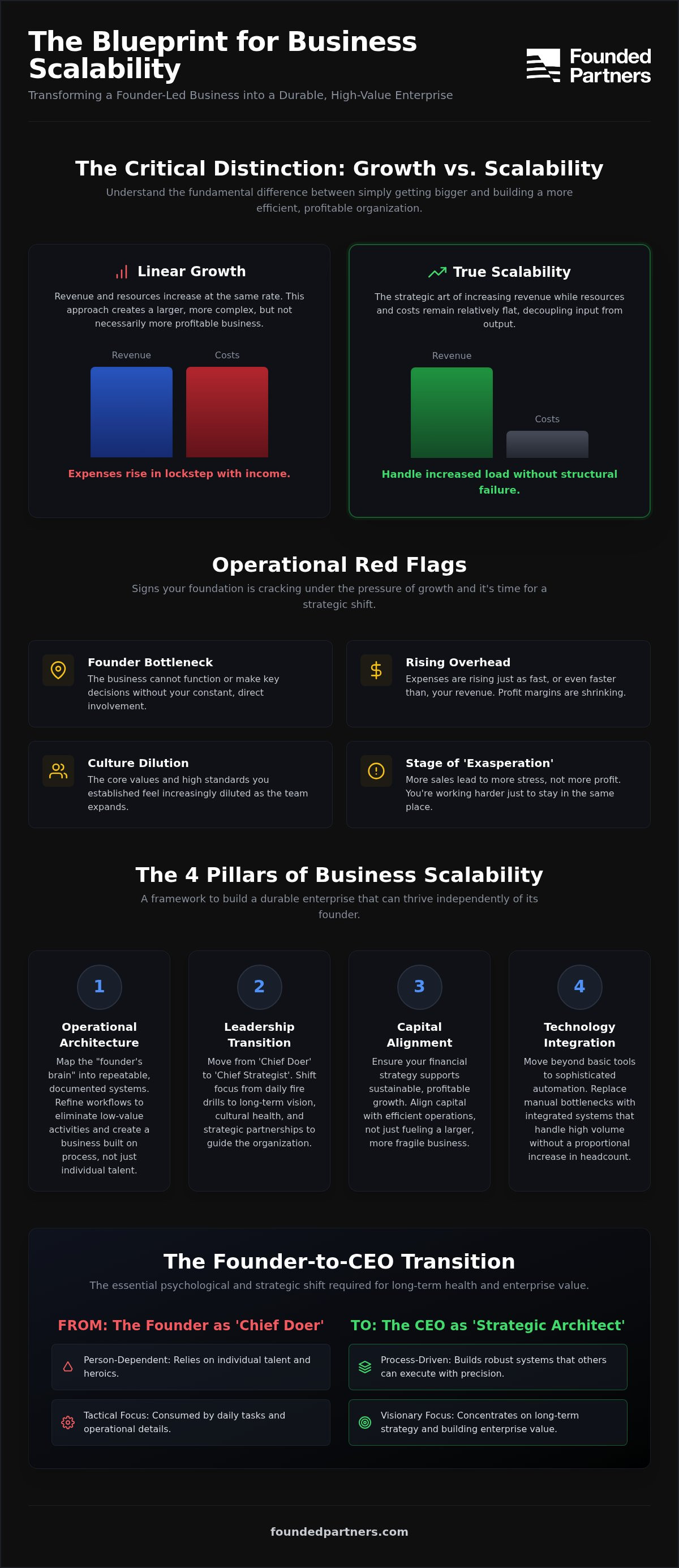
Growth is often celebrated as the ultimate metric of success, yet for many founder-led firms, it becomes a double-edged sword. In its simplest form, growth occurs when you increase your resources at the same rate as your revenue. If you double your sales but also double your headcount and overhead to manage that volume, you haven't scaled; you've simply grown larger. True scalability is the strategic art of increasing revenue while resources and costs remain relatively flat. This distinction is the primary focus of business scalability consulting, where the goal is to ensure that expansion doesn't compromise the health of the organization.
Many founders inadvertently fall into the "growth trap." They build unscalable monsters by solving every new problem with more people or more manual oversight. This approach creates a denominator that grows just as fast as the numerator. When expenses rise in lockstep with income, the business becomes more fragile, not more durable. To build a sustainable enterprise, leadership must focus on operational efficiency. It's about refining the foundation so that the business can support more weight without requiring the founder's constant intervention.
The Mathematical Reality of Scaling
In a truly scalable model, the relationship between input and output is decoupled. As the business expands, the marginal cost of serving each additional customer should decrease or at least stabilize. This requires a shift from person-dependent workflows to process-dependent systems. By optimizing the operational architecture, you ensure that the infrastructure can handle a higher volume of work without a proportional increase in complexity or cost. Scalability is the ability to handle increased load without structural failure.
When Growth Becomes 'Exasperation'
There is a specific tipping point where more sales lead to more stress rather than more profit. We call this the stage of exasperation. It occurs when the existing foundation is too weak to support the new volume, leading to operational bottlenecks and culture dilution. The psychological toll on a founder is significant; they feel like they're running faster just to stay in the same place. Business scalability consulting addresses this by guiding leaders to refine their core operations before adding further complexity. By strengthening the internal architecture first, you transform growth from a source of anxiety into a predictable, manageable journey toward increased enterprise value.
The 4 Pillars of Business Scalability Consulting
To transform a high-growth startup into a durable enterprise, business scalability consulting focuses on four foundational pillars. Each pillar acts as a load-bearing wall, supporting the weight of expansion while maintaining structural integrity. These pillars include operational architecture, leadership transition, capital alignment, and technology integration. Together, they form a cohesive framework that allows a business to thrive independently of its founder's daily presence.
The shift begins with leadership. A business cannot scale if the founder remains the primary decision-maker for every tactical detail. This transition requires moving from the role of 'Chief Doer' to 'Chief Strategist,' where the focus shifts to long-term vision, cultural health, and strategic partnerships. Engaging in business scalability consulting provides the steady hand needed to navigate these complex transitions with composure. Simultaneously, technology integration must move beyond basic tools toward sophisticated automation. By replacing manual bottlenecks with integrated systems, the organization can handle a higher volume of transactions without a proportional increase in administrative burden.
Operational Architecture and Optimization
The most significant bottleneck in many founder-led firms is the founder's own expertise. Scaling requires mapping the 'founder's brain' into repeatable, documented systems that others can follow with precision. This process involves identifying, refining, and eliminating low-value activities that consume time but don't contribute to strategic growth. By refining these workflows, you create a business that's built on systems, not just individual talent. If you're looking to refine your foundation, exploring Operations Optimization for Startups can provide the roadmap needed to streamline your internal processes.
Capital Strategy for Scaling
Scalability isn't just about internal efficiency; it's a prerequisite for successful capital raising. Investors in Series B and C rounds look for organizations that have decoupled growth from headcount, showing a clear path to high margins. A scalable business is inherently more attractive because it demonstrates a lower risk profile and a higher potential for return.
By aligning your capital raising with strategic scalability goals, you directly improve your enterprise value at exit. This alignment ensures that every dollar invested strengthens the architectural foundation, making the business a more valuable asset for future stakeholders. When the financial structure and corporate structure solutions from Encor Group support the operational reality, the business becomes a durable vehicle for wealth creation and long-term impact.
Operational Red Flags: When to Seek Scalability Advisory
Growth often masks structural weaknesses until they manifest as daily crises. While a rising revenue line suggests health, the internal reality may be one of mounting friction and diminishing returns. Recognizing these operational red flags is the first step in engaging with business scalability consulting to prevent a total system failure. These symptoms aren't just growing pains; they're signals that your current architecture has reached its limit.
- The Founder Bottleneck: You remain the ultimate clearinghouse for every tactical decision, from project approvals to minor administrative queries.
- Culture Dilution: The original 'magic' and shared values begin to fade as the team expands past 20 employees, replaced by silos or individual apathy.
- Customer Experience Variance: Quality becomes inconsistent because the business lacks standard operating procedures, relying instead on individual heroics to deliver results.
- Stagnant Profitability: You witness a 50% increase in revenue, yet your net profit remains flat or even declines as expenses outpace your growth.
Identifying Invisible Bottlenecks
A pervasive red flag is the rise of 'hero culture,' where the business relies on a few key individuals to save the day through sheer effort. This is not a strategy; it's a structural vulnerability. To gauge your organizational health, audit your time over a typical week. If 80% of your calendar is consumed by reactive troubleshooting rather than proactive strategy, your foundation is failing. Scalability consultants identify these friction points that founders are often too close to see, providing an objective lens on where the architecture is cracking.
The Cost of Delayed Transformation
Ignoring these signs builds 'technical debt' within your operations. Messy systems and manual workarounds become significantly harder to untangle as the organization grows larger. It's much more efficient and cost-effective to fix an operational foundation at $5M in revenue than it is at $50M. Beyond immediate stress, unresolved operational chaos directly erodes your future exit valuation. Sophisticated buyers look for businesses that run without the founder's intervention. By addressing these red flags now, you protect your enterprise value and ensure the business remains a durable, attractive asset for the long term.
The Founder-to-CEO Transition: A Strategic Leadership Shift
True scalability requires a fundamental redefinition of the founder’s role. While tactical systems are necessary, they are ultimately secondary to the psychological shift of the leader at the helm. Business scalability consulting serves as a mirror; it reveals where a founder’s desire for control is inadvertently stifling the organization’s potential. Moving from an owner-operator mindset to that of a strategic architect is perhaps the most difficult transition a leader will ever make. It requires a move away from intuition-led decisions toward a reliance on data-driven systems and a specialist bench. This shift ensures the business is no longer a reflection of one person’s stamina, but a durable entity capable of independent performance.
Building this specialist bench is a cornerstone of the transition. As the business grows, the founder can no longer be the smartest person in every room. You must hire experts who possess deeper technical knowledge in finance, operations, and marketing than you do. Your role shifts to managing the alignment of these specialists, ensuring they work toward a unified vision. By replacing founder intuition with rigorous, data-backed workflows, you create a business that is predictable, professional, and prepared for the scrutiny of high-level investors or future buyers.
Advisory for the Consequential Transition
The jump from Series A to Series B is often where the 'founder bottleneck' becomes terminal. Tactical management, which served you well in the early days, becomes a liability as the organization’s complexity increases. Leadership advisory focuses on helping you navigate this transition by shifting your focus toward strategic governance. You stop managing tasks and start managing outcomes, culture, and capital. This evolution is essential for long-term organizational health. To begin your own evolution, review our Founder to CEO Transition roadmap to identify the milestones required for this strategic shift.
Maintaining Culture During Rapid Scale
One of the greatest fears founders face is losing the company’s soul during rapid expansion. Scalability doesn't mean sacrificing your values; it means codifying them. When you hire past 20 or 50 employees, you can't rely on proximity to transmit the company culture. You must build organizational resilience through transparent communication and documented principles that guide decision-making at every level. In this model, the founder remains the 'Cultural Anchor,' providing the moral and visionary weight, while the CEO persona handles the 'Ship,' ensuring the vessel is operationally sound and moving in the right direction. This balance allows the original magic of the startup to survive the transition into a mature, scalable enterprise.
Partnering for Scalability: The Founded Partners Methodology
Scaling an enterprise is a deliberate architectural choice, not a byproduct of luck or brute force. Our methodology for business scalability consulting is designed to move beyond theoretical advice, focusing instead on the practical mechanics of transformation. We begin with The Audit, a comprehensive assessment of your current operational health and capital readiness. This deep dive identifies the specific bottlenecks that threaten your stability and assesses whether your current structure can support a consequential transition.
From these insights, we craft The Blueprint. This is not a generic template but a custom scalability strategy that aligns your operational needs with your personal vision as a founder. We then move into The Execution phase, providing hands-on guidance through operations optimization and leadership advisory. The ultimate Result is a durable, efficient organization that functions with precision. Whether you are preparing for a capital raising round or a strategic exit, your business becomes an asset that attracts premium value because it no longer depends on your constant intervention.
A Bespoke Approach for Founder-Led Firms
High-stakes private companies require more than the distant, "Ivory Tower" perspective often found in large scale consulting firms. We position ourselves as a Trusted Peer who has navigated these complex waters before. This boutique approach prioritizes character as much as competence, ensuring that the partnership is rooted in shared values and mutual respect. We don't just deliver a report; we join you in the work of refining, guiding, and strengthening your organization. This proximity allows us to address the human elements of scaling, such as team dynamics and culture, with the same rigor we apply to your financial spreadsheets.
Your Next Stage of Growth Starts Here
The transition from a high-growth startup to a scalable enterprise is the most consequential period in a business's lifecycle. Strengthening your foundation today ensures long-term performance and psychological security for years to come. By aligning your capital strategy, operational workflows, and leadership structure, you create a legacy that is both sustainable and highly valuable. If you are ready to move from owner-operator to strategic architect, we invite you to schedule a strategic briefing with Founded Partners to discuss your specific goals and challenges.
Building an Enterprise That Endures
Building a business that outlasts your daily intervention is the ultimate mark of leadership. We've explored how true scalability relies on decoupling revenue from resources and the vital role of operational architecture in driving long-term performance. It's clear that the transition from a high-growth startup to a durable enterprise is a leadership challenge that requires a shift in both systems and mindset. By refining your foundation today, you ensure that future growth creates value rather than complexity.
Founded Partners provides the steady hand needed for these consequential transitions. As a boutique advisory for founder-led organizations, we combine strategic leadership and transaction expertise with a partner-led approach that offers global coverage. Our business scalability consulting focuses on refining your core, guiding your team, and strengthening your foundation for a future exit or capital raise. We value the "how" of the process as much as the "what," ensuring your culture remains intact as you scale.
The path to sustainable growth is a shared journey; the work you do today defines the durability of your legacy. You don't have to navigate these waters alone. Build a foundation for the future with Founded Partners. We look forward to strengthening your enterprise together.
Frequently Asked Questions
What exactly is business scalability consulting?
This is a strategic advisory service focused on refining a firm's operational architecture and leadership structures. It prepares founder-led businesses for durable growth by moving from person-dependent to process-dependent workflows. The ultimate goal is to build an enterprise that functions with precision and independence, allowing the founder to step away from daily tactical intervention while the business continues to thrive.
How is scaling different from growing a business?
Growing involves increasing revenue and resources at a similar rate, whereas scaling focuses on increasing revenue while costs remain relatively flat. Scaling requires a decoupled relationship between input and output. It's a fundamental architectural shift toward efficiency. Instead of simply adding more floors to a shaky foundation, you refine the core structure to support significantly more weight without structural failure.
When is the right time to hire a scalability consultant?
The ideal time is when you reach an operational plateau or notice that "founder bottlenecks" are stalling your momentum. If every minor decision must cross your desk or expenses are rising faster than revenue, your current systems have reached their limit. Engaging in business scalability consulting early prevents the accumulation of technical debt in your operations as you expand toward the next milestone.
Can we scale without losing our company culture?
Scaling culture is possible if you codify your core values into repeatable systems and transparent communication protocols. Culture often dilutes during rapid hiring cycles because it relies on proximity rather than documentation. To maintain your original magic, you must treat culture as an architectural element. This ensures your values survive the transition from a small, tight-knit team into a larger, mature enterprise.
How does scalability affect my company's valuation for an exit?
Scalability significantly increases enterprise value by reducing the risk for future buyers. A business that runs efficiently without its founder is a more attractive, durable asset. Sophisticated investors look for high margins and process-driven workflows. These elements demonstrate that the company's success is repeatable and sustainable, which justifies a higher multiple during the exit planning process and subsequent negotiations.
What are the common pitfalls in scaling a founder-led business?
Common pitfalls include hiring into broken systems, maintaining a hero culture, and failing to delegate strategic authority. Many founders try to solve operational friction by simply adding headcount, which often accelerates the underlying chaos. Without a refined foundation, growth becomes a source of exhaustion rather than profit. Success requires a psychological shift from being an owner-operator to becoming a strategic architect of the organization.
Does scalability consulting include help with capital raising?
Yes, our methodology includes capital raising support to ensure your financial structure aligns with your growth objectives. Scalability is a prerequisite for successful Series B and C rounds. By engaging in business scalability consulting to optimize your operations first, you present a more compelling case to investors. You demonstrate a clear path to long-term organizational health and a high potential for return on their investment.
How long does a business transformation engagement typically take?
Most engagements range from six months to a year, depending on the complexity of your organization. This isn't a quick fix but a methodical process of audit, blueprint design, and hands-on execution. This steady pace ensures that transformation is deeply integrated into the company's DNA. It leads to lasting performance and prepares the leadership team for the psychological demands of the next stage of growth.