
Raising Capital: Strategic Path to Growth (2026)

Fundraising is not a sales pitch; it is an architectural project where the strength of your foundation determines the height of your ceiling. Many leaders treat the search for investment as a desperate race, yet the most successful outcomes happen when capital is treated as a strategic component of a larger design. If you are wondering how to raise capital as a founder without compromising your company's soul, you must first look at the structural integrity of your current operations. The capital you attract will always be a mirror of the business you have built.
It's exhausting to hit operational bottlenecks just as you're trying to scale, and we understand the quiet anxiety that comes with the fear of choosing the wrong partner. You want growth, but you also want to maintain the character and vision of what you've built. This article promises a masterclass in the architectural approach to fundraising, ensuring your business is not just funded, but truly ready for the demands of the next stage. We will walk through the steps to refine your strategic narrative, optimize your internal systems for scrutiny, and secure the right capital to build a durable, scalable future.
Key Takeaways
- Reframe fundraising as an architectural milestone rather than a sales event to ensure your operational foundation aligns with strategic capital.
- Master how to raise capital as a founder by identifying and resolving the specific operational red flags that stall high-level investment in the 2026 market.
- Navigate the modern capital stack by balancing equity and debt to protect your vision while securing the leverage needed for sustainable growth.
- Implement a structured five-stage roadmap to manage the complexities of a raise without compromising your company's daily performance or culture.
- Prepare for the critical post-funding transition where business transformation turns new capital into a durable and scalable organizational structure.
Beyond the Pitch Deck: Why Capital Raising is an Architectural Challenge
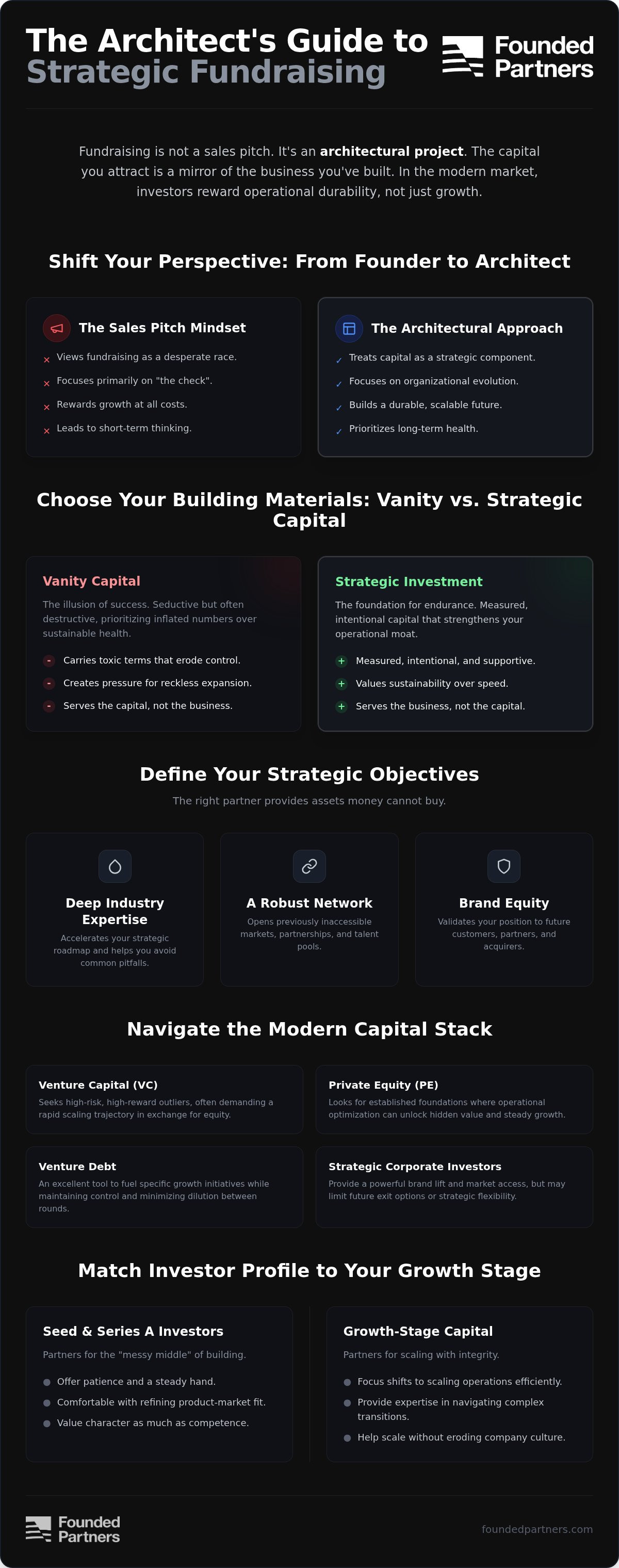
Raising capital is often mistaken for a simple transaction. In reality, it's a consequential transition in a broader journey of business transformation. For many, the goal is the check. For the strategic leader, the goal is the evolution of the organization. The 2026 market has shifted its gaze from reckless expansion toward operational durability. Investors no longer reward growth at all costs; they reward the integrity of the foundation. By understanding capital formation from a macro perspective, you begin to see that money is merely a tool for building a more resilient structure.
Vanity capital is a seductive trap. It offers the illusion of success through inflated numbers, yet it often carries toxic terms that erode founder control. Strategic investment is different. It is measured, intentional, and supportive of your operational moat. It values sustainability over speed. It builds. It strengthens. It endures. Understanding how to raise capital as a founder in this climate requires a shift in perspective. You are not just asking for fuel; you are refining the engine itself.
Shifting from Founder to Strategic Architect
The journey begins with a psychological pivot. You're no longer just the operator; you're the architect. This requires stepping back from the daily friction of service delivery to view your enterprise as an investable product. It's a shift from working in the business to refining the logic of the business. Accepting outside capital means inviting a new partner into your design. This requires a disciplined mind that prioritizes long-term health over short-term ego. When you master how to raise capital as a founder, you realize that your primary job is to prove that the machine works without you at the controls.
Defining Your Strategic Capital Objectives
To build with intention, you must determine the precise amount of funding required to optimize operations without diluting your long-term vision. This process should always align with your ultimate exit planning. If you take too much, you lose agility. If you take too little, you starve the transformation. Beyond the dollar amount, consider the character of the partner. You're looking for more than a bank account; you're looking for specific assets that money cannot buy:
- Deep industry expertise that accelerates your strategic roadmap.
- A robust network that opens previously inaccessible markets.
- Brand equity that validates your position to future acquirers.
This architectural approach ensures that capital serves the business, rather than the business serving the capital. It's about finding the right partner to help you build something that lasts.
Equity, Debt, and Strategic Alliances
Venture Capital and Private Equity serve different masters. VC seeks the outlier, the high-risk, high-reward trajectory that often demands rapid scaling. Private Equity typically looks for established foundations where operational optimization can unlock hidden value. For those prioritizing ownership, venture debt is an excellent mechanism to bridge the gap between rounds. It allows you to maintain control while fueling specific growth initiatives. Strategic corporate investors can provide a powerful brand lift, though they may limit your future exit options by signaling to competitors that you are off-limits.
Matching Investor Profiles to Your Growth Stage
Your stage of growth dictates the type of character you need in a partner. Seed and Series A investors must be comfortable with the "messy middle" of organizational building. They should offer patience and a steady hand as you refine your product-market fit. As you move into growth-stage capital, the focus shifts toward scaling operations without eroding the culture that made you successful.
Evaluating an investor goes beyond the term sheet. You must look for a "value-add" that complements your weaknesses. Does the investor have a history of navigating complex transitions? Do they value character as much as competence? Aligning your foundation with these capital sources requires a steady hand. Many founders find that expert capital raising support provides the clarity needed to choose the right path. Choosing the wrong partner is far more expensive than a higher interest rate or a lower valuation. It's about ensuring the person across the table shares your architectural vision for the company's future.
The Operational Moat: Building an Investable Foundation
Investors in the 2026 climate have moved beyond the allure of high-octane growth. They now seek businesses with an operational moat. This moat isn't built with marketing spend; it's constructed through disciplined systems that protect and scale the enterprise. When you consider how to raise capital as a founder, you must realize that your operational efficiency is your most persuasive argument. A business that relies on a founder's constant intervention is a business with a fragile ceiling. True enterprise value is found in the health of the organization, where processes are repeatable, outcomes are predictable, and growth is sustainable.
Specific red flags in the current funding landscape include opaque reporting, high churn masked by aggressive acquisition, and a lack of middle-management autonomy. If your leadership team cannot articulate the strategic roadmap without looking to you for confirmation, investors will hesitate. Strengthening these areas before you begin the raise is the most effective way to protect your valuation. Operational optimization isn't just a preparation step; it's a value multiplier that signals you've built a machine, not just a job.
Fixing Operational Bottlenecks Before the Raise
The most common single point of failure in a founder-led firm is the founder. If every strategic decision, client approval, or operational pivot requires your direct input, you are the bottleneck. Investors see this as a significant risk to scalability. To build a foundation that invites capital, you must streamline your "Quote-to-Cash" cycle and delivery mechanisms. This involves documenting the "Founder’s Intuition", those unwritten rules of success, and baking them into repeatable systems. By removing yourself from the critical path of daily operations, you demonstrate that the business is a durable asset rather than a personal project.
The Psychology of Due Diligence
Due diligence is often viewed with dread, yet it's an opportunity to showcase your architectural rigor. Your data room shouldn't be a disorganized digital drawer; it should be a curated narrative of operational excellence. Transparency regarding your weaknesses is not a liability if it's paired with a clear plan for refinement. Investors value a leader who understands their gaps and has already begun the work of closing them. This level of self-awareness builds the trust required for a long-term partnership. When you master how to raise capital as a founder, you understand that the numbers must tell the same story as the systems. Investor Readiness is the alignment of financial data and operational reality.
The Strategic Fundraising Roadmap: From Preparation to Close
Success in fundraising is the result of a methodical, intentional process. It isn't found in a single pitch but in a series of strategic moves designed to build confidence and reduce risk. When you master how to raise capital as a founder, you realize the journey follows a distinct architectural path. This roadmap begins with internal refinement, moves through narrative design, and concludes with the technical precision of closing. Every stage requires a balance of high-level vision and granular operational focus.
Managing the timeline is perhaps the greatest challenge for any leader. A capital raise is a full-time commitment that often threatens to distract from the daily performance of the business. If your growth metrics dip during the process, your leverage evaporates. This is where the role of transaction advisory becomes critical. By offloading the technical complexities of the deal, you can maintain your focus on the health of the organization. To ensure a successful outcome, you must follow a disciplined five-stage approach:
- Internal Audit: Identifying and resolving operational red flags.
- Architectural Design: Defining the ideal capital stack and investor profile.
- Market Engagement: Opening the funnel and managing competitive tension.
- Deep-Dive Diligence: Providing transparent, data-backed evidence of scalability.
- Final Execution: Negotiating terms that protect long-term independence.
Crafting the Strategic Narrative
In the 2026 market, a standard pitch deck is rarely enough to secure high-level investment. Sophisticated partners look for a "Strategic Brief" that tells a story of transformation. You aren't just selling what you do; you're selling the future scalability of the machine you've built. Addressing your exit strategy early is a sign of leadership maturity. It shows you understand the lifecycle of capital and are committed to a path that delivers value for everyone involved. This clarity builds the psychological security investors need to commit significant resources.
Managing the Transaction Process
The final sprint to the close is where many deals fail. Common "deal killers" include shifting financial data, unresolved legal complexities, or a loss of operational momentum. You must create competitive tension by managing multiple bidders simultaneously. This ensures you aren't forced into a corner by a single term sheet. Understanding the nuances of 2026 term sheets, particularly regarding liquidation preferences and control rights, is vital for protecting your vision. If you're ready to move from preparation to execution, our capital raising support can help you navigate these final negotiations with confidence. The real work is ensuring the round closes without leaving your team exhausted or your systems strained.
Scaling with Integrity: Managing the Transition After the Round
The arrival of capital is a beginning, not a finish line. While the pursuit of funding often consumes a leader's focus, the true test of an enterprise lies in the months following the deposit. This is a consequential transition. It is the moment where the architectural plans you've pitched must be translated into operational reality. Learning how to raise capital as a founder is a significant achievement, but the ability to transform that capital into a scalable, durable organization is what defines long-term success. The frantic energy of the raise must now be replaced by a disciplined, methodical approach to business transformation.
Post-funding failure rarely stems from a lack of effort. It usually arises from "Series A Red Flags" that go unaddressed during the transition. These include a sudden loss of cultural cohesion, a lack of middle-management depth, and the failure to evolve from a founder-led model to a CEO-led structure. If you simply pour capital into an inefficient system, you won't scale growth; you will only scale complexity. Maintaining integrity during this phase means staying true to the foundational strength of the organization while building the systems required for its next iteration.
From Capital Raising to Operations Optimization
Deploying capital requires a high-leverage strategy that prioritizes processes over headcounts. Many leaders fall into the "hiring trap," believing that more people will automatically solve operational bottlenecks. In reality, adding staff to a broken system only creates more friction. Real scalability comes from operations optimization. You must refine your delivery mechanisms, automate repetitive tasks, and ensure that your organizational resilience can withstand the pressures of rapid expansion. This focus on the "how" of your growth ensures that the business remains healthy as it gets larger.
The Role of Leadership Advisory in Long-Term Success
The evolution from a founder to a strategic CEO is a psychological and operational shift. It requires building a leadership team that can operate with autonomy, allowing you to focus on high-level strategy rather than daily fire-fighting. This transition is essential for any future strategic exit. An investable foundation is one that does not collapse when the founder steps away. By investing in leadership advisory, you ensure that your team is equipped to guide the organization through the complexities of scaling. If you are ready to move beyond the pitch and build a business that endures, you can partner with Founded Partners to build your investable foundation. We provide the steady hand and strategic expertise required to turn your capital into a lasting legacy.
Building for the Consequential Transition
Building a durable enterprise requires more than a successful pitch; it requires a commitment to structural integrity. You have seen that fundraising is an architectural challenge where your operational moat determines your valuation. By aligning your capital stack with your long-term vision, you ensure that growth never comes at the expense of your company's character. Mastering how to raise capital as a founder is ultimately about preparing your organization for the transition from a personal project to a scalable, investable asset.
The journey is complex, but you don't have to navigate it alone. Adam and Matt provide a boutique, partner-led approach that prioritizes long-term enterprise value over quick wins. We offer an integrated strategy that combines capital raising support with deep operational health assessments. This ensures that when the capital hits your account, your foundation is ready to support the weight of rapid scaling. If you are ready to move beyond the transaction and build for the future, secure your strategic capital with Founded Partners. Your vision deserves a foundation that is as ambitious as your goals.
Frequently Asked Questions
How long does it typically take to raise capital as a founder in 2026?
A standard capital raise in the 2026 market typically requires six to nine months from initial preparation to the final close. This timeline accounts for the increased depth of due diligence now expected by sophisticated investors. While some rounds move faster, rushing the process often leads to unfavorable terms or misaligned partners. Patience is a strategic asset during this phase.
What is the #1 mistake founders make when preparing for a Series A round?
The most common error is focusing exclusively on the pitch deck while neglecting the operational foundation of the business. Investors in 2026 are looking for a durable machine rather than a founder's personal intuition. If you haven't documented your processes or removed yourself as a single point of failure, you'll likely face significant valuation hair-cuts or stalled negotiations.
Do I need a business transformation consultant before I raise capital?
Engaging in business transformation consulting before a raise ensures your operations can actually support the capital you're requesting. It's about shifting from a "growth at all costs" mindset to one of operational durability. By refining your systems early, you present a much lower risk profile to potential partners, which directly translates to higher enterprise value.
How much equity should a founder expect to give up in a growth round?
Founders should generally expect to dilute their ownership by 15% to 25% during a typical growth round. The exact figure depends on your current valuation, the amount of capital required, and the structure of your capital stack. Understanding how to raise capital as a founder involves balancing this dilution against the strategic value and network that a specific investor brings to the table.
Can I raise capital if my business is still founder-dependent?
You can raise capital with a founder-dependent business, but you'll likely find the terms restrictive and the valuation lower. Institutional investors seek to fund a scalable system, not a single individual's capacity to work. Demonstrating that your leadership team can operate autonomously is the most effective way to build investor confidence and secure favorable terms.
What is the difference between capital raising support and venture capital?
Capital raising support is a strategic advisory service that helps you architect the deal, whereas venture capital is the actual source of the funds. Our role is to act as a trusted peer, guiding you through the complexities of preparation and negotiation. We help you identify the right partners so you don't end up with capital that is misaligned with your long-term vision.
How do I know if my business is ready for institutional investment?
Readiness is defined by the alignment of your financial data and your operational reality. If you have predictable revenue streams, documented SOPs, and a leadership team that doesn't require your daily intervention, you're likely ready. Knowing how to raise capital as a founder means recognizing when your foundation is strong enough to support the weight of institutional scrutiny.
What documents are essential for a 2026 investor data room?
A modern data room must go beyond basic financials to include operational SOPs, a detailed strategic brief, and a clean cap table. You should also include historical audits and a clear roadmap for your post-funding business transformation. This organized approach tells a story of architectural rigor, signaling to investors that you've built a professional and durable organization.