
Capital Raising for Founders: Guide to Sustainable Growth

What if the capital you're chasing is actually the very thing that threatens to dismantle the enterprise you've worked so hard to build? It's a sobering thought, but many leaders find that the pursuit of funding creates more friction than it resolves. You likely recognize the tension of needing to scale while fearing the excessive equity dilution or the operational bottlenecks that often follow a major round. Approaching capital raising for founders shouldn't mean sacrificing your strategic control or losing sight of your core business during the process.
You deserve a fundraising strategy that feels like a deliberate architectural phase, not a desperate scramble. This guide explores how to master a sustainable approach that secures the right capital while protecting your operational integrity and long-term vision. By focusing on organizational health and validated unit economics, you can attract high-quality partners who align with your character. We'll examine how to build a scalable foundation that justifies the $62 million median Series A valuations seen in early 2026, ensuring your business remains resilient and ready for the next stage of growth.
Key Takeaways
- Reframe capital as a strategic fuel for a specific growth thesis rather than a temporary solution for operational inefficiencies.
- Evaluate how choosing between venture capital, private equity, or strategic debt impacts your long-term control and ultimate exit timeline.
- Strengthen your operational foundation to eliminate red flags and transform your back office into a powerful tool for investor confidence.
- Master a phased approach to capital raising for founders that ensures internal alignment and precise target mapping before you enter the market.
- Discover the advantage of a strategic architect who bridges the gap between daily business transformation and high-stakes transaction advisory.
What is Strategic Capital Raising for Founders?
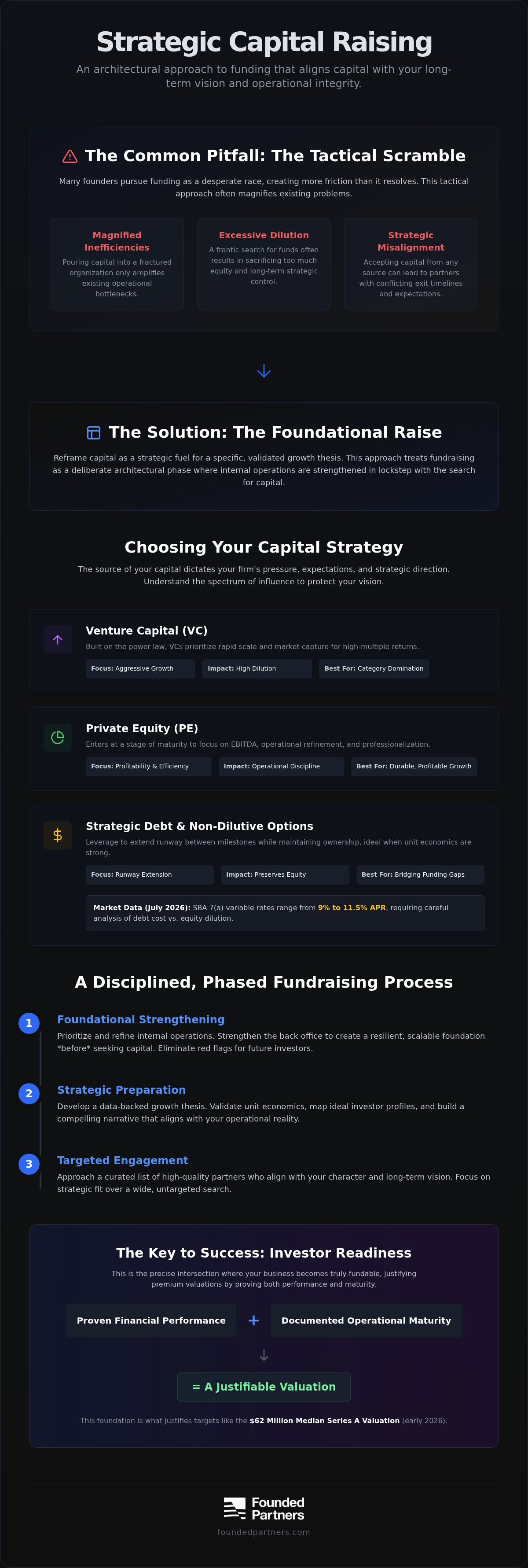
Capital is not a prize to be won; it's a resource to be deployed. For many, capital raising for founders is viewed as a frantic sprint toward a bank account balance. This tactical mindset often overlooks the reality that capital should serve a specific, validated growth thesis. Strategic capital raising involves the intentional acquisition of resources that align with your long-term vision, ensuring every dollar brought into the business has a clear, operational purpose. It moves beyond the simple act of "getting funded" to the more complex art of architectural growth.
Pouring capital into a fractured organization is like adding high-octane fuel to a vehicle with a broken axle. You might move faster for a moment, but the eventual crash is far more destructive. Money rarely solves operational inefficiencies; it usually magnifies them. A strategic approach prioritizes the "Foundational Raise." This is a process where internal operations are refined, guided, and strengthened alongside the search for capital. It creates a cohesive structure where your business transformation and your funding strategy work in lockstep rather than at cross-purposes.
The Difference Between Funding and Strategic Capital
Founders often focus on the "how much" while ignoring the "from whom." Funding is a generic financial transaction, but strategic capital is a partnership. The source of your capital dictates the pressure, expectations, and strategic direction of your firm for years to come. While Venture Capital Financing offers significant scale, it requires a specific alignment of values and exit expectations. Strategic capital acts as a catalyst for your enterprise, providing the psychological security and professional expertise needed to optimize your organizational health rather than just extending your cash runway. It's about finding partners who value your character as much as your competence.
When is the Right Time for Founders to Raise?
Timing is a matter of discipline. You're ready to raise when your product-market fit is matched by a scalable operational framework. Raising too early often leads to valuation traps, where high expectations outpace your actual organizational maturity. This premature scaling creates a cycle of stress that distracts from your core mission. You must ensure your back office is as resilient as your sales pitch before inviting external scrutiny. Discipline in the early stages prevents the "grow at all costs" mindset that often erodes a founder's strategic control.
Investor Readiness is the precise intersection of proven financial performance and documented operational maturity.
Choosing the Right Capital Strategy for Your Vision
The capital landscape is a spectrum of influence. Choosing where to source your funds is a decision that dictates your daily operational reality, your strategic autonomy, and your ultimate exit options. For most, capital raising for founders feels like a binary choice between growth and control, but a sophisticated strategy allows you to balance both. By understanding the nuances of the capital stack, you can layer resources to fuel expansion without dismantling the character of your firm.
Strategic capital raising for founders requires an understanding of the "Capital Stack." This is the deliberate layering of equity, debt, and internal cash flow to fund specific growth milestones. In July 2026, with SBA 7(a) variable rates ranging from 9% to 11.5% APR, the cost of debt must be carefully weighed against the cost of equity dilution. A well-architected stack ensures that you aren't over-leveraged while simultaneously protecting your ownership percentage during high-growth phases.
Venture Capital vs. Private Equity for Founder-Led Firms
Venture Capital is built on the power law. It prioritizes rapid scale, aggressive market capture, and high equity dilution. While this path is ideal for those seeking to dominate a category, it introduces a specific type of pressure that may conflict with a founder's long-term operational integrity. In contrast, Private Equity often enters at a stage of relative maturity. These partners focus on EBITDA, operational refinement, and the professionalization of the leadership team. If your 10-year vision involves building a durable, profitable enterprise rather than a quick flip, the PE model provides a more grounded partnership.
Alternative Financing: Debt and Non-Dilutive Options
Equity is the most expensive form of capital you will ever spend. Many founders overlook the utility of strategic debt when bridging the gap between major funding milestones. Venture debt allows you to extend your runway while maintaining ownership, provided your unit economics are strong enough to service the obligation. For those in the earliest architectural phases, resources like the Y Combinator Guide to Seed Fundraising offer a roadmap for initial equity rounds, but revenue-based financing can often serve as a non-dilutive alternative for established firms with predictable cash flows.
Building a sophisticated capital stack requires more than just a pitch deck. It requires a partner who understands how to align your balance sheet with your business transformation goals. If you're ready to refine your approach, consider how capital raising support can help you secure the right partners without compromising your long-term vision.
Investor Readiness: Building the Operational Foundation
A pitch deck is a promise; your back office is the proof. While the visual narrative of a deck captures attention, the actual transaction of capital raising for founders is won or lost in the engine room of your organization. Investors in 2026 are moving past the "grow at all costs" era, prioritizing validated unit economics and a clear path to profitability. They look for operational integrity, structural durability, and the psychological readiness of the leadership team to handle a sudden influx of resources.
Operational red flags often stall Series A and B rounds long before the final handshake. Fragmented data, key-person dependencies, and opaque reporting systems suggest a lack of discipline that scares away high-quality partners. When you commit to operations optimization, you aren't just saving costs; you're directly increasing your company's valuation multiple. Efficiency signals that your business is a predictable machine rather than a series of heroic, unrepeatable efforts. This shift requires a transition from founder to CEO, where leadership advisory becomes essential to manage the complexities of a larger, more professionalized enterprise.
The Due Diligence Checklist: Operations and Governance
Before entering the market, you must treat your own firm with the same scrutiny an institutional investor would. This involves cleaning up legal structures, securing intellectual property rights, and ensuring your cap table is beyond reproach. A scalable financial reporting system is non-negotiable, as investors now use the "Rule of 40" as a primary metric to evaluate your growth versus profit balance. A Strategic Architect views due diligence as a comprehensive health check that strengthens the organization, not just a hurdle to be cleared for a check.
Scalability Strategy: Proving the Model Can Grow
Investors need to see that your unit economics hold up at ten times your current volume. They're looking for evidence that your systems can absorb a median Series A deal size of $19.6 million without breaking. This requires a roadmap for Business Transformation Consulting that outlines how you will automate manual processes, refine your supply chain, and strengthen your middle management. By showing a clear path to optimization post-investment, you demonstrate that you're prepared to protect their capital while accelerating your growth. It's about building a foundation that is as ambitious as your vision yet as disciplined as your balance sheet.
The Strategic Fundraising Process: Step-by-Step
The journey of capital raising for founders is a methodical progression that requires as much discipline as it does ambition. It's a high-stakes relationship cycle where your character is scrutinized as closely as your cap table. Unlike automated crowdfunding platforms that prioritize volume, a strategic institutional raise relies on a structured, five-phase approach designed to maintain your operational integrity while securing the right partners.
- Phase 1: Internal Audit and Strategic Alignment. We begin by refining your growth thesis. This Founded Partners approach ensures your internal operations are prepared to absorb capital before you ever speak to an investor.
- Phase 2: Target Mapping. Identifying investors who bring more than money. We look for partners whose expertise, network, and character align with your long-term vision.
- Phase 3: The Narrative. Crafting a story that links your past performance to a future of business transformation. It's about selling the destination, not just the current engine.
- Phase 4: The Hunt. Managing the funnel and creating competitive tension. This phase requires a composed, steady hand to keep multiple conversations moving toward a term sheet.
- Phase 5: Closing and Integration. Finalizing the transaction and starting "Day 1" with a clear plan. Capital is fuel; we ensure you have the map ready the moment it hits your account.
Crafting the Narrative: Beyond the Numbers
Founders often fail to communicate their full potential because they get lost in the spreadsheet. While your unit economics must be flawless, investors are buying into your ability to lead a transformation. You must link your capital request to specific operational milestones, such as automating your supply chain or expanding your leadership team. Presenting this with "calm expertise" in the boardroom signals that you're a seasoned leader who values the "how" of growth as much as the "what."
Managing the Transition: Keeping the Business Running
The most dangerous part of fundraising is the "fundraising dip." This happens when a founder becomes so distracted by the raise that revenue stalls and team morale drops. A strategic advisor acts as a shield, managing the heavy lifting of the process so you can stay focused on core operations. This partnership builds organizational resilience, ensuring your firm remains healthy and attractive throughout the entire round. If you're looking for a partner to guide you through this architectural shift, explore our capital raising support to ensure your business continues to thrive while you scale.
Partnering for the Long Game: Why Founded Partners?
Choosing a partner for your capital journey is a decision of character. While massive, ivory-tower consultancies often offer generic frameworks delivered by junior associates, Founded Partners provides a boutique alternative rooted in the lived reality of building an enterprise. We act as your Strategic Architect, bridging the gap between daily operations and high-stakes transactions. For founder-led organizations, the challenges are never just financial; they are deeply personal and structural. We understand that capital raising for founders is a pivotal leadership transition that requires both technical precision and grounded empathy.
Our approach eschews the frantic energy of the traditional startup world in favor of a more measured, long-term perspective. We don't just help you "get funded." We help you refine, guide, and strengthen your firm so that it becomes an asset that high-quality investors are eager to support. This process involves a sophisticated balance of professional authority and a partner-oriented focus on your shared journey. By prioritizing the health of the organization over vanity metrics, we ensure that your growth is not just rapid, but durable and sustainable.
From Capital Raising to Exit Planning
Every round of funding you accept today fundamentally dictates your exit options tomorrow. A raise shouldn't be a standalone event but rather a calculated step in a broader Business Transformation. We integrate Ownership Transition Consulting into our process to ensure your legacy remains intact while your enterprise value is maximized. Whether you are looking toward a future IPO or a strategic acquisition, the architectural decisions you make during your initial capital rounds will determine your ultimate success. We prepare you for a future exit that honors your vision, protects your operational integrity, and rewards your long-term commitment.
The Power of a Boutique Advisory Partnership
You deserve direct access to seasoned expertise rather than a rotation of entry-level consultants. At Founded Partners, you work directly with our partners, Adam and Matt, ensuring that every strategic decision is guided by leaders who have navigated these complexities before. We offer a customized approach that respects the unique Founders Spirit while driving the professionalization required for global scale. Our role is to provide the psychological security of a steady hand, allowing you to focus on your core business while we manage the intricacies of the transaction. Secure your strategic capital raising support with Founded Partners today to build a foundation that justifies your vision and secures your future.
Architecting the Future of Your Enterprise
Successful capital raising for founders is not measured by the size of the initial check, but by the operational integrity you maintain after the wire arrives. It requires a fundamental shift from chasing immediate funding to attracting partners who align with your character and your ten-year vision. By treating your back office as your most powerful sales tool and refining your growth thesis, you transform your organization into a resilient asset capable of sustainable scale. Capital is merely the fuel; your operational foundation is the engine that determines how far you can travel.
At Founded Partners, we specialize in this architectural approach to growth. Led by partners with deep operational and transaction experience, we provide a boutique advisory tailored specifically for founder-led organizations. Our focus remains on maximizing long-term enterprise value rather than just securing short-term funding. When you're ready to move beyond the pitch deck and build a scalable foundation that justifies your ambition, partner with Founded Partners for your next capital raise. Your vision deserves a strategy that is as disciplined as it is bold. We look forward to building something substantial together.
Frequently Asked Questions
How long does the capital raising process typically take for founders?
A standard institutional raise typically requires six to nine months from initial preparation to the final wire transfer. This timeline accounts for the essential architectural phase of internal alignment, target mapping, and the intensive due diligence period. Capital raising for founders is a methodical journey of relationship building that shouldn't be rushed if you want to protect your long-term vision and operational integrity.
What is the most common mistake founders make when raising capital?
The most frequent error is treating fundraising as a standalone financial event rather than an operational milestone. Founders often focus exclusively on the valuation or the check size while ignoring investor alignment and the "how" of growth. This tactical nearsightedness often leads to excessive equity dilution or a fractured culture when the new capital meets a foundation that hasn't been properly optimized.
How much equity should a founder expect to give up in a Series A round?
Founders should typically expect to dilute their ownership by 15% to 25% during a Series A round. While the median Series A deal size reached $19.6 million in early 2026, the specific percentage depends on your pre-money valuation and the competitive tension you create. Maintaining strategic control requires building the efficient business foundations that justify a higher valuation and lower dilution for the leadership team.
Do I need a business transformation consultant before I raise money?
Engaging in business transformation before a raise ensures that your capital acts as fuel rather than a temporary fix for broken systems. It involves refining your operations through a scalability strategy to prove the model can grow. This proactive optimization eliminates red flags that often cause sophisticated investors to pass during the due diligence phase, ultimately securing better terms and higher quality partners for your firm.
What is investor readiness consulting, and why is it necessary?
Investor readiness is the process of aligning your financial performance with documented operational maturity. It's necessary because it transforms your back office into a credible sales tool that withstands institutional scrutiny. This preparation involves cleaning up governance, refining unit economics, and ensuring your leadership team is psychologically ready for the CEO transition. It provides the psychological security needed to negotiate from a position of strength.
How does Founded Partners differ from a traditional investment bank?
Unlike traditional banks that focus solely on the transaction, Founded Partners acts as a Strategic Architect for your entire organization. We provide direct access to seasoned partners rather than junior associates, focusing on the intersection of operations and capital. Our boutique approach prioritizes your long-term enterprise value and the "Founders Spirit" rather than just closing a high volume of generic deals without regard for your organizational health.
Can I raise capital if my operations are currently unoptimized?
You can raise capital with unoptimized operations, but you'll likely face a lower valuation and more restrictive terms. Investors in 2026 prioritize validated unit economics and a clear path to profitability over "growth at all costs." Unoptimized systems suggest a lack of discipline. This often leads to a "Series A crunch" where capital raising for founders fails because the foundation couldn't support rapid expansion.
What documents are required for a professional data room?
A professional data room requires a comprehensive set of legal, financial, and operational documents. You should include three years of audited financials, a clean cap table, and documented intellectual property rights. It's also vital to include your strategic growth thesis, customer contracts, and evidence of operations optimization. These documents demonstrate that your firm is ready for institutional scale and can effectively deploy the capital you're seeking.