
Strategic Growth Advisory Services: Building a Foundation for Scalable Success

Most founders believe that more revenue solves every problem, but without a reinforced foundation, rapid growth acts more like a stress test that eventually breaks the machine. You've likely felt the friction of operational bottlenecks stalling your momentum, or perhaps the weight of being too deeply embedded in daily tasks has started to dim the original vision. It's a common inflection point where the effort required to maintain current levels creates a ceiling that no amount of hustle can pierce.
This is where strategic growth advisory services move beyond the surface-level advice of traditional consulting to address the structural integrity of your firm. By aligning your operational health with your long-term ambitions, you can build a resilient, founder-led organization that's truly ready for scale. You'll discover how to navigate complex transitions, refine your capital strategy, and strengthen your leadership framework. This article provides a methodical briefing on moving from tactical firefighting to strategic architecture, ensuring your business is prepared for its next capital round or an eventual exit with composure and clarity.
Key Takeaways
- Shift your perspective from short-term project fixes to a holistic partnership that builds a durable foundation for long-term scalability.
- Understand how operations optimization serves as the architectural requirement for increasing enterprise value and ensuring transaction readiness.
- Identify the specific operational red flags that signal your business is merely growing linearly rather than achieving true exponential scale.
- Navigate the complex psychological and strategic transition from founder to CEO with the support of strategic growth advisory services.
- Adopt a rhythmic, intentional approach to organizational transformation that prioritizes sustainable health over frantic startup energy.
What are Strategic Growth Advisory Services?
Growth is often mistaken for a purely external metric, such as rising sales or new market entries. However, strategic growth advisory services treat growth as an internal architectural challenge. Unlike traditional consulting, which often focuses on isolated, project-based fixes, advisory is a holistic partnership. It's not about delivering a single report; it's about guiding a founder through the continuous process of refining, strengthening, and scaling their enterprise. This relationship provides a steady hand for leaders who have reached the limits of their current operational structure.
The work of a growth advisor rests on three primary pillars: Business Transformation, Capital Strategy, and Leadership Transition. These elements function as an integrated system rather than separate departments. Effective Strategic management requires that every operational tweak aligns with a long-term capital goal. For founder-led organizations, this specialized approach is vital. It replaces the frantic, reactive energy of early-stage growth with a "calm expertise" that prioritizes organizational health over vanity metrics. It's the difference between building a business that lasts and one that merely burns bright before fading.
The Distinction Between Growth and Scaling
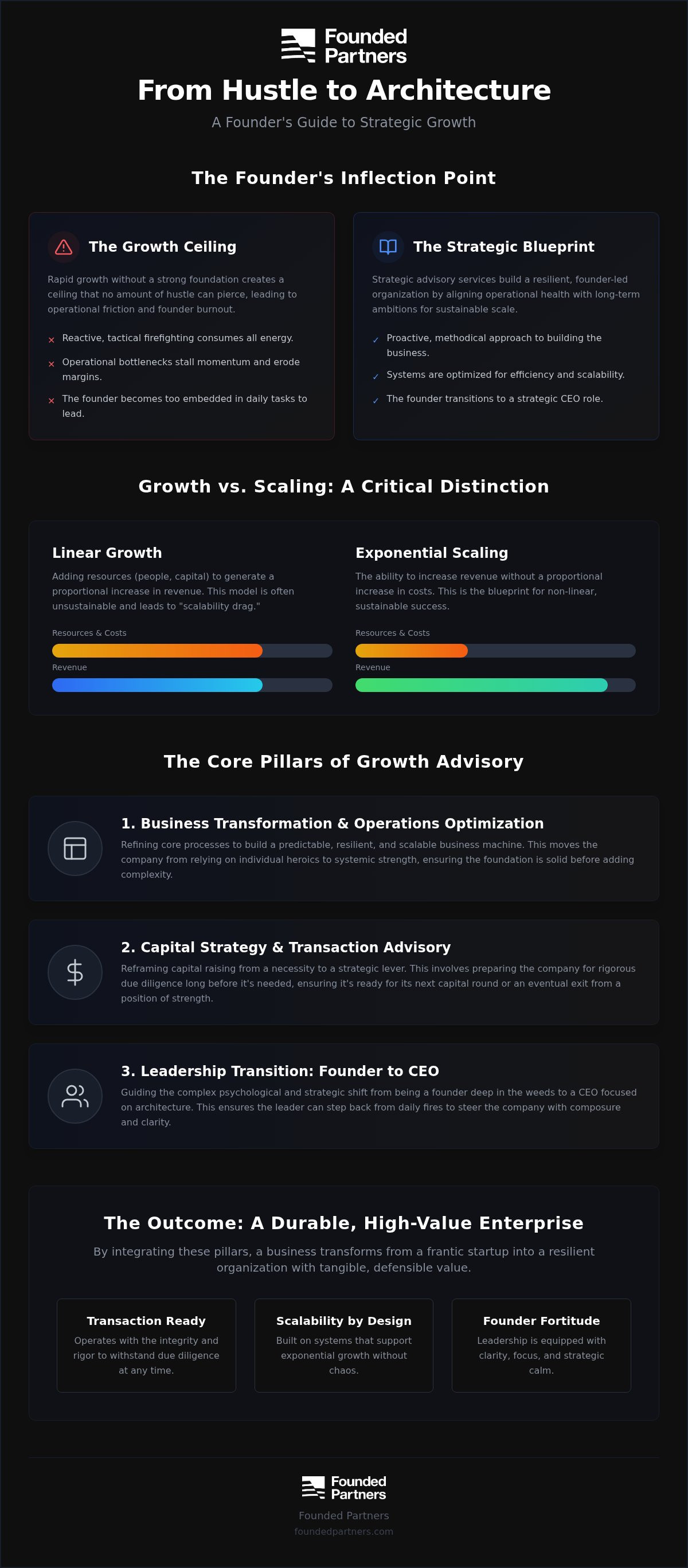
Founders frequently use the terms "growth" and "scaling" interchangeably, but the distinction is critical for long-term survival. Growth is linear; it's the act of adding resources like new staff or equipment to drive more revenue. Scaling is the ability to increase revenue without a proportional increase in costs. An advisor works to identify "scalability drag," which consists of those hidden bottlenecks and manual workarounds that quietly erode your margins as you expand. Scalability Strategy is the architectural blueprint for non-linear growth that allows a business to expand its impact while maintaining its integrity.
The Role of the Strategic Architect
A growth advisor functions as a Strategic Architect, focusing on the bedrock of the company before adding new floors. This starts with Operations Optimization. You can't scale a chaotic process; you can only make it more expensive. By refining the core foundation, an advisor ensures the business remains resilient during periods of high-stakes change. This methodical approach provides the psychological security founders need to step back from daily fires. Having a trusted peer to navigate these transitions helps prevent founder burnout and ensures that the organization’s character remains intact as it evolves into a larger, more complex entity.
The Core Pillars of Growth Advisory for Founders
Growth is not a single event but a series of calculated transitions. To move beyond the limits of individual effort, a founder must embrace an architectural approach to their enterprise. This means integrating daily execution with long-term transaction readiness. Strategic growth advisory services provide the framework for this alignment, ensuring that every operational shift increases the tangible value of the company. When your foundation is strong, growth becomes a choice rather than a struggle; for those exploring inorganic expansion, you can visit PP-X to learn how strategic acquisitions can be integrated into your scaling roadmap.
Startups often hit a ceiling where the hustle that got them to the first few million won't get them to the next level. This usually happens because of operational bottlenecks that drain resources and focus. Through Operations Optimization, we refine the core processes that allow a business to scale without losing its soul. It's about building a machine that is predictable and resilient. When you implement these systems, you don't just solve a problem. You create a scalable business foundation that allows you to step back from the tactical minutiae. This shift is essential for maintaining your mental clarity and the long-term health of the organization.
Capital Raising and Transaction Advisory
Many founders view funding as a desperate necessity. A seasoned advisor reframes it as a strategic lever. By focusing on capital raising support early, you position your firm to attract investors who value your stability and character. This readiness is also the cornerstone of effective exit planning. Rigorous due diligence shouldn't be a source of anxiety. It should be a validation of the architectural integrity you've built over time. Aligning your organizational vision with daily execution ensures that when a transaction opportunity arises, you're operating from a position of strength rather than a need for rescue. If you're looking to strengthen your organization's future, considering a partner for strategic growth advisory can ensure you're prepared for whatever transition comes next.
The true power of strategic growth advisory services lies in their integration. You can't separate business transformation from transaction readiness. An optimized operation is naturally more attractive to capital partners, and a clear capital strategy provides the resources needed for further transformation. This rhythmic, intentional approach replaces the frantic energy of the startup world with a measured perspective. It allows you to build something substantial, knowing that your foundation is designed to support the weight of your highest ambitions.
Growth vs. Scaling: A Framework for Evaluation
Growth is often a trap disguised as a victory. Many founders chase top-line revenue as the ultimate sign of health, yet growth alone can be a deceptive metric. Linear growth requires a proportional increase in resources, people, and capital for every new dollar earned, which often leads to a fragile, overextended organization. Exponential scaling, by contrast, is the ability to increase revenue while costs remain relatively flat. Strategic growth advisory services shift the focus from these vanity metrics toward organizational durability. This architectural view treats the business as a system that must be engineered for efficiency before it's pushed for expansion.
Identifying Growth Red Flags
Recognizing when your business is growing but not scaling is the first step toward meaningful transformation. One primary red flag is the "growth trap," where increasing revenue leads to decreasing margins. This happens when operational inefficiencies are amplified by volume, making the business less profitable as it gets larger. Another sign is when the founder remains a permanent bottleneck in every decision. If the business can't move without your direct involvement, it isn't a scalable asset; it's a high-pressure job. Finally, look for culture dilution. Rapid expansion often outpaces the ability to instill core values, leading to a team that is technically competent but strategically unaligned. These indicators suggest that your current foundation is reaching its structural limit.
The Scaling Roadmap
Moving from linear growth to exponential scale requires a methodical, three-step roadmap. It begins with refining the core value proposition and the operational foundation. You must ensure your service or product is truly ready for the weight of more customers without losing its integrity. Next, you optimize systems for repeatability and decentralized decision-making. This involves building frameworks that empower your leadership team to act with autonomy, removing the dependency on the founder for daily tactical choices. Only after these systems are in place do you execute strategic growth through capital raising or market expansion. This sequence ensures that when you do pour fuel on the fire, the structure you've built is strong enough to handle the heat. It turns scaling from a chaotic risk into a disciplined, rhythmic progression toward market leadership; to ensure your brand identity matches this new level of scale, you can discover Phoenix Design and their expertise in elevating SMEs into industry leaders.
Scaling a business is as much a psychological challenge as it is an operational one. For many, the identity of "founder" is rooted in the act of doing, fixing, and deciding. However, as the organization matures, this hands-on approach becomes a liability. Strategic growth advisory services provide the necessary friction to help you pause and reassess your role within the machine you've built. This transition requires moving from a state of constant tactical involvement to a position of strategic oversight. It's about shifting your focus from the "how" of a task to the "who" of the team and the "why" of the mission.
Having a "Trusted Peer" in your corner provides the objective perspective needed to manage the emotional weight of ownership transitions. While you're often too "in" the business to see the bottlenecks, an advisor acts as a Strategic Architect, identifying where your presence is helping and where it's stalling growth. This relationship offers the psychological security of knowing that your decisions are backed by seasoned expertise. It allows you to lead with a sense of calm authority, eschewing the frantic energy that often accompanies rapid expansion.
The Roadmap for Founder Leadership
The journey from founder to CEO involves a deliberate roadmap of delegation and trust. You must move from doing the work to leading the people who do the work. This starts with building a leadership team that doesn't just share your vision but actively owns the execution of it. It's a rhythmic process of refining your communication, guiding your directors, and strengthening your delegation muscles. This evolution is essential for long-term exit planning. If the business depends entirely on your daily input, it isn't an asset; it's a job. By stepping back, you actually increase the enterprise value and ensure the organization can thrive in your absence.
Building Organizational Resilience
Resilience is the ultimate competitive advantage in volatile markets. It is the ability of an organization to absorb shocks, adapt to change, and maintain momentum without the founder's constant intervention. Through Leadership Advisory for Founders, we help you create a culture of disciplined innovation. This isn't about rapid pivots; it's about a methodical approach to problem-solving that permeates every level of your team. When your organization is resilient, it possesses a structural integrity that survives market shifts and internal transitions alike. If you're ready to evolve your role and secure your company's future, exploring strategic growth advisory services can provide the steady hand you need for this transformation.
Partnering with Founded Partners for Strategic Growth
Choosing a partner to guide your company’s evolution is a decision that requires both strategic logic and personal trust. At Founded Partners, we provide strategic growth advisory services that balance professional authority with grounded empathy. We don't operate as distant observers. Instead, we act as deeply invested peers who understand that behind every operational metric is a founder’s vision and years of personal commitment. Our approach is designed to replace the frantic energy of reactive management with a composed, long-term perspective that prioritizes the structural health of your enterprise.
The rhythm of our engagement is methodical and intentional. We believe that lasting transformation cannot be rushed or forced through generic templates. By moving through a progressive narrative, we help you identify the "why" and "when" of your next stage before we ever touch the "how." This steady pace ensures that every change we implement is durable, sustainable, and architecturally sound. We focus on refining your core, guiding your transitions, and strengthening your leadership to ensure the business is ready for the weight of its own success.
A Boutique Approach to Transformation
Founders often find that "ivory-tower" global consultancies lack the human-centric values necessary for true partnership. These large firms frequently prioritize vanity metrics over the actual health of the organization. Founded Partners offers a specialized alternative. You work directly with partners who have navigated the specific pitfalls of rapid growth and ownership transitions. We value character as much as competence, ensuring that our advice aligns with your integrity and the unique culture of your firm. This boutique focus allows us to act as a Strategic Architect, helping you build a foundation that is as resilient as it is profitable.
Next Steps: From Assessment to Execution
The journey toward a scalable business foundation begins with a thorough organizational assessment. We look past the surface-level revenue numbers to evaluate the integrity of your systems, the clarity of your capital strategy, and the strength of your leadership framework. This assessment provides the clarity needed to define your strategic objectives for the next 12 to 24 months. By creating a logical roadmap, we ensure your team is aligned and your operations are optimized for non-linear growth. If you are ready to move from tactical firefighting to intentional leadership, we invite you to Explore our Strategic Advisory services and begin the process of building your company’s future with a steady hand.
Architecting Your Future for Scale
Building a scalable enterprise is less about the speed of your expansion and more about the structural integrity of your foundation. True scaling requires a shift from linear growth to a system that functions independently of your daily input. By prioritizing operations optimization and a clear capital strategy, you ensure your organization is resilient enough to handle high-stakes transitions. This methodical approach transforms your business into a durable asset, ready for the next capital round or a successful exit.
At Founded Partners, led by partners Adam and Matt, we specialize in this integrated approach to business transformation and transaction advisory. We provide strategic growth advisory services tailored specifically for founder-led organizations, offering the steady hand of a trusted peer. You don't have to navigate these complex transitions in isolation. It's time to move from tactical firefighting to intentional leadership. Begin your transformation with Founded Partners and build a legacy that stands on its own merits.
Frequently Asked Questions
What is the difference between a business consultant and a growth advisor?
A business consultant typically addresses a specific, isolated problem within a fixed timeframe. In contrast, strategic growth advisory services involve a long-term partnership focused on the architectural health of the entire organization. While a consultant delivers a report, an advisor guides the founder through the continuous process of refining operations, strengthening leadership, and preparing for capital events. This holistic approach ensures that solutions are integrated into the company's core foundation rather than applied as temporary patches.
How do I know if my business is ready for strategic growth advisory?
Your business is likely ready when you experience the "growth trap" where increasing revenue leads to stagnant or decreasing margins. Other indicators include the founder being a permanent bottleneck in daily decision-making or a palpable sense of burnout. If you're planning a capital round or looking toward an exit in the next 18 to 24 months, engaging an advisor now ensures your foundation is strong enough to support that transition without breaking.
Can a growth advisor help with capital raising and investor readiness?
Yes, advisors provide essential capital raising support by ensuring your business is "investor-ready" before you approach the market. This involves conducting rigorous internal due diligence, refining your financial narrative, and optimizing operations to prove scalability. By acting as a Strategic Architect, an advisor helps you attract the right kind of capital that aligns with your long-term vision, rather than accepting terms out of a desperate need for liquidity or rescue.
What industries do strategic growth advisors typically serve?
Strategic growth advisory services are most effective for founder-led organizations across diverse sectors, including technology, professional services, and specialized manufacturing. The industry matters less than the stage of the business and the complexity of its organizational challenges. We focus on firms that have proven their market fit but now face structural hurdles that prevent them from reaching the next level of scale or successfully navigating a major ownership transition.
How long does a typical strategic advisory engagement last?
Most engagements are methodical and intentional, typically spanning 12 to 24 months. This timeframe allows for a thorough assessment, the implementation of organizational changes, and the stabilization of new systems. Transformation isn't an overnight event; it's a rhythmic process of refining and strengthening. A longer-term engagement ensures that the advisor can provide a steady hand during high-stakes periods, such as capital raises or the early stages of an exit planning strategy.
What is the "Founder to CEO" transition and why does it matter?
This transition is the psychological and strategic shift from being the primary "doer" to the primary "leader." It matters because a business that depends entirely on a founder's daily tactical involvement cannot scale or be sold at a premium. By moving toward a CEO mindset, you empower a leadership team to own execution. This shift builds organizational resilience, ensuring the company thrives based on its systems and character rather than just your individual effort.
How does operations optimization impact the final sale price of a business?
Operations optimization directly increases enterprise value by reducing the perceived risk for a buyer. A business with documented, repeatable systems and a decentralized decision-making structure is far more attractive than one plagued by operational chaos. Buyers pay a premium for "turnkey" scalability. When your foundation is architecturally sound, it proves that the company's revenue isn't fragile, which significantly strengthens your position during the final stages of transaction advisory and price negotiation.
Do strategic growth advisors assist with exit planning?
Exit planning is a core component of a comprehensive advisory relationship. It isn't just about the final transaction; it's about building a company that is "always ready" for an exit. This involves aligning your long-term organizational vision with daily execution to ensure a smooth ownership transition. By focusing on transaction readiness years in advance, an advisor helps you maximize value while protecting the character and legacy of the firm you've spent years building.