
Executive Team Alignment for Founder-Led Firms

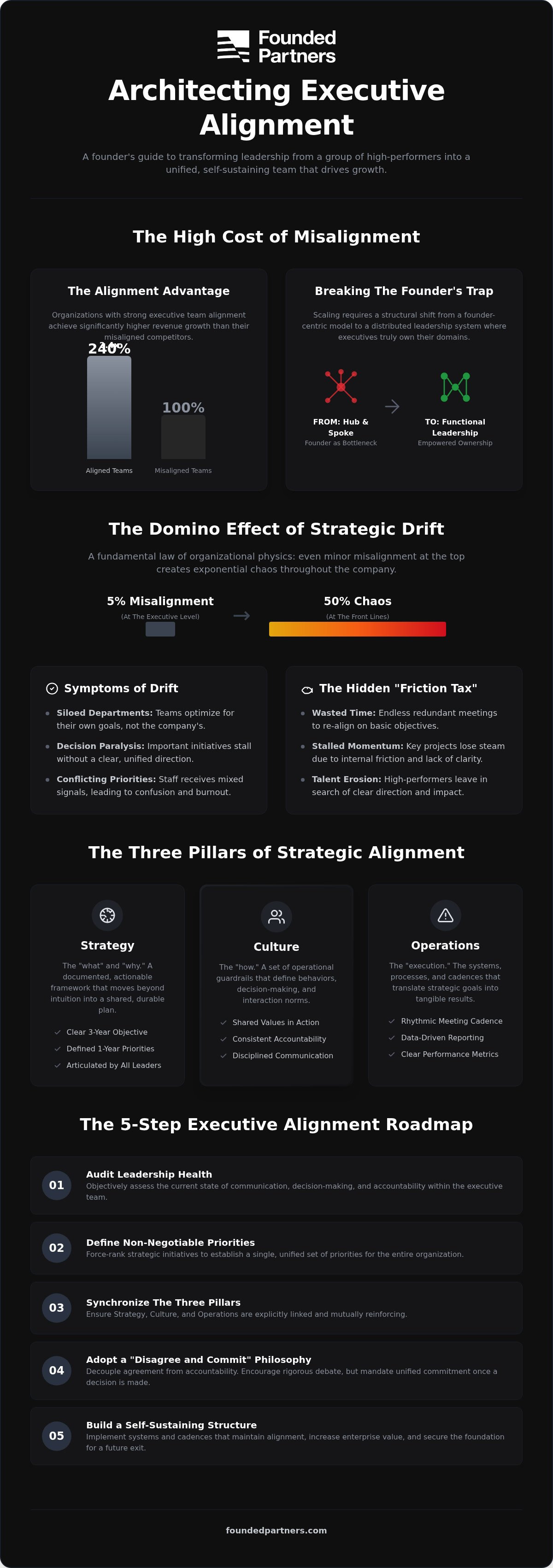
If your department heads are individual high-performers but your strategic initiatives keep stalling during execution, you don't have a talent problem; you have an architectural one. It's an exhausting reality for many founders who find themselves acting as the "Chief Problem Officer" rather than the CEO. You've likely noticed that as your firm grows, informal communication breaks down and conflicting priorities begin to pull the organization in different directions. Recent data suggests that organizations with strong executive team alignment achieve 2.4 times the revenue growth of their misaligned competitors. This isn't just about efficiency; it's about the durability of your enterprise.
We understand the weight of carrying the vision alone. You need a leadership group that doesn't just manage tasks but truly owns the results. This article will show you how to transform your executive layer into a unified, self-sustaining team that operates with clarity and discipline. We'll examine the structural shifts required to move past the scaling cliff, ensure your strategy survives daily chaos, and build a foundation that increases enterprise value for a future exit. By the end, you'll have a roadmap to step back from the tactical minutiae and lead with the composed authority your firm requires.
Key Takeaways
- Identify the symptoms of the "Founder's Trap" and learn to transition from a solo visionary into a strategic architect who empowers others.
- Master the three pillars of executive team alignment to synchronize your firm’s strategy, culture, and operations for sustainable growth.
- Distinguish between consensus and accountability by adopting a "disagree and commit" philosophy that keeps high-stakes decisions moving forward.
- Follow a disciplined five-step roadmap to audit your leadership health and define the non-negotiable priorities that scale your vision.
- Build a self-sustaining leadership structure that increases enterprise value and secures the foundation for a successful future exit.
Beyond the Founder’s Shadow: Why Executive Team Alignment Fails in Scaling Firms
At its core, executive team alignment is the deliberate synchronization of vision, values, and operational execution across a firm’s leadership layer. It represents the transition from a group of individuals reporting to a boss to a unified body that owns the organization's outcomes. For founder-led firms, this alignment is often the missing bridge between a successful small business and a scalable enterprise. Without it, the very intuition that built the company begins to act as a ceiling on its potential.
Many founders unknowingly fall into the "Founder's Trap." In the early days, your personal drive and rapid decision-making were the primary engines of growth. However, as the headcount increases and market complexities grow, relying on a single person’s intuition creates a dangerous bottleneck. This goes beyond simple agreement; it requires a deep level of strategic alignment where every leader understands how their specific function contributes to the broader mission. When this clarity is missing, symptoms like siloed departments and decision paralysis become the norm. Addressing these structural gaps is a core component of business scalability consulting, providing the foundation for growth that doesn't rely on your constant intervention.
The Shift from 'Founder + Helpers' to 'Functional Leadership'
Scaling requires moving away from the hub-and-spoke model, where every significant choice orbits the founder. You must transition to a distributed leadership model where department heads aren't just "helpers" but owners of their domains. It’s a common frustration to see high-performing individuals fail to act as a high-performing team. This usually happens because they are optimized for their specific silo rather than the collective goal. Engaging leadership in structured, experiential problem-solving sessions through specialists like CtrlX can help break down these departmental barriers and unlock collective innovation. The shift is psychological as much as it is structural. You must move from being the primary operator to becoming the strategic architect, designing a system where your team is empowered to lead without seeking permission for every move.
The High Cost of Strategic Drift
Strategic drift occurs when the leadership team lacks a unified front. It's a fundamental law of organizational physics that a 5% misalignment at the executive level translates into 50% chaos at the front lines. When your leaders aren't in sync, the rest of the staff receives mixed signals. This fragmentation erodes trust and drives away high-performing talent who crave clear direction. We often call this the "friction tax." It's the hidden cost of wasted time, redundant meetings, and stalled initiatives that drain your operational efficiency and stall your momentum.
The Three Pillars of Strategic Alignment: Strategy, Culture, and Operations
True executive team alignment is not a singular event but an ongoing structural discipline. It functions as the architectural foundation of a scaling firm, ensuring that the momentum generated at the top is effectively distributed throughout the organization. To achieve this, leadership must synchronize three specific pillars: Strategy, Culture, and Operations. When these are in harmony, the business moves with a level of precision that attracts high-value investors and simplifies capital raising for founders by demonstrating institutional maturity.
Strategy: Beyond the Pitch Deck
Visionary founders often carry the roadmap in their heads, but scaling requires moving that vision into a documented, actionable framework. Every member of the leadership group must be able to articulate the three-year objective and the immediate one-year priorities without hesitation. This clarity prevents the "priority drift" that often occurs when department heads focus solely on their own functional targets. As a Strategic Architect, your role is to refine this roadmap, ensuring it is durable enough to withstand market volatility while remaining flexible enough for tactical pivots. If you find your team is still operating from intuition rather than a shared plan, our leadership advisory can help bridge that gap.
Culture as an Operational Guardrail
Corporate values are often dismissed as "soft" concepts, but in a high-growth firm, they serve as essential operational guardrails. Culture defines the behavioral norms that govern decision-making when the founder isn't in the room. It dictates how the team handles conflict, processes failure, and communicates bad news. A culture of radical transparency ensures that problems are surfaced early rather than hidden within silos. To reinforce this, incentives must be aligned with collective team outcomes rather than individual departmental wins. When the CFO and the Head of Sales are measured by the same North Star, the friction between their departments naturally dissipates.
Operations acts as the final execution engine for executive team alignment. This involves aligning the systems and KPIs that track progress toward the vision. If your strategic goal is high-end market penetration but your operations are optimized for volume, the team will remain fundamentally misaligned. By ensuring that your reporting structures and daily workflows mirror your strategic intent, you create a self-sustaining organization that scales with predictable results. If the data doesn't reflect the vision, the vision won't happen.
Consensus vs. Alignment: Decoupling Agreement from Accountability
A common misconception in scaling firms is that executive team alignment requires universal agreement. In reality, waiting for total consensus is one of the fastest ways to paralyze a growing organization. True alignment isn't about everyone liking a decision; it's about everyone committing to it. When leaders prioritize harmony over honesty, they create a culture of "false harmony" where critical flaws are left unchallenged to avoid social friction. This silence is expensive, as it allows weak strategies to proceed without the rigorous stress-testing that healthy conflict provides.
High-performing teams embrace the "disagree and commit" philosophy. This approach encourages vigorous debate during the decision-making phase, ensuring every perspective is heard and every risk is evaluated. However, once a final direction is set, the debate ends. Every executive, regardless of their original stance, must own the outcome with total accountability. This discipline ensures that the organization receives a single, clear signal from the top, which is essential for maintaining momentum during complex transformations.
The Trap of Democratic Decision-Making
Leadership by committee often stalls growth in founder-led firms. In an effort to be inclusive, founders sometimes inadvertently create a democratic structure where every major choice requires a vote. This dilutes the founder’s visionary edge and leads to compromised, middle-of-the-road outcomes. To prevent this, you must define clear decision rights using a RACI framework (Responsible, Accountable, Consulted, Informed). By clarifying who has the final "A," you empower individual leaders to move quickly while ensuring the rest of the team remains informed and supportive.
Building a Foundation of Trust
Alignment cannot exist without a specific type of trust. While most teams have "predictive trust"-the ability to guess how a colleague will behave based on past experience-scaling firms require "vulnerability-based trust." This is the confidence that you can admit a mistake, ask for help, or voice a dissenting opinion without fear of political retribution. Building this foundation is what creates organizational resilience, allowing the leadership group to navigate crises without fracturing. A seasoned leadership advisor often plays a crucial role here, facilitating the difficult conversations that surface underlying tensions and turn them into strategic breakthroughs. When the executive layer is unified by trust rather than just proximity, the entire firm becomes more durable.
The Executive Alignment Roadmap: Five Steps to a Unified Leadership Front
Building a cohesive leadership layer isn't a matter of chance; it's a matter of design. To move from a hub-and-spoke model to a self-sustaining enterprise, you need a disciplined roadmap that replaces intuition with structural clarity. This process transforms your leadership group into a unified front capable of scaling your vision without requiring your presence in every meeting. By following these five steps, you can establish the executive team alignment necessary for long-term organizational health.
The Alignment Audit: Assessing the Gaps
The first step is a rigorous assessment of your current state. You can't fix what you haven't accurately measured. An alignment audit examines the synchronization between your strategy, culture, and operations to uncover hidden silos that drain efficiency. We often find "shadow strategies" within scaling firms-unspoken departmental goals that quietly conflict with the company's North Star. A boutique consultancy provides the objective, outside perspective needed to surface these tensions. This external eye identifies where communication is breaking down and where decision rights have become blurred, providing a clear baseline for the transformation ahead.
Once the gaps are identified, you must define the "Critical Few." These are the three to five non-negotiable strategic priorities that every executive must own. In a founder-led firm, there's a constant temptation to chase every opportunity. By narrowing the focus, you ensure that the team’s collective energy is concentrated on the initiatives that drive the highest enterprise value.
Establishing the Rhythm of Business
Alignment is a perishable asset that evaporates without a consistent cadence. Establishing a Rhythm of Business (RoB) creates the meeting architecture necessary for sustained accountability. This isn't about adding more meetings; it's about designing the right ones. Daily huddles focus on tactical roadblocks, while quarterly offsites provide the space for high-level strategic refinement. To keep the team focused, you should utilize data-driven dashboards that track KPIs in real-time. This structural discipline allows the strategic architect to remain focused on the future, rather than being pulled back into daily fire-fighting. If you're looking to professionalize your leadership layer, our business transformation consulting provides the framework to make this transition permanent.
The final steps involve cascading this alignment down through the organization and continuously refining the foundation. Once the executive layer is unified, they must translate the high-level vision into functional targets for their own teams. This ensures that every employee understands their role in the broader mission. Finally, alignment is not a "one and done" project. It requires ongoing maintenance to ensure the architectural foundation remains resilient as the firm reaches new growth thresholds.
Architectural Leadership: Partnering for Organizational Resilience
The ultimate measure of a founder’s success isn't the height of the peak they reached alone, but the strength of the foundation they left behind. Building a durable legacy requires a fundamental shift from being the central engine of the firm to becoming its strategic architect. This transition ensures the organization remains resilient, profitable, and focused long after your daily involvement has scaled back. At this level of maturity, executive team alignment transforms from an operational goal into a significant driver of enterprise value.
When your leadership layer operates as a unified front, you effectively decouple the business's success from your personal presence. This is a critical prerequisite for exit planning for founders. A firm that relies on a single visionary is often seen as a high-risk asset. Conversely, a firm led by a synchronized, high-performing executive team represents a stable, scalable investment that commands a premium in the market.
Maximizing Enterprise Value Through Alignment
Investors and acquirers look for management depth. They seek businesses where decision-making is distributed and strategic initiatives move forward with precision. By distributing leadership authority, you drastically reduce "key man risk," making the company far more attractive during a sale or capital raise. An aligned team is also better prepared for the rigors of due diligence. When every department head can articulate the same vision and provide consistent data, it signals institutional maturity. They demonstrate they don't just follow orders; they own the results.
The Founded Partners Approach
We don't believe in "one-and-done" training sessions that fail to address the root causes of misalignment. Our approach is rooted in long-term strategic partnership, where we work alongside you to refine your leadership structure and optimize your operations. We understand the unique psychological and operational hurdles of founder-led firms. By combining leadership advisory with deep operations optimization, we help you build a self-sustaining leadership model that thrives on accountability and clarity.
Our Strategic Architects provide the steady hand and seasoned perspective needed to navigate complex organizational change. We focus on the "how" of business building, ensuring your systems are as robust as your vision. If you're ready to step out of the tactical chaos and into a role of strategic oversight, we're here to guide that transition. Schedule a consultation with our Strategic Architects to begin strengthening your firm’s foundational alignment today.
Securing the Future of Your Enterprise
Moving your firm beyond the limitations of the "Founder's Trap" requires more than just hiring talented people; it requires a structural commitment to executive team alignment. By synchronizing your strategy, culture, and operations, you transform your leadership group into a self-sustaining engine. This shift reduces key man risk, increases enterprise value, and ensures your vision survives the daily chaos of scaling. You've already explored how decoupling agreement from accountability allows for faster, more disciplined execution across your leadership layer.
At Founded Partners, we specialize in guiding founder-led organizations through these critical transitions. Our Strategic Architect approach combines deep business transformation expertise with exit planning support to help you prepare for high-value results. You don't have to carry the weight of every operational decision alone. The most resilient firms are those where the founder’s vision is shared, owned, and executed by a unified team.
Scale your vision with Founded Partners’ Leadership Advisory. Your firm’s greatest potential is realized when the team is empowered to lead with clarity. We're ready to help you build that foundation.
Frequently Asked Questions
What is the difference between executive team building and executive team alignment?
Executive team building often focuses on interpersonal chemistry and social cohesion through shared experiences. While valuable for morale, it doesn't solve structural issues. In contrast, executive team alignment is a rigorous, operational discipline that synchronizes vision, values, and execution. It ensures every leader is running toward the same North Star and understands the specific trade-offs required to reach it. Alignment is about creating a unified front for scaling, not just a friendly group of colleagues.
How do I know if my executive team is misaligned?
Misalignment usually surfaces as persistent friction between departments or strategic initiatives that stall during execution. You might notice that your department heads are high-performers individually but fail to own collective results. If you feel like the "Chief Problem Officer" who must resolve every conflict, your team is misaligned. Other red flags include "shadow strategies" where unspoken goals conflict with the company's vision and a lack of clarity on long-term priorities during daily operations.
Can a founder stay involved while aligning the team, or must they step back?
A founder shouldn't necessarily step away, but they must shift their role from primary operator to Strategic Architect. This transition involves moving from a hub-and-spoke model where you make every decision to a distributed leadership model. By aligning the team, you create the structural clarity needed to lead with composed authority. You stay involved in the "why" and the "what" while empowering your leadership layer to handle the "how" without your constant intervention.
How long does the executive alignment process typically take?
The initial phase of an executive team alignment audit and roadmap typically takes three to six months. However, alignment isn't a "one and done" project; it's a perishable asset that requires ongoing maintenance. As your firm reaches new growth thresholds, such as 50 or 150 employees, the communication systems that worked yesterday will likely break. Successful firms treat alignment as a core part of their Rhythm of Business, continuously refining their architectural foundation to support growth.
What are the most common barriers to executive alignment in founder-led firms?
The most common barrier is the "Founder's Trap," where the founder's intuition becomes a bottleneck for the entire organization. Many teams also suffer from "false harmony," where leaders avoid difficult conversations to maintain a polite atmosphere. This prevents the rigorous stress-testing that healthy conflict provides. Other barriers include a lack of clear decision rights (RACI) and misaligned incentives that reward departmental wins over collective company outcomes. Overcoming these requires a disciplined, architectural approach to leadership.
How does executive alignment impact my company's valuation during an exit?
Executive alignment is a significant value driver that directly impacts your company's valuation. Investors and acquirers pay a premium for management depth, which signals that the business can thrive without the founder's daily involvement. By distributing leadership authority, you reduce "key man risk" and demonstrate institutional maturity. An aligned team provides consistent data and a unified narrative during due diligence, making the firm a more stable and attractive investment for a high-value exit.
Do I need a fractional COO to help with team alignment?
A fractional COO can help implement systems, but alignment is primarily a leadership advisory and scalability strategy challenge. While a COO manages the operational engine, the entire executive layer must be unified around the vision and culture. Many founders find that partnering with a boutique consultancy offers a more strategic, objective perspective. This approach helps you design the architectural foundation of the team before hiring for specific roles, ensuring your leadership structure is built for long-term resilience.
What is the role of the founder during a leadership transition?
During a leadership transition, the founder's role is to act as the guardian of the vision and the primary mentor for the executive team. You are responsible for defining the non-negotiable strategic priorities and ensuring the team's behavioral norms align with the company's culture. Your focus should shift toward business transformation and long-term performance rather than tactical fire-fighting. By acting as a Strategic Architect, you guide the team toward self-sufficiency while maintaining the firm's core integrity.