
The Strategic Architect’s Guide to Startup Workflow Automation Strategy

The most resilient startups are built on architecture, not just activity. When your lead routing slows to a crawl or your customer success team spends more time in spreadsheets than with people, you aren't just facing a bottleneck. You're facing a structural limit that threatens your ability to scale. It's natural to fear that introducing machines might dilute the unique founder touch that defines your brand. However, true operational health requires a shift from manual friction to a deliberate startup workflow automation strategy that honors your values while reclaiming your time.
We understand that a fragmented tech stack often feels like a puzzle with missing pieces. This guide provides a clear framework to help you identify what to automate, how to unify your systems, and when to let technology take the lead. By the end of this article, you'll have a blueprint for reducing operational overhead and strengthening your business foundation for your next funding round or exit. We'll explore the architectural shift from doing more to building better through the lens of strategic transformation.
Key Takeaways
- Learn why a successful startup workflow automation strategy requires aligning your technical tools with high-level business objectives rather than applying temporary tactical patches.
- Master the two pillars of durable automation by establishing a single source of truth for your data and defining clear ownership for process governance.
- Navigate the "App for Everything" trap by learning how to evaluate all-in-one platforms against best-of-breed ecosystems for long-term scalability.
- Discover how to standardize operational logic and build playbooks that scale your efficiency without diluting the core vision and human touch that define your brand.
- Understand the direct correlation between clean, automated operations and your company's valuation, positioning operational excellence as a key asset for future capital raising.
Beyond the Hype: Defining a Strategic Startup Workflow Automation Strategy
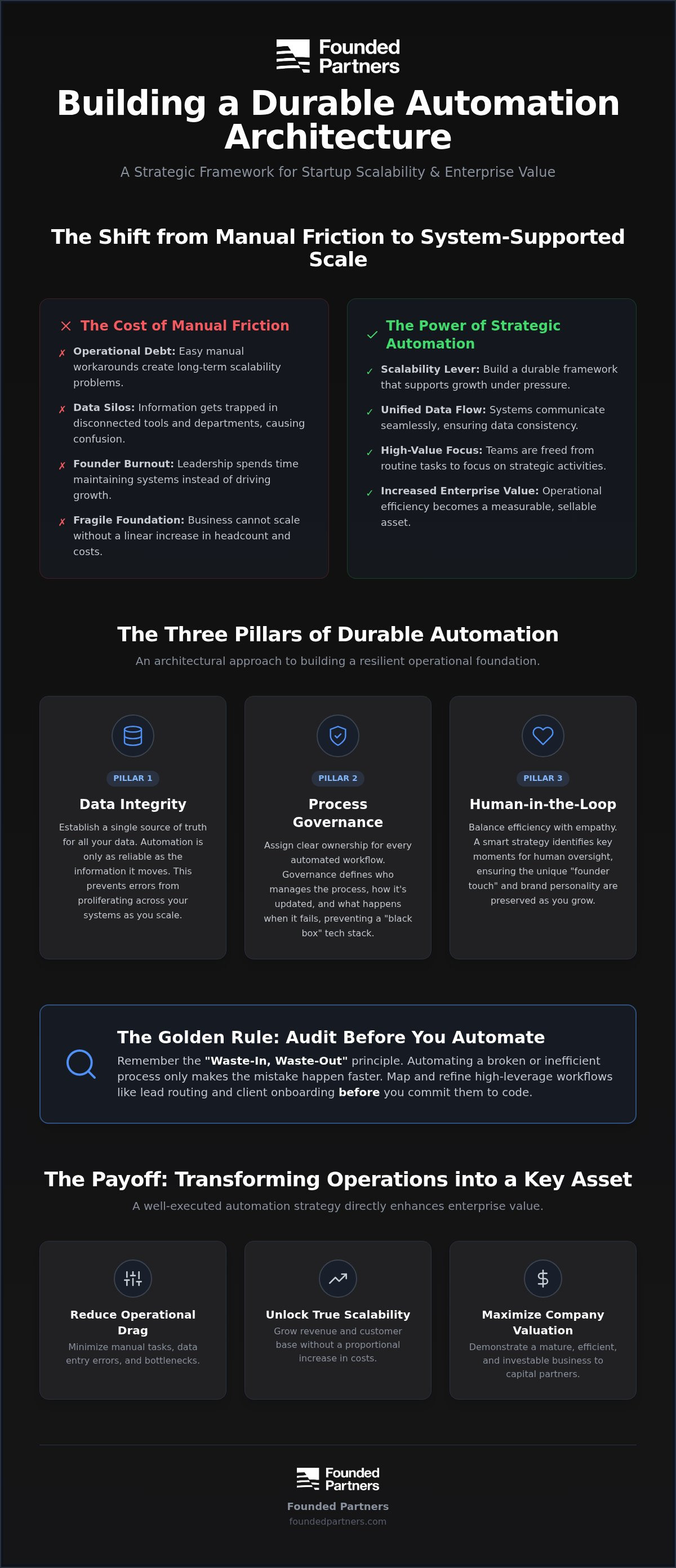
In the early stages of a venture, speed is often prioritized over structure. Founders frequently adopt software as a reaction to immediate pain, creating a patchwork of tools that solve isolated problems but fail to communicate. A true startup workflow automation strategy is not merely a collection of task-based connections or AI integrations. Instead, it is the architectural alignment of your digital tools with your long-term business objectives. It requires moving away from tactical patches, which offer temporary relief, and toward strategic foundations that support sustained growth.
When operations are built on reactive decisions, the result is operational debt. This concept mirrors technical debt; it's the cumulative cost of choosing an easy, manual workaround today over a scalable system. Poor strategy accelerates this debt, making every new customer or hire increasingly expensive to manage. Unlike standard corporate environments where Business process automation (BPA) often focuses on rigid compliance, a founder-led automation strategy must preserve agility. It should strengthen the organization without stifling the creative energy that sparked the business in the first place.
The High Cost of Manual Friction
Manual friction is a silent growth killer. It manifests as data silos where information is trapped in a single department, or as redundant entry where team members spend hours copying details from a CRM to a project management tool. These bottlenecks do more than slow down lead routing. They erode team morale and accelerate founder burnout. When you are the primary bridge between disconnected systems, you aren't leading; you're maintaining. These inefficiencies also become glaring red flags during investor due diligence. Sophisticated capital partners look for businesses that can scale without a linear increase in headcount, and manual dependency suggests a fragile foundation.
Automation as a Scalability Lever
Transitioning from a people-heavy model to a system-supported one is the hallmark of a mature enterprise. By refining your processes and guiding data through automated paths, you create a framework for business scalability that remains durable under pressure. This shift allows your team to focus on high-value activities while the architecture handles the routine. A well-executed startup workflow automation strategy acts as a primary driver of enterprise value by transforming operational efficiency into a measurable, sellable asset.
The Three Pillars of a Durable Automation Architecture
Building a resilient startup workflow automation strategy requires more than just connecting APIs. It demands a structural foundation that can withstand the pressures of rapid growth. By approaching automation as an architect rather than a technician, you ensure that every digital connection serves the broader goal of organizational health. This architectural phase is where calm expertise becomes your most valuable asset, helping you distinguish between noise and necessity.
- Pillar 1: Data Integrity. Automation is only as reliable as the data it moves. You must establish a single source of truth across your stack to prevent the proliferation of errors. If your CRM and project management tools disagree, your automation will simply scale the confusion.
- Pillar 2: Process Governance. Every workflow needs an owner. Governance defines who manages the automation, how it is updated, and what happens when it fails. Without clear ownership, your tech stack becomes a "black box" that no one understands or dares to touch.
- Pillar 3: Human-in-the-loop (HITL). Efficiency should never come at the cost of empathy. A sophisticated strategy identifies specific moments where a human must override the system to preserve the founder touch. This balance ensures your brand remains personal even as it scales.
Audit Before You Automate
The "Waste-In, Waste-Out" principle is the most important rule of workflow design. If you automate a broken or redundant process, you only succeed in making a mistake faster. Before applying technology, you must map your existing founder-led processes. Start by identifying high-leverage workflows such as lead routing, client onboarding, and financial reporting. Auditing these steps allows you to refine the logic before committing it to code. Seeking a peer to guide your Operations Optimization ensures these pillars are built to last.
Designing for Flexibility, Not Just Efficiency
Rigid systems break. Startups often pivot, and an automation that is too tightly coupled to a specific product or pricing model will become a bottleneck during a transition. You should focus on building modular workflows that grow with your business transformation. An architectural approach involves selecting an adaptable tech stack that allows for easy adjustments without requiring a complete rebuild. This flexibility ensures that your startup workflow automation strategy remains an asset during every stage of your company's evolution.
Platform Strategy vs. Point Solutions: Making the Right Choice
Early-stage founders often fall into the "App for Everything" trap. Every new operational friction leads to a new subscription, creating a fragmented stack that demands constant attention. A sophisticated startup workflow automation strategy requires a more disciplined approach to tool selection. You must choose between the convenience of an "All-in-One" platform and the depth of a "Best-of-Breed" ecosystem. While all-in-one solutions promise simplicity, they often lack the specialized features needed for true scalability. Conversely, a best-of-breed approach allows you to select the finest tools for sales, marketing, and finance; however, it places the burden of connection on your internal architecture.
The allure of "free" open-source tools is a common siren song for technical founders. Platforms like n8n offer self-hosting options that appear cost-effective on the surface. However, the hidden costs of maintenance, server management, and the accumulation of technical debt often outweigh the initial savings. Strategic selection should instead prioritize API maturity, robust community support, and enterprise-grade security. These factors ensure your tools can grow alongside your ambitions without requiring a total rebuild every eighteen months. You aren't just buying software; you're investing in the durability of your operations.
Orchestration vs. Integration
Orchestrators like Zapier and Make serve as the central nervous system of your business. Zapier's task-based model, starting at $19.99 for 750 tasks, provides accessibility for simpler setups. Make's operation-based pricing, offering 10,000 operations for $9, often proves more economical for high-volume, complex workflows. These platforms move you beyond basic native integrations toward true operations optimization. They provide the flexibility to build custom middleware that bridges the gaps between your core systems, ensuring data flows where it is needed most.
The Role of AI in 2026 Workflows
By 2026, automation has moved beyond simple triggers into the realm of agentic workflows. These systems use background processors to make decisions based on plain-English instructions, refining data and guiding leads with minimal intervention. While these capabilities are powerful, they must be deployed with care. You should evaluate whether a process needs a visible chat interface or an invisible processor that handles data enrichment in the background. Maintaining founder empathy remains the priority. AI should strengthen your team's ability to connect with customers, not replace the human warmth that defines your brand's character.
Implementing Automation Without Diluting Founder Vision
Automation often feels like a threat to the "soul" of a startup. Many founders worry that by removing themselves from the daily gears, they lose the very essence that made the company successful. However, a mature startup workflow automation strategy isn't a replacement for human character; it's a structural reinforcement of it. By systematically identifying what can be delegated to machines, you protect the time required for high-level creative and strategic work. This architectural approach ensures that your vision remains the guiding force, even as the execution becomes more efficient.
The implementation process begins with identifying your "Founder Essence." These are the high-empathy, high-stakes moments that should never be automated, such as final product decisions or high-level relationship building. Once these are ring-fenced, you can standardize the logic for everything else. This involves writing a literal "playbook" for the system, defining the exact rules and triggers that guide a process from start to finish. Before a single workflow goes live, it must be tested in a sandbox environment to ensure the logic holds under pressure. Finally, team enablement ensures that your staff understands how these new tools empower them rather than replace them, turning automation into a collective superpower.
Managing the Transition to System-Led Ops
Moving from manual to system-led operations often triggers team anxiety about job security. You must frame automation as a way to remove the "drudge work," allowing your team to focus on the roles they were actually hired for. For the founder, this transition is a critical step in the journey from "Doer" to "CEO." By using systems to handle the routine, you buy back the strategic time necessary for long-term planning and board management. Utilizing leadership advisory can be instrumental in navigating these complex psychological and organizational shifts.
Maintaining Organizational Health
True organizational health requires that your automation reinforces your company culture. If your values prioritize transparency, your systems should make data more accessible, not less. You also need a "Steady Hand" approach to deployment, rolling out changes incrementally to avoid overwhelming the organization. Monitoring for "silent failures," where a process stops working without an obvious error message, is essential for maintaining trust in the new architecture. If you're ready to build a foundation that scales with your vision, consider how Scalability Strategy can transform your daily operations.
Maximizing Enterprise Value Through Operational Excellence
Excellence is the result of intention, discipline, and architectural clarity. While many founders focus exclusively on top-line growth, the Strategic Architect understands that true value is built within the margins. A well-executed startup workflow automation strategy does more than reclaim hours. It directly impacts your EBITDA by reducing the cost of service delivery and increases your valuation multiple by de-risking the entire enterprise. When your processes are documented, automated, and measurable, you aren't just running a company; you're building a durable asset.
For founders looking toward capital raising, having "Clean Ops" is a significant advantage. Investors aren't just buying your current revenue. They're buying your future scalability. A business that relies on the founder for every minor decision is a liability. Conversely, a business supported by a strategic foundation of automation is a safe bet. It demonstrates that you have the discipline to build a system that outlasts your personal involvement, making it an attractive prospect for sophisticated capital partners.
This structural integrity becomes even more critical when preparing for a business exit. The role of systems in transferability cannot be overstated. A buyer wants to know that the engine will keep humming after the keys are handed over. By refining your workflows and guiding your data through a scalable foundation, you ensure that your business remains a high-value, transferable entity rather than a founder-dependent project.
The Investor’s Perspective on Automation
Due diligence for a highly automated startup goes beyond financial audits. Investors look at system logs, efficiency metrics, and the modularity of your tech stack. They want to see that you've built a "Durable" business that doesn’t collapse when the founder steps away. Demonstrating scalability through automated lead routing, customer success triggers, and financial reporting provides the psychological security that investors need to commit. It proves that your growth is supported by a robust architecture rather than just brute force.
Your Roadmap to a Scalable Foundation
The journey from manual chaos to strategic automation requires a steady hand and a long-term perspective. It involves moving from tactical patches to strategic foundations, identifying your founder essence, and building pillars of data integrity. Having a "Trusted Peer" to guide this architectural process ensures that you avoid the pitfalls of rapid growth while prioritizing the health of your organization. We are here to act as the bridge between your current operational friction and your future enterprise value. Partner with Founded Partners for your strategic transformation.
Securing Your Operational Legacy
Transitioning from manual operations to a scalable foundation represents a fundamental shift in your leadership journey. By treating your startup workflow automation strategy as an architectural priority, you move beyond tactical fixes toward a business model that compounds in value. You've seen that true optimization requires protecting your founder essence while establishing the rigorous data integrity and process governance needed to scale without friction.
These systems do more than save time; they build the institutional health required for successful capital raising and exit planning. At Founded Partners, we provide the strategic advisory and calm expertise needed to guide founder-led firms through these complex transformations. We focus on durable growth, ensuring your organization remains resilient as it expands. It's time to move from being the primary engine of your business to being the architect of its future.
Ready to transform your operational friction into a measurable, sellable asset? Architect your scalable foundation with Founded Partners and prepare your company for its next major milestone. Your vision deserves a foundation that is built to last.
Frequently Asked Questions
What is the first step in creating a startup workflow automation strategy?
The first step is conducting a comprehensive audit of your existing manual processes. You cannot refine what you haven't documented. Mapping your current workflows allows you to identify high-leverage bottlenecks and ensures you aren't just automating inefficiency. This architectural phase prioritizes structural clarity over tool selection, helping you build a foundation that supports long-term organizational health rather than just applying tactical patches.
How do I know if my startup is ready for advanced automation?
Your startup is ready for advanced automation when manual friction begins to limit your team's ability to focus on strategic initiatives. If lead routing, customer onboarding, or financial reporting requires a linear increase in headcount to maintain quality, you've reached a structural limit. Readiness is also signaled by data silos where information is trapped in specific tools. At this stage, transitioning to a system-supported model is essential for building a scalable foundation. To discover how applied automation and AI can streamline these day-to-day operations, learn more about Ascendra Growth Systems.
Can automation help with capital raising for founders?
A sophisticated startup workflow automation strategy significantly strengthens capital raising efforts by demonstrating operational maturity to potential investors. Sophisticated capital partners look for "Clean Ops" that prove a business can scale without the constant intervention of the founder. By presenting a strategy backed by system logs and efficiency metrics, you provide the psychological security investors need. This structural integrity suggests a durable, transferable asset that is ready for its next stage of growth.
What are the most common mistakes startups make with automation?
The most common mistake is adopting a tool-first approach rather than an architectural one. Startups often buy software to solve isolated problems without considering how it fits into the broader tech stack. Other frequent errors include:
- Automating broken or redundant processes.
- Failing to establish clear ownership and governance.
- Over-automating moments that require a founder's unique touch.
Avoiding these pitfalls requires a strategy-first mindset that values durability over quick fixes.
How does a business transformation consultant help with automation?
A business transformation consultant provides the calm expertise needed to design a durable operational architecture. They act as a strategic architect, helping you distinguish between tactical noise and foundational necessity. By guiding the transition from manual friction to system-led operations, a consultant ensures your automation strategy aligns with your long-term goals. This partnership-oriented approach helps you avoid expensive technical debt while strengthening the overall health of your organization.
Is it better to build custom automations or use off-the-shelf tools?
For most startups, using off-the-shelf tools connected by a central orchestrator is more sustainable than building custom software. Orchestration platforms like Zapier or Make provide the flexibility to build modular workflows without the high maintenance costs of custom code. This approach allows your tech stack to remain adaptable during pivot phases. It balances speed with structural integrity, ensuring your systems can evolve alongside your business transformation without requiring constant developer intervention.
How do I ensure my team adopts the new automated workflows?
Ensuring team adoption requires clear enablement and a focus on human-centric values. You must frame new systems as tools that empower your staff by removing the drudge work of manual entry. Training should be intentional, providing the team with the confidence to trust the new systems. When employees see that automation protects their time for high-value work, resistance fades. This transition should be managed with a steady hand to reinforce company culture.
What is the ROI of a well-executed automation strategy in 2026?
The ROI of a well-executed strategy in 2026 is seen through both financial gains and enterprise value. Research indicates that automating invoice processing or lead nurturing can return a 200% to 400% ROI within the first year at typical transaction volumes. Beyond immediate cost savings, the primary return is found in your increased valuation. A scalable foundation makes your business more attractive during exit planning or future funding rounds by proving the engine runs independently.