
Founder Dependency: Why Scaling Breaks When Your Processes Are Designed for You
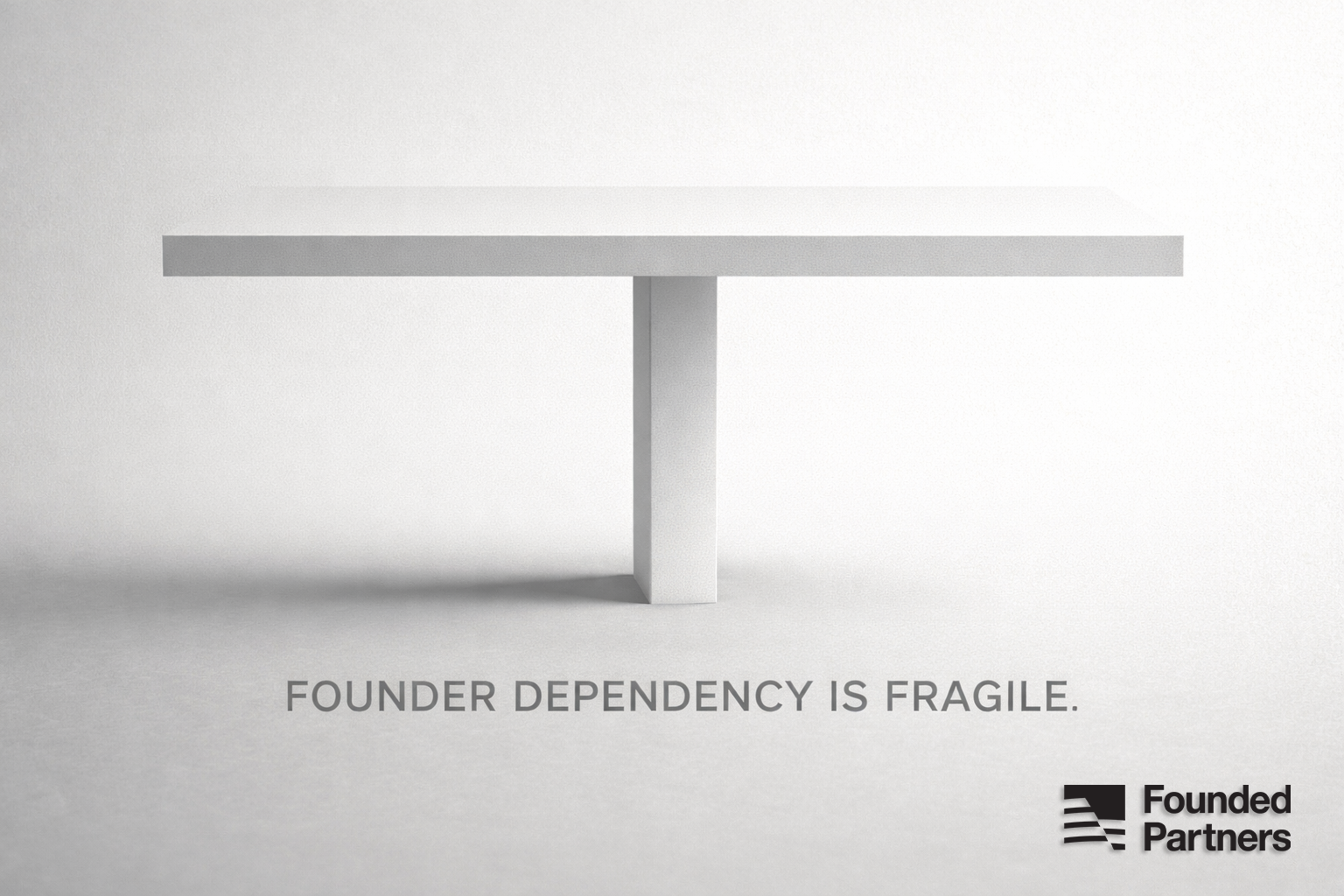
Most founder led companies work beautifully at 5 people.
They even work at 12.
At 18, friction begins.
At 25, cracks appear.
At 40, things that once felt smooth now feel fragile.
Founders often interpret this as:
We need better managers.We need stronger operators.We need more accountability.
But there is a quieter truth.
Many processes were designed around you.
Your memory.Your tolerance for ambiguity.Your pattern recognition.Your stamina.Your cognitive style.
And when the company scales beyond your direct involvement, those processes break.
Not because your team is weak.
But because the system was never designed for them.
The Academic Backbone: Designing Beyond the Mean
In physical product design, there is a field called anthropometrics.
Anthropometrics studies the measurement and distribution of human physical characteristics. Designers use it to ensure products work not just for the average person, but across a range of users.
If you are unfamiliar, here is a useful overview:
Anthropometrics explained: https://www.sciencedirect.com/topics/engineering/anthropometry
Designing for the 5th to 95th percentile: https://www.interaction-design.org/literature/topics/anthropometrics
The key insight:
Designing for the “average” user excludes a large percentage of real users.
Instead, designers often design for the 5th to 95th percentile range.
Meaning:
The system works for most people, not just the center.
Now translate this to leadership and operational design.
Founders often design processes around a single cognitive profile:
Themselves.
Founder Cognitive Bias: Designing for Your Own Brain
Founders tend to have:
High ambiguity tolerance.
Strong working memory.
Fast pattern recognition.
High energy.
Context switching ability.
Informal communication comfort.
But these are not universal traits.
Research in cognitive psychology consistently shows wide variation in working memory capacity, ambiguity tolerance, and information processing style.
See:
If your processes rely on:
Remembering verbal agreements.
Interpreting loosely defined priorities.
Juggling multiple untracked tasks.
Reading between the lines.
Making decisions without documentation.
They may work perfectly for you.
They will not scale to 30 employees.
Why Scaling Founder Led Companies Often Break
Here is the pattern.
At small scale:
The founder remembers everything.
Decisions happen in hallways.
Tasks are delegated verbally.
Context is shared informally.
Correction happens immediately.
At larger scale:
People need clarity without access to you.
Tasks multiply.
Communication layers increase.
Decision rights blur.
Errors surface later.
If the process still assumes founder memory and availability, it becomes fragile.
The system works only when you are directly involved.
That is not scale.
That is dependency.
Founder Translation: Where This Shows Up
Let us make this concrete.
1. The Founder Remembers Everything
You know:
Which client is sensitive.
Which invoice needs follow up.
Which deal has hidden risk.
Which hire is struggling.
Which project is actually behind.
If none of that is structurally documented, your absence creates confusion.
Memory is not a scalable process.
2. The Founder Thrives in Ambiguity
You can operate with:
Loose priorities.
Incomplete data.
Evolving strategy.
Half formed ideas.
Your team cannot.
When goals are vague, many employees hesitate rather than improvise.
Ambiguity tolerance is not evenly distributed.
3. The Founder Makes Fast Contextual Decisions
You combine:
History.
Market intuition.
Personal judgment.
Emotional signals.
Risk appetite.
That decision model lives in your head.
If you do not externalize it, managers will either:
Over escalate decisions to you.
Or guess incorrectly.
Both slow scale.
Task Variation and Cognitive Diversity
Another concept from human factors research is task variability.
Different people perform tasks differently depending on cognitive style, experience, and context.
When processes are informal, variability increases.
When variability increases, predictability decreases.
Predictability is essential for:
Raising capital.
Creating liquidity.
Scaling operations.
If investors see a business dependent on one person’s brain, valuation risk increases.
Reducing founder dependency is not just operational.
It is financial.
Designing for the 5th to 95th Percentile
Instead of designing processes that work for you, design processes that work for most capable professionals.
Ask:
If a competent but new hire joined tomorrow, could they execute without constant clarification?
If the answer is no, your process is memory dependent.
Design for:
Clear step sequencing.
Visible ownership.
Explicit decision rights.
Documented context.
Feedback loops.
This is not bureaucracy.
It is anthropometric leadership.
Actionable Steps for Founders
Here is how to operationalize this shift.
Step 1: Identify Memory Dependent Processes
Audit your company for processes that rely on:
Verbal instructions.
Founder recall.
Informal Slack agreements.
Unwritten priorities.
Context known only to you.
If a process cannot survive your vacation, it is fragile.
Step 2: Document Using Simple Hierarchical Task Analysis
As discussed previously, Hierarchical Task Analysis (HTA) is a simple way to break tasks into structured steps.
Overview:
https://www.interaction-design.org/literature/topics/hierarchical-task-analysis
Pick one critical workflow:
Deal approval.
Product release.
Hiring process.
Capital reporting.
Write:
Goal
Sub tasks
Sequence
Decision points
Ownership
This exposes hidden assumptions.
Step 3: Reduce Memory Reliance
Replace memory with structure:
Shared dashboards.
Checklists.
Approval workflows.
Decision logs.
Playbooks.
Research consistently shows that checklists dramatically reduce error in complex environments.
See Atul Gawande’s work:
https://www.nejm.org/doi/full/10.1056/NEJMsa0810119
If surgeons use checklists, founders can too.
Step 4: Test With New Hires, Not Senior Leaders
Senior leaders adapt.
New hires reveal design flaws.
When testing a process, ask a newer team member to walk through it.
Observe:
Where do they hesitate?
Where do they ask clarifying questions?
Where do they assume incorrectly?
Where do they seek you out?
These are design gaps.
Step 5: Clarify Decision Architecture
Scaling requires clarity in:
Who decides.
Who recommends.
Who approves.
Who executes.
Who is informed.
Ambiguity here creates founder bottlenecks.
Decision rights should not depend on proximity to you.
They should be explicit.
Reducing Founder Dependency
Many founders reach a point where everything depends on them.
Revenue depends on them.Hiring depends on them.Major decisions depend on them.Culture depends on them.
At first this feels powerful.
Over time it becomes exhausting.
And strategically dangerous.
Reducing founder dependency is not about stepping back emotionally.
It is about operationalizing leadership.
Systems that scale:
Capture context.
Standardize decisions.
Reduce variability.
Work without heroics.
Operationalizing Leadership
Operationalizing leadership means translating:
InstinctintoInfrastructure.
It means turning:
Personal judgmentintoDocumented criteria.
It means converting:
Founder intuitionintoShared frameworks.
When leadership is operationalized:
Growth stabilizes.
Teams gain confidence.
Investors see maturity.
Liquidity becomes plausible.
When it is not:
Scaling stalls.
Founder Reflection Questions
If you are wrestling with scale, ask:
What breaks when I am not in the room?
What decision only I can make?
What knowledge lives only in my head?
What process works because I remember details?
What would fail if I stepped away for 30 days?
If your systems are designed for you, they will not work for 30 people.
Scaling founder led companies requires a shift:
From being the enginetodesigning the engine.
Your processes must outgrow your brain.
That is not loss of control.
It is the beginning of durable growth.
If your processes work perfectly when you are involved but break when you step away, book a call with Founded Partners today. We help founders between five million and fifty million in revenue operationalize leadership by translating founder intuition into shared frameworks, reducing memory dependence, and building systems that scale beyond one person's brain.