
Founder to CEO Transition Coaching: Navigating the Strategic Pivot

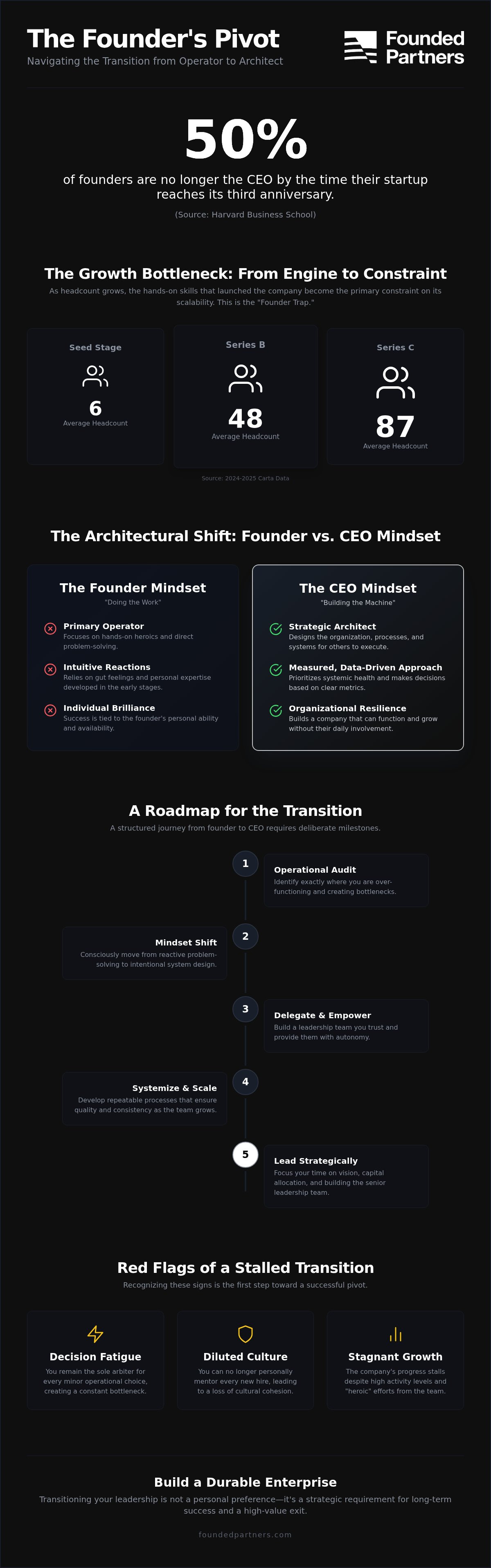
By the time a startup reaches its third anniversary, 50% of founders are no longer the CEO. This statistic from Harvard Business School isn't necessarily a reflection of failed vision, but rather a failure to navigate a fundamental architectural shift. You likely feel the weight of this reality every day. The hands-on heroics that built your company from a small team to over 50 people now act as a bottleneck, stalling growth and eroding the culture you worked so hard to establish. It's common to feel a growing anxiety as investors look for professionalized leadership ready for the complexities of Series C and beyond.
We understand that you don't need a cheerleader; you need a strategic partner. Through specialized founder to CEO transition coaching, you can master the pivot from primary operator to the architect of a durable organization. We promise to provide a clear roadmap that helps you reclaim your time and lead with renewed composure. This article outlines a proven framework for delegation, the psychological shift required to let go of daily operations, and the specific strategies needed to scale your leadership as your headcount grows toward 100 people and beyond.
Key Takeaways
- Identify the "Founder Trap" where your personal involvement shifts from a growth driver to a primary operational bottleneck.
- Learn to transition your mindset from intuitive, hands-on reactions to a measured, data-driven approach that prioritizes systemic health.
- Master the architectural shift through founder to CEO transition coaching, moving from a primary operator to a strategic leader of people and processes.
- Execute a structured five-step roadmap that begins with a comprehensive operational audit to identify exactly where you're over-functioning.
- Connect your personal leadership evolution to broader operations optimization to build a durable enterprise ready for Series C and future exit planning.
Beyond the 'Founder Trap': Why the Skills That Built the Business Can Stall Its Growth
Every founder eventually reaches a ceiling where their personal involvement becomes the primary constraint on growth. This is the "Founder Trap." It occurs when the very grit and technical mastery that launched the company begin to limit its scalability. You transition from being the engine of the business to its bottleneck. The emotional friction of letting go is real, but staying tethered to every operational detail prevents the organization from maturing.
The shift required is fundamental; you must move from "doing the work" to "building the machine that does the work." This inflection point typically peaks during the transition from Series A to Series B. According to 2024-2025 Carta data, average startup headcount grows from six people at the Seed stage to 48 at Series B. This rapid expansion triggers a predictable leadership crisis within the organizational life cycle, where traditional founder habits, like micromanaging product details or making every final decision, begin to fail. Recognizing this as a structural milestone rather than a personal failure is the first step toward a successful pivot.
The Paradox of the Successful Founder
Your original "superpowers" often become your greatest liabilities. Individual brilliance is sufficient when a team is small, but it cannot replace organizational resilience as you scale toward 87 people at Series C. When you are the only person who can solve a specific problem, you haven't built a business; you've built a job that you cannot leave. Red flags of a stalled transition include:
- Decision fatigue from being the sole arbiter of every minor operational choice.
- A dilution of company culture as you can no longer personally mentor every new hire.
- Stagnant growth despite high activity levels and "heroic" efforts across the team.
Why 'Founder to CEO Transition Coaching' is a Strategic Requirement
Transitioning your role isn't a matter of personal preference; it's a structural business move. Engaging in founder to CEO transition coaching allows you to move from reactive firefighting to intentional strategic architecture. This evolution is vital for maintaining investor confidence. As headcounts rise, stakeholders look for a steady hand capable of navigating complex transformations rather than a leader who is still operating in a state of constant urgency.
Professional leadership advisory provides the psychological security and operational framework needed to delegate effectively. It's about refining your character and your systems simultaneously. By strengthening your ability to design the organization rather than just run it, you ensure the enterprise is built for durability and a potential high-value exit. Master the founder to CEO transition coaching process to ensure your company outgrows its dependence on your daily presence.
The Architectural Shift: Moving from Primary Operator to Strategic Architect
The role of a CEO is fundamentally different from that of a founder. While a founder is often defined by their ability to build a product, a CEO is defined by their ability to build an organization. This shift is not merely a change in title; it is a structural business move that requires deliberate planning. Successfully making the founder-to-CEO transition means you are no longer the primary operator of the business. Instead, you become its strategic architect, drawing the blueprints for how the enterprise functions, scales, and survives.
This evolution requires a conscious move from "over-functioning" to "empowering." Over-functioning occurs when you step in to solve problems yourself because it feels more efficient in the short term. However, this habit creates a culture of dependency that stalls growth. Engaging in founder to CEO transition coaching allows you to identify these operational bottlenecks and replace them with a posture of calm expertise. You become the steady hand that guides the organization through rapid scaling, ensuring the C-suite operates with autonomy rather than waiting for your permission.
Designing the Organizational Foundation
True leadership advisory treats Operations Optimization as a critical leadership function. As you scale, you must build a management layer that doesn't require your daily input to remain productive. Your focus moves from the "what" of daily tasks to the "how" of organizational health. This includes designing communication loops and accountability frameworks that maintain your company culture even as headcount grows beyond your direct span of control.
The Three Pillars of the Strategic CEO
To lead effectively through the complexities of Series C and beyond, you must master three specific domains. These pillars form the foundation of your new role and ensure the enterprise remains durable:
- Visionary Alignment: You ensure every team member understands the long-term destination and their specific role in reaching it.
- Capital Strategy: You manage the financial resources and investor relationships necessary to fuel expansion.
- Talent Architecture: You focus on putting the right people in the right seats, ensuring the team's skills evolve with the company's needs.
By focusing on these architectural elements, you master the founder to CEO transition coaching journey, moving from the stress of daily operations to the clarity of strategic leadership.
Founder vs. CEO: Comparing Mindsets and Operational Frameworks
The founder mindset is fueled by urgency; the CEO mindset is sustained by order. In the early days, being scrappy and hands-on is a necessary survival mechanism. However, as the enterprise matures, these traits can become liabilities that restrict organizational health. This tension is famously explored in The Founder's Dilemma, where the desire for personal control often clashes with the requirements for sustainable growth. Transitioning from a founder to a CEO involves a fundamental shift in how you process information, interact with your team, and measure your own success.
Decision-making must evolve from intuition-based reactions to data-driven strategies. While your "gut feeling" served you well during the seed stage, it is insufficient for managing a Series B organization with 50 or more employees. Communication also changes. You move from "directing" daily tasks to "influencing" outcomes through culture, vision, and shared values. Professional founder to CEO transition coaching provides the psychological security and strategic framework to navigate this evolution without losing the spirit that built the company.
The Decision-Making Matrix
A CEO's primary output is clarity, not activity. You must stop making every decision and start defining the criteria for how those decisions are made. Empowerment is the act of delegating the right to fail. By utilizing business scalability consulting, you can design frameworks that allow your leadership team to operate with autonomy. This shift reduces your operational stress and ensures the organization can function without your constant intervention or approval.
From Generalist to Specialist in Leadership
The "Swiss Army Knife" identity is vital for a founder, but it is detrimental for a CEO. You must shed the habit of being a generalist and focus on the one or two areas where you add unique, irreplaceable value. This often involves identifying gaps in your leadership team and knowing when to bring in a Fractional COO to bridge the gap. Mastering founder to CEO transition coaching requires you to refine your role until you are working on the business, rather than merely in it.
To begin this shift, perform a weekly schedule audit. Categorize every hour spent into three distinct buckets:
- Operator: Tasks others could do, such as approving small expenses or troubleshooting technical details.
- Manager: Supporting your direct reports, removing blockers, and refining workflows.
- Architect: Designing systems, setting long-term strategy, and building a durable culture.
A successful transition requires moving at least 70% of your time into the "Architect" bucket to ensure the enterprise remains resilient through its next stage of growth.
A Roadmap for the Transition: 5 Key Milestones in the Journey
The evolution from founder to CEO is not a single event, but a methodical series of architectural shifts. It requires a disciplined commitment to redesigning your role while simultaneously strengthening the enterprise. This journey is characterized by five distinct milestones that move you away from the center of daily operations and toward the helm of strategic leadership. By following this roadmap, you ensure the organization remains stable as you master the founder to CEO transition coaching process.
Milestone 1-2: Internal Reflection and Vision
The journey begins with an Operational Audit. This phase requires a high degree of self-awareness to identify exactly where you are currently over-functioning. You must pinpoint the specific tasks, approvals, and meetings where your involvement has become a bottleneck rather than an accelerant. Once these bottlenecks are identified, you can move to Milestone 2: Defining the Vision. A CEO's primary duty is to clarify the long-term destination for the entire team. This involves setting a 3-year vision that is robust enough to survive your daily absence from the front lines.
During these early milestones, the role of a leadership coach is critical. They act as a neutral, strategic peer who challenges your assumptions and helps you develop the steady hand required for Series B and beyond. This internal reflection is the necessary foundation for the external changes that follow. It's about moving from a reactive state to one of intentional strategic architecture, ensuring you have the mental clarity to lead through increasing complexity.
Milestone 3-5: External Execution and Governance
Milestone 3 focuses on Building the Executive Layer. At this stage, you must hire for your weaknesses rather than your strengths. If you're a product-focused founder, your first major hires should be experts in operations or finance who can manage the details you need to delegate. Milestone 4 involves Implementing Governance. This means setting up boards and reporting structures that drive accountability across the organization. Utilizing sophisticated founder board management strategies allows you to turn governance into a tool for strategic leverage rather than a mere compliance exercise.
The final milestone is Scaling Through Systems. This is the point where the culture shifts from being founder-led to being values-led. You move from managing people directly to managing the systems that guide those people. This creates a durable foundation that is attractive for future capital raising or an eventual exit. If you are ready to begin this structured evolution, our leadership advisory services can provide the roadmap and partnership you need to navigate these milestones with confidence.
Leadership Advisory at Founded Partners: Building the Foundation for Your Next Act
At Founded Partners, we don't view leadership in a vacuum. We operate as the Strategic Architect for founder-led firms, recognizing that the health of the leader and the health of the enterprise are inextricably linked. Our approach to founder to CEO transition coaching isn't just about personal development; it's a critical component of a broader business transformation. We work to ensure that as you evolve, your organization's systems, governance, and culture evolve alongside you. This holistic perspective turns a potentially turbulent shift into a structured period of value creation.
Transitioning your role is the ultimate act of operations optimization. By refining your focus, you allow the business to build the internal resilience it needs to thrive without your constant intervention. We focus on long-term enterprise value, ensuring that your company is not just growing, but is fundamentally exit-ready. Whether your goal is a future acquisition or preparing for the rigors of Series C, the foundation you build now determines the ceiling of your success. We invite you to join us for a confidential briefing to assess your current transition readiness and identify the strategic pivots required for your next act.
A Partnership Based on Shared Values
We believe that high-stakes leadership requires more than just a consultant; it requires a trusted peer. As a boutique advisory led by partners Adam and Matt, we provide the grounded empathy and seasoned mentorship that traditional, large-scale consultancies often lack. We've seen the pitfalls of rapid growth and understand the psychological weight of investor expectations. This architectural evolution is the prerequisite for any successful exit planning for founders. If the organization cannot function independently of its creator, its market value remains capped. We help you bridge that gap by strengthening both your character and your company's structural integrity.
Your Next Stage of Growth
The journey from founder to CEO is the bridge to your company's maturity. Our engagement model is designed to support you through complex milestones, providing the capital raising support and scalability strategy needed to secure your legacy. We help you move beyond the "founder trap" to build a resilient organization that lasts well beyond your daily tenure. This isn't just about changing how you work; it's about refining the enterprise into a durable, high-performing machine. If you're ready to master this pivot and reclaim your strategic focus, it's time to Schedule a strategy session with Founded Partners.
Building the Architecture for Your Series C Legacy
The transition from founder to CEO is the most significant structural redesign you'll ever undertake. It requires moving from the frantic energy of a primary operator to the measured, long-term perspective of a strategic architect. By auditing your operational involvement and building a robust executive layer, you ensure the organization remains durable through rapid scaling. You don't have to navigate this complex identity shift alone.
Through intentional founder to CEO transition coaching, you can successfully master the pivot from intuition-based decisions to systemic governance. Founded Partners provides partner-led advisory for Series A+ founders, offering global expertise in business transformation and capital strategy. We focus on the health of the organization and the clarity of its leader to ensure you're ready for Series C and beyond.
Refine your leadership and build a durable foundation with Founded Partners. Your enterprise's potential is no longer limited by your personal capacity; it's fueled by your strategic vision.
Frequently Asked Questions
What is the primary difference between a founder and a CEO?
A founder is primarily an innovator and a doer who brings a vision to life through tactical heroics. In contrast, a CEO is the strategic architect of the enterprise. The CEO role focuses on designing systems, refining culture, and ensuring long-term sustainability. This shift requires moving from "doing the work" to "building the machine that does the work." It's a fundamental change in identity that prioritizes organizational health over individual technical brilliance.
When is the right time to start founder to CEO transition coaching?
The optimal time to engage in founder to CEO transition coaching is typically during the Series A to Series B inflection point. This usually occurs when your headcount reaches 20 to 50 employees and your direct span of control begins to fail. You'll notice that the informal communication styles of the early days no longer sustain the company's growth. Starting this process early ensures you build the necessary management layer before operational bottlenecks become critical.
Can a founder remain CEO through an IPO or large acquisition?
Founders can lead through an IPO or acquisition, provided they evolve their operational frameworks. Success at this level depends on shedding the "Swiss Army Knife" mentality and focusing on capital strategy and visionary alignment. Many high-performing S&P 1500 companies are led by founders who successfully professionalized their leadership. The transition isn't about stepping aside; it's about stepping up into a role that manages the organization's architecture rather than its daily tasks.
How does leadership coaching impact the valuation of my company?
Leadership advisory directly impacts valuation by reducing key-man risk and demonstrating organizational maturity. Investors and acquirers look for businesses that can thrive independently of the founder's daily presence. When you implement professional governance and a durable management layer, you create a more resilient asset. This structural integrity increases investor confidence during capital raising and ensures the company is exit-ready by proving it can maintain performance through ownership changes or leadership transitions.
What are the first signs that a founder is becoming a bottleneck?
Red flags include constant decision fatigue, a growing backlog of approvals, and a team that feels hesitant to act without your explicit permission. You might find yourself in every minor meeting or troubleshooting technical problems that your managers should handle. If the business cannot scale because you are the sole arbiter of operational choices, you've become a bottleneck. This over-functioning prevents your leadership team from developing the autonomy required for a successful Series C expansion.
How does a CEO transition impact the company culture?
A successful transition matures the culture from a founder-led environment to a values-led organization. In the early stages, culture is often maintained through personal proximity to the founder. As you scale, this becomes impossible. By shifting your role to a strategic architect, you design the communication loops and accountability frameworks that keep the culture intact. This evolution empowers your team and builds a sense of collective ownership that is essential for maintaining organizational resilience at scale.
Does every founder need an executive coach to become a CEO?
Most founders assume the CEO role by default, yet few have a playbook for the structural demands of a growing enterprise. While not mandatory, founder to CEO transition coaching provides a neutral, strategic partnership that accelerates your evolution. It helps you navigate the psychological friction of letting go while providing a roadmap for operations optimization. This advisory is a strategic investment in your ability to lead through the increasing complexities of business transformation and capital raising.
How do I explain this transition to my board and investors?
Frame the transition as a proactive move toward professionalization and scalability. Board members and investors value leaders who recognize their own growth areas and prioritize the company's durability. Explain that you are engaging in leadership advisory to build the structural foundation needed for Series C and future exit planning. This signals to stakeholders that you are committed to building a resilient organization that can attract the right capital and navigate the rigors of rapid expansion.