
Strategic Roadmap for Founders: Blueprint for Success

The most successful enterprises aren't built on the back of relentless hustle, but through the quiet discipline of structural design. Many leaders find themselves trapped in the friction of daily execution, where every operational bottleneck requires their personal intervention. If you feel stuck in the weeds of tactical firefighting, you're likely the primary constraint on your own growth. A robust strategic roadmap for founders is the bridge between a business that relies on your presence and an organization that possesses inherent, independent durability.
It's natural to feel the weight of uncertainty when you look toward a future funding round or an eventual exit. We understand that the transition from founder to strategic architect requires more than just a change in title; it requires a fundamental shift in how you view your role. This guide provides a clear framework for decision-making that removes you from the center of every crisis. You'll learn how to refine your operations, strengthen your leadership, and build an enterprise with the clarity and value required for a truly successful transition.
Key Takeaways
- Learn to differentiate between a tactical to-do list and a strategic architectural blueprint to address foundational cracks before they stall growth.
- Discover how a strategic roadmap for founders integrates operational optimization with capital strategy to ensure long-term investor readiness.
- Move beyond simple prioritization models to focus on enterprise durability, ensuring your organization can thrive without your constant intervention.
- Audit your personal dependencies to facilitate a smooth transition from founder to CEO through structured leadership advisory.
- Align your current operations with exit readiness to bridge the gap between a functional business and a high-value, transaction-ready asset.
The Founder’s Dilemma: Why Most Strategic Roadmaps Fail
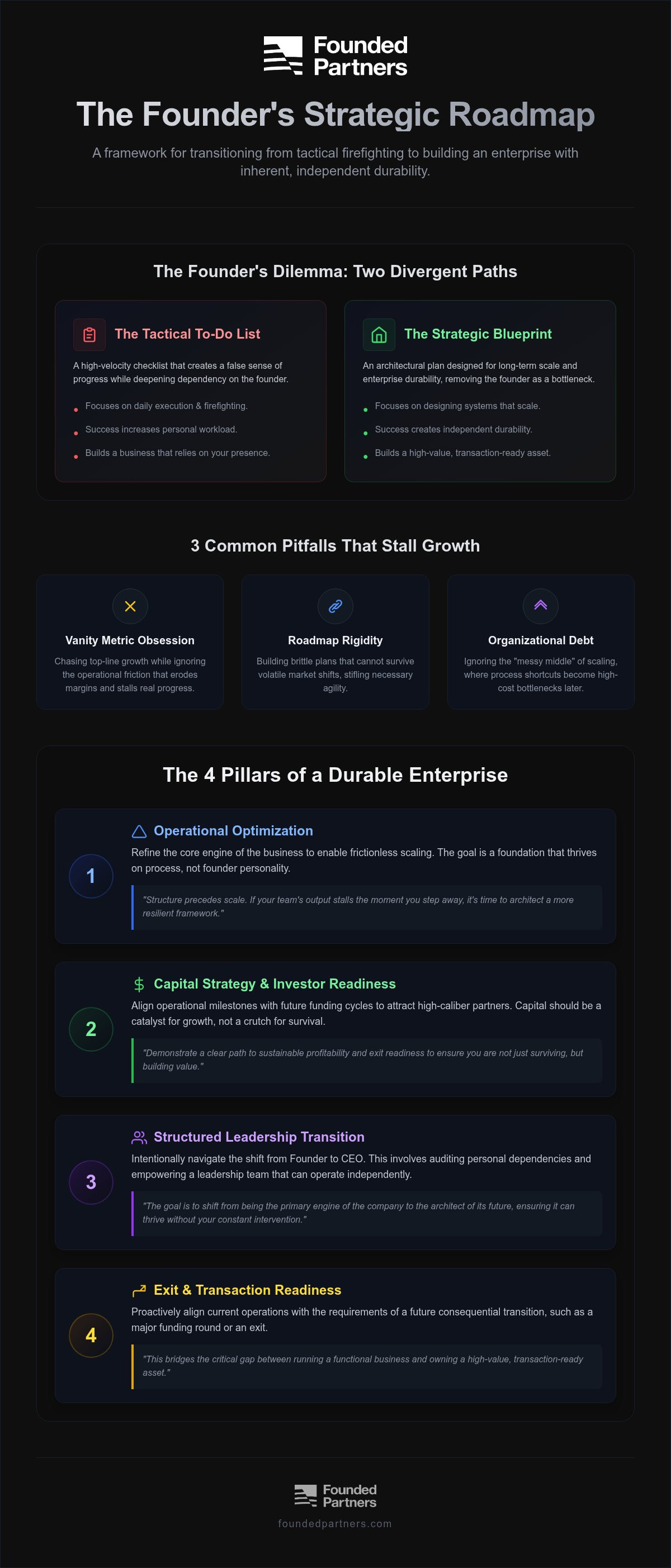
Many founders mistake a high-velocity to-do list for a genuine strategy. While checking off tasks provides a temporary sense of progress, it often fails to build the structural integrity required for long-term scale. A true strategic roadmap for founders isn't just a timeline of activities; it's an architectural blueprint designed to ensure enterprise durability. Without this foundation, rapid growth acts as a stress test that exposes hidden cracks in your operations. This often leads to the "Founder's Trap," where success only increases your personal workload and deepens your involvement in daily execution.
This dilemma stems from a focus on tactical execution over strategic architecture. When you prioritize surviving the next quarter, you inadvertently build a business that's entirely dependent on your presence. The goal must shift from simply running a company to building an asset that possesses inherent value, regardless of your daily intervention. This requires a transition from firefighting to designing systems that scale with ease.
The Difference Between Planning and Strategy
Planning focuses on the "what" and the "when," but strategy addresses the "why" and the "how." Many organizations engage in strategic planning without ever defining their Strategic North Star. This lack of direction turns a roadmap into a collection of expensive hopes rather than a focused path to value. Identifying this North Star allows you to filter out noise and concentrate resources on high-leverage activities. A strategic roadmap for founders is the essential bridge between a visionary intent and the creation of tangible enterprise value.
Common Pitfalls in Founder-Led Planning
Even well-intentioned founders often fall into predictable patterns that compromise their organization's health. These pitfalls include:
- Vanity Metric Obsession: Prioritizing top-line growth or user acquisition while ignoring the operational friction that erodes margins and stalls real progress.
- Roadmap Rigidity: Building plans that are too brittle to survive volatile market shifts. A strategic roadmap should be a living document that guides direction without stifling agility.
- Organizational Debt: Ignoring the "messy middle" of scaling. Every shortcut taken in process design today becomes a bottleneck you'll have to solve at a much higher cost tomorrow.
By recognizing these traps early, you can stop reacting to the market and start architecting your exit readiness with a steady hand.
The Four Pillars of the Strategic Roadmap for Founders
The architecture of an enterprise determines its destiny. While many roadmaps focus on short-term startup sprints, a truly effective strategic roadmap for founders prioritizes long-term enterprise durability. This requires a shift from the frantic energy of survival to the measured, intentional pace of business building. By focusing on four specific pillars, you can transform a high-performing company into a transaction-ready asset that functions independently of your daily intervention.
Operational Optimization as a Foundation
Structure precedes scale. For many organizations, growth is often hindered by founder heroics, where the leader acts as the primary engine for every critical process. This creates a ceiling that no amount of effort can break. Operational optimization involves refining the core engine, identifying hidden bottlenecks, and strengthening the systems that allow for frictionless scaling. It's about building a foundation that thrives on process rather than personality. If you find that your team's output stalls the moment you step away, it's time to consider business scalability consulting to architect a more resilient framework.
Capital Strategy and Investor Readiness
Capital should be a catalyst for growth, not a desperate crutch for survival. A strategic roadmap for founders must align every operational milestone with future funding cycles or investor expectations. In a landscape where SBA variable-rate ceilings can reach 13.25%, understanding the nuances of the SBA's guide to business planning is just the first step. You must demonstrate a clear path to sustainable profitability and exit readiness to attract high-caliber partners. Integrating capital raising for founders into your long-term plan ensures that you aren't just chasing the next check, but rather building a narrative of consistent value creation.
The final two pillars involve leadership evolution and exit readiness. True leadership advisory helps you manage the psychological and organizational shift from being a founder-led firm to a professionally managed enterprise. Simultaneously, embedding value-drivers into every strategic milestone ensures that your business remains attractive to potential acquirers at every stage of growth. If you're ready to move from tactical execution to strategic architecture, partnering with a strategic advisor can provide the steady hand and calm expertise needed for this transition.
Beyond the 'Rocks': Building for Enterprise Durability
The "Rocks and Pebbles" framework is a staple of startup productivity. It teaches that if you place your big goals first, the smaller tasks will naturally fill the gaps. While this is an effective tool for managing a busy quarter, it often lacks the strategic depth required to build a legacy. Prioritization alone isn't enough to ensure long-term success. A strategic roadmap for founders must move beyond simple task management to become a deliberate plan for enterprise durability. Efficiently completing the wrong tasks only accelerates the path to a foundational crisis.
Adopting a Strategic Architect approach means prioritizing durability over raw speed. In many growth-obsessed environments, speed is a vanity metric that masks structural weakness. True durability is found in systems that are reliable, scalable, and independent. When you evaluate your quarterly "Rocks," you must measure their impact on the organization's ultimate value. Every initiative should be filtered through a simple question: does this strengthen the architectural integrity of the business, or does it merely add more weight to a fragile foundation? Balancing short-term delivery with long-term structural needs is the hallmark of a seasoned leader.
Defining Enterprise Durability
Enterprise durability is the ability of a business to function and grow independently of its founder. This trait is the primary driver of attractiveness for institutional investors and potential acquirers. They aren't just buying your current revenue; they're buying the certainty that your engine will continue to run once you've exited the vehicle. Resilience is built into the roadmap by ensuring every milestone strengthens the organization's ability to withstand market volatility, talent shifts, and leadership transitions. A durable business is one that possesses its own character, momentum, and value.
Measuring Business Transformation Success
Traditional KPIs often fail to capture the nuances of structural change. To understand the true health of your operational foundation, you must move beyond surface-level metrics to transformation milestones. This involves measuring business transformation success through the lens of system maturity and organizational health. By tracking how well your team adopts new frameworks and how effectively your processes handle increased volume, you gain a clearer picture of your readiness for scale. A strategic roadmap for founders serves as the benchmark for these transitions, providing a clear view of where the organization stands on its journey toward independence and value.
Execution: Navigating the Founder-to-CEO Transition
Execution isn't just about doing more; it's about doing less of the wrong things. The transition from founder to CEO is perhaps the most significant structural change an organization undergoes. It requires a methodical approach, a steady hand, and a clear vision. A strategic roadmap for founders serves as the blueprint for this evolution, breaking a complex leadership shift into manageable, repeatable phases. This process ensures that the durability we've discussed becomes a functional reality rather than a theoretical goal.
The journey follows four distinct phases. Phase 1 begins with a rigorous audit of your current involvement. You must identify "founder-only" dependencies where decision-making grinds to a halt without your input. Phase 2 involves implementing leadership advisory to manage the inevitable friction of organizational change. In Phase 3, you empower your leadership team through clear strategic delegation, moving from "doing" to "directing." Finally, Phase 4 marks your arrival as the Strategic Architect, where your primary focus shifts to long-term visionary goals and enterprise health.
The Role of Leadership Advisory
Founders often lack a "Trusted Peer" who can provide objective perspective during the psychological shift of scaling. Transitioning from a hands-on builder to a strategic leader is emotionally taxing and operationally complex. Leadership advisory provides the security needed to navigate these consequential transitions of leadership and ownership. It helps you build a culture of accountability that doesn't crumble the moment you step out of the room. If you're ready to step out of the weeds and into a visionary role, our leadership advisory services can guide your transition with calm expertise.
Scaling Without Losing Culture
Rapid expansion often threatens the very values that made the company successful. Your strategic roadmap for founders acts as a vital communication tool, ensuring every new hire understands the core mission. Transparent, value-aligned leadership is the only way to scale without losing the organization's soul. By codifying your core values into the roadmap, you ensure that culture remains a driver of value rather than a casualty of growth. This clarity allows your team to make decisions that align with your vision, even when you aren't in the meeting.
Preparing for Consequential Transitions: The Ultimate Goal
The ultimate measure of an enterprise's strength is its readiness for a consequential transition. Whether you're preparing for a significant capital event or an eventual exit, the foundation you build today determines the options you have tomorrow. A strategic roadmap for founders shouldn't be viewed as a static document for internal alignment; it's a dynamic tool for value creation. By architecting your organization with the end in mind, you bridge the gap between a high-performing business and a transaction-ready asset that commands a premium.
Exit Planning as a Strategic Discipline
Exit planning isn't an event that happens at the end of a journey. It's a strategic discipline that should inform every operational decision from the early stages of growth. Strategic acquirers look for specific value drivers: recurring revenue, diversified customer bases, and a leadership team that can thrive without the founder. By integrating exit planning for founders into your roadmap, you ensure that every milestone reached is a step toward greater enterprise value. This proactive approach allows you to negotiate from a position of strength rather than necessity.
Navigating these transitions requires more than just technical skill; it requires the perspective of someone who has walked the path before. At Founded Partners, our boutique approach is led by seasoned partners who understand the nuances of business transformation and transaction consulting. We provide the capital raising support, operations optimization, and strategic clarity needed to prepare your firm for the next stage of growth. A well-architected strategic roadmap for founders ensures that when the time comes for a transition, the organization is resilient, durable, and ready.
Next Steps: From Roadmap to Reality
Moving from a visionary roadmap to a functional reality is a process of constant refinement. It requires the discipline to address foundational cracks, the patience to build scalable systems, and the courage to delegate operational control. A boutique advisory firm serves as a trusted peer, helping you navigate the complexities of scaling while preserving your core values. This partnership allows you to step into your role as a Strategic Architect, focusing on the high-level decisions that drive long-term sustainability. If you're ready to transform your organization into a durable asset, connect with Founded Partners to architect your strategic roadmap and secure your legacy.
Architecting Your Enterprise Legacy
Transitioning from the daily friction of tactical execution to the role of a strategic architect is a deliberate, necessary choice for sustainable growth. It requires moving beyond simple quarterly goals to build a foundation that supports frictionless scaling and long-term durability. By refining your operational core and aligning your growth with future capital requirements, you ensure your organization becomes a valuable, independent asset rather than a personal burden. A comprehensive strategic roadmap for founders provides the essential clarity needed to navigate these consequential transitions with confidence and poise.
Founded Partners provides a boutique advisory experience led by seasoned partners who specialize in founder-led business transformation. We bring a proven track record in capital raising and exit planning to help you bridge the gap between current performance and future readiness. Our focus remains on strengthening your foundation so you can step into a visionary leadership role without fear of operational collapse. Partner with Founded Partners to build your strategic roadmap and transform your enterprise into a transaction-ready reality. Your organization has the potential to thrive far beyond your personal intervention; it's time to build the structure that makes that possible.
Frequently Asked Questions
What is the difference between a business plan and a strategic roadmap for founders?
A business plan often serves as a static document intended for external stakeholders or compliance. In contrast, a strategic roadmap for founders is a dynamic architectural blueprint focused on internal execution and long-term enterprise durability. It bridges the gap between your visionary intent and the operational reality of your firm. While a plan describes what the business is, the roadmap defines how it will evolve independently of your personal intervention.
How often should a founder-led business update its strategic roadmap?
A founder-led business should treat its roadmap as a living document. You should review tactical milestones every quarter to ensure the team remains aligned with immediate goals. However, the broader strategic architecture requires a deeper assessment annually or during significant market shifts. This rhythm allows you to maintain a steady hand on the rudder while remaining agile enough to navigate the volatile landscape of rapid growth without losing sight of your North Star.
Who should be involved in the strategic planning process?
Effective planning requires a balance of visionary leadership and operational reality. You should involve your core leadership team to ensure buy-in and accountability across the organization. Additionally, engaging a strategic advisor or a "Trusted Peer" provides the objective perspective needed to identify foundational cracks you might miss. This collaborative yet disciplined approach ensures that your strategic roadmap for founders is rooted in both high-level ambition and practical, scalable systems.
Can a strategic roadmap help with raising Series A or B capital?
Institutional investors look for more than just top-line growth during Series A or B rounds. They seek evidence of operational maturity and a clear path to sustainable profitability. A well-architected roadmap demonstrates that you've built a durable engine capable of absorbing new capital without collapsing. By showing how your systems handle increased volume, you increase your enterprise value and prove that your organization is ready for the rigors of institutional investment.
How do I know if my business foundation is strong enough to scale?
The primary indicator of a strong foundation is the ability of the organization to function without your direct involvement. If a one-week absence causes operational bottlenecks or halts decision-making, your foundation isn't yet ready for scale. You must audit your processes to identify "founder-only" dependencies. A scalable business is one where the systems, rather than the founder's heroics, drive the daily engine and ensure consistent delivery to your clients and partners.
What are the first signs that a founder needs a strategic advisor?
The first signs often manifest as a feeling of being stuck in tactical firefighting. You might notice that despite working harder, growth has plateaued or operational friction has increased. Another key indicator is the psychological weight of making every consequential decision alone. When the complexity of scaling begins to outpace your current organizational structure, it's time to seek the calm expertise of an advisor who can help architect your next stage of growth.
How does a roadmap help with exit planning if I'm not ready to sell yet?
Exit planning is most effective when it begins years before you intend to leave. A roadmap allows you to embed value-drivers into your daily operations today. By focusing on enterprise durability and founder independence now, you transform your business into a transaction-ready asset. This preparation gives you the luxury of choice, allowing you to exit on your own terms when the right strategic opportunity arises rather than being forced by burnout or plateaued growth.
What is the most common mistake founders make during the planning process?
The most frequent error is confusing a high-velocity to-do list with a genuine strategy. Founders often over-index on vanity metrics like user acquisition while ignoring the organizational debt accumulated during early scaling. They build rigid plans that lack the structural flexibility to survive market volatility. True strategic planning requires you to step back from the "what" and "when" to focus on the "how" and "why" of building a durable, independent enterprise.