
How Good Companies Slowly Drift Into Failure Without Noticing
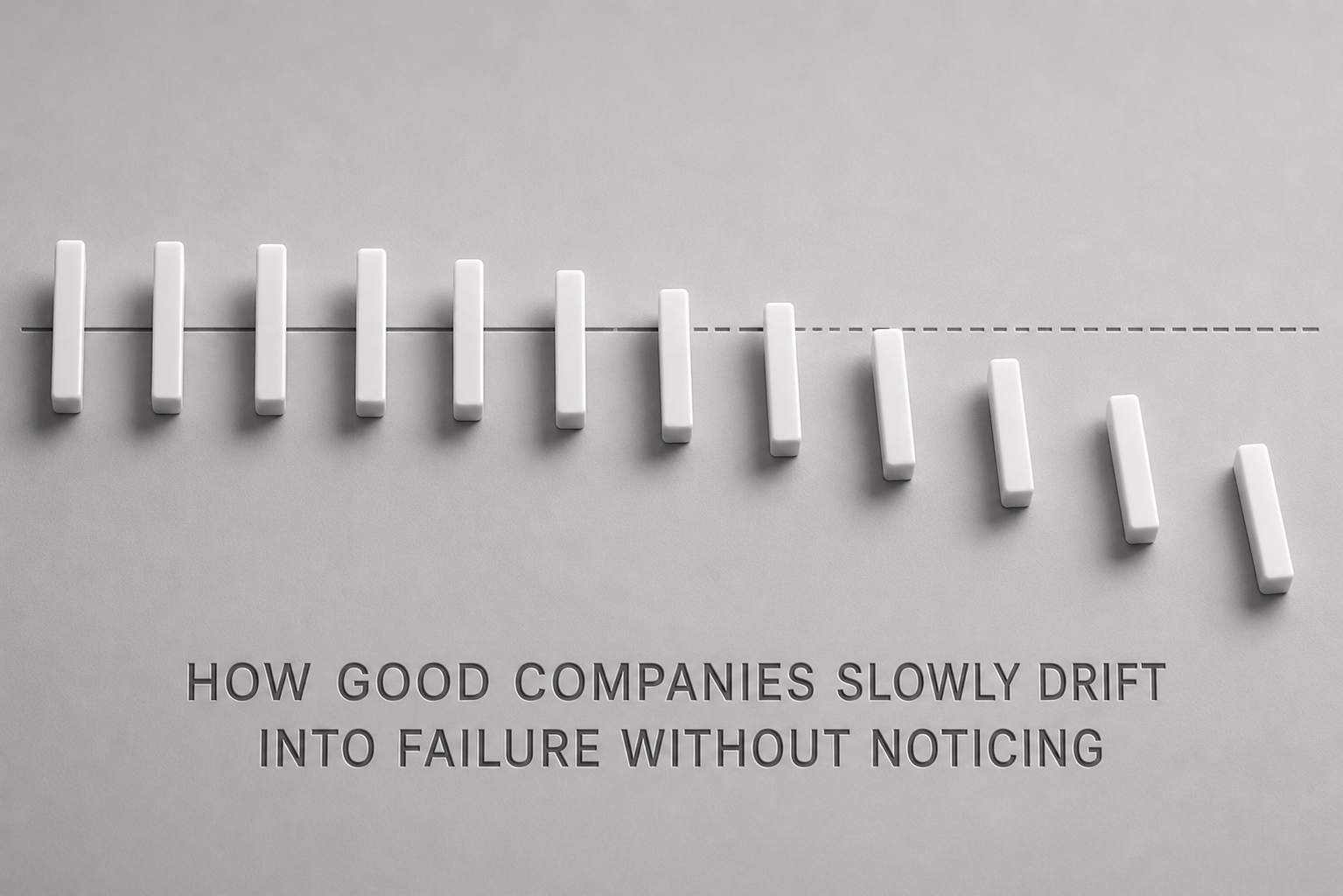
In 1975 a young engineer at Kodak named Steven Sasson built the first digital camera, a toaster sized contraption that wrote images to a cassette tape, and Kodak patented it. Over the following decades Kodak did not ignore digital photography the way the legend suggests. They developed it, held a deep portfolio of patents, and for a stretch in the early 2000s were among the top sellers of digital cameras in the world. They were not blind and they were not incompetent. And in 2012 they filed for bankruptcy anyway. The interesting part of the Kodak story is not that they missed the future. It is that they saw it, owned it, and still drifted past it, because for thirty years the most rational move in any given quarter was to protect the enormously profitable film business in front of them. No single decision was the fatal one. The failure was assembled out of a long series of perfectly reasonable quarters.
This is the shape of the most dangerous failures. They are rarely sudden, they are slow, and they are built from small, defensible choices that each make sense at the time. The safety researcher Sidney Dekker calls this drift into failure, the gradual migration of a system toward the edge, caused not by recklessness but by normal, competent people responding sensibly to pressure one small step at a time, until the organization has quietly moved somewhere no one would ever have chosen to go on purpose. The cruelty of drift is that there is no alarm, because nothing big enough to set one off ever actually happens.
The engine underneath drift is a quiet recalibration of what counts as normal. Diane Vaughan named this normalization of deviance, the process by which something that would once have alarmed you becomes accepted simply because it happened and nothing immediately broke. The first time you miss the number it stings. The third time, it is just the number. Slowly the standard you originally set bends down to match the performance you are actually getting, instead of the performance climbing to meet the standard, and because you keep measuring today against last month rather than against the bar you first chose, the decline never registers as decline. It registers as the new normal.
Drift hides this well because the feedback that would expose it is slow, noisy, and easy to explain away. A strong quarter masks a weakening trend. A missed target arrives wrapped in a reason, the market, the timing, the one off, and the reason is often genuinely true. Each individual data point is deniable, so the pattern only becomes undeniable years later, by which point you are deep inside it. Combine that with the simple human tendency to adapt to whatever surrounds us, and you get an organization that has steadily lowered its own expectations without anyone ever consciously deciding to.
In a growing company drift wears ordinary clothes. It is the underperformer quietly tolerated for a year because letting them go is uncomfortable and they are not quite bad enough. It is the metric that has sat amber for so long it no longer reads as a problem. It is the definition of a good hire creeping down so gently that a B player surrounded by other B players starts to look like an A. It is the meeting everyone agrees is useless and everyone still attends. None of these feel like failure. Each one feels like a small, sensible accommodation to reality. That is precisely what drift is made of.
The genuinely hard part is that you cannot easily detect drift from inside it, because your own sense of normal is drifting at the same rate as everything else. The founder is the worst positioned person to notice, not the best, because you lived through every tiny adjustment and adapted to each one, so the cumulative distance between where you are and where you meant to be stays invisible to you. You did not lower the bar in one clear move. You lowered it a millimeter at a time, and a millimeter never looks like a decision.
The only reliable defense against drift is an external fixed reference point, something or someone standing outside the slowly moving baseline who can hold up the standard you originally set and ask, plainly, whether the version of you from two years ago would accept this. Drift is not solved by trying harder, because trying harder inside a drifted system only makes you more efficient at the wrong baseline. It is solved by re anchoring, by regularly comparing the present not to last month but to the goals and the standard you deliberately chose, before you grew accustomed to falling a little short of them.
This is one of the quiet reasons a steady outside relationship is worth far more than it looks, because an advisor who meets with you on a regular rhythm becomes the fixed point that does not drift along with you. Founder Advisory at Founded Partners is built around exactly that, a confidential weekly cadence with Adam Miron, a serial entrepreneur with three exits including a unicorn and a background in business psychology, that pairs honest strategic counsel with real accountability against the goals you actually set, so a slow slide gets caught while it is still a minor correction rather than a crisis. If your company is busy and profitable and yet something feels like it has quietly slipped, take that feeling seriously, because more often than not it is drift announcing itself before the numbers do.
See how Founder Advisory works at foundedpartners.com/founder-advisory, or explore the full range of what we do for founders across our services.