
Resilient vs Fragile: Why the Best Companies Plan to Fail Well
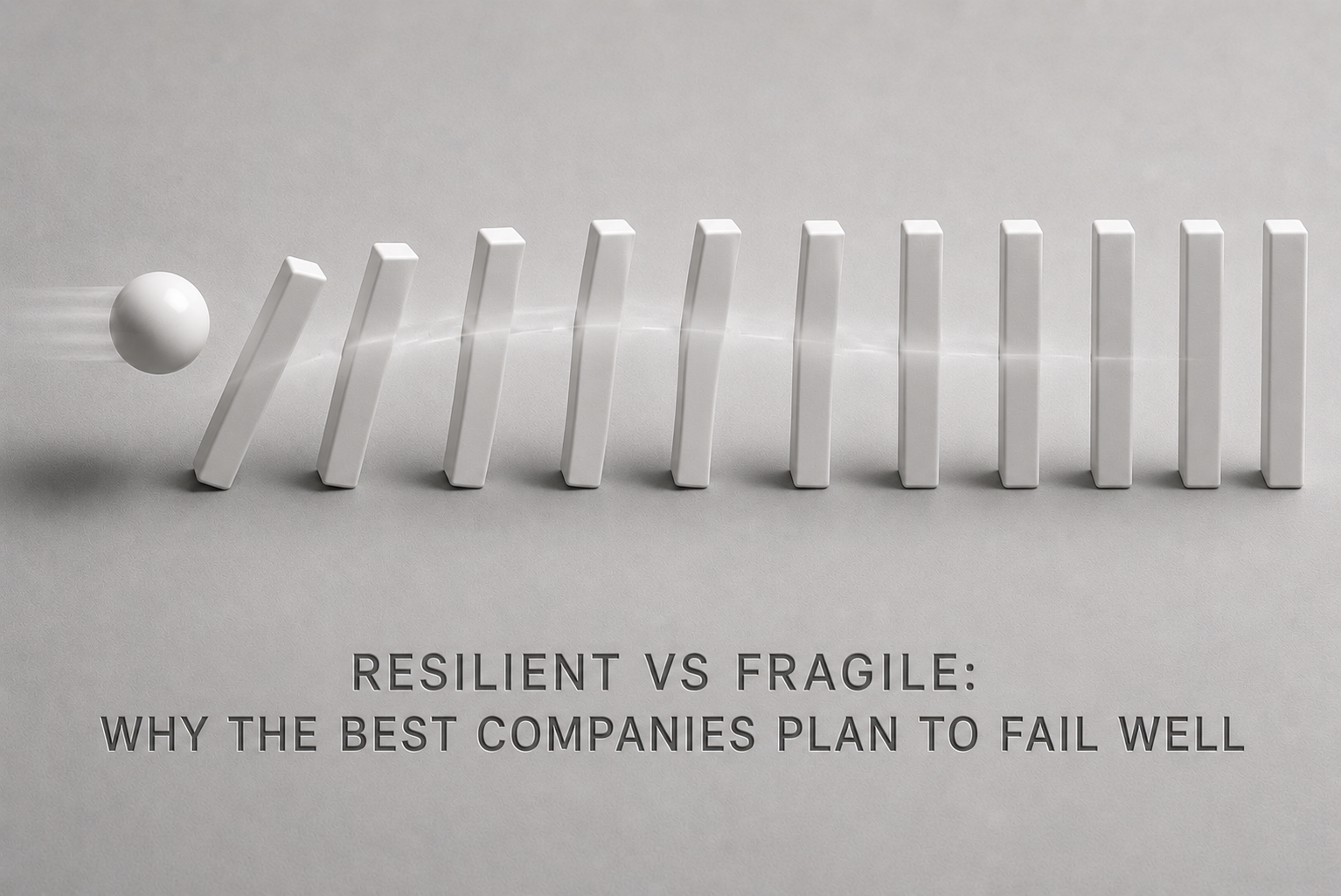
On a snowy morning in December 1974, TWA Flight 514 flew into a Virginia mountainside on its approach to Washington, killing everyone aboard, after a misunderstanding between the crew and air traffic control about how low they were cleared to descend. The detail that haunts the story is this. Just six weeks earlier, a United Airlines crew had made almost the identical mistake near almost the identical ridge, caught it in time, and reported the close call inside their own airline. The knowledge existed. It simply had nowhere to go, because in 1974 there was no way to share one airline's near miss with the rest of the industry. So a second crew flew into the mountain the first crew had only grazed.
The response to that crash is a large part of why you can board a plane today without a second thought. The industry built the Aviation Safety Reporting System, run by NASA as a neutral third party, where pilots, controllers, and crew can confidentially report their own mistakes and near misses without being punished for them, in exchange for limited immunity. More than two million reports later, it has become one of the quiet engines of the safest complex system humans have ever built. And notice what it actually does. It does not try to eliminate error. It assumes error is constant and builds a machine for catching the small ones before they grow into fatal ones. That is the real meaning of resilience, and it is almost the opposite of what most people assume.
Nassim Taleb draws a useful line between three kinds of systems. The fragile breaks under stress. The robust resists it. And the resilient, or in his stronger term antifragile, actually uses stress and small failures to get stronger. Most founders instinctively aim for robust, a company so tightly controlled that nothing ever goes wrong, but robustness is often brittleness in disguise, because a system that is never allowed to fail in small ways has no idea where it is weak, and it tends to discover its fault lines all at once, at the worst possible moment, at full scale. Resilience is not the absence of failure. It is the capacity to fail small, often, cheaply, and out loud, so that you never have to fail big.
This is why the real line between a resilient company and a fragile one is not how many problems they have, because they have roughly the same number. It is what happens in the minutes and days after something breaks. The fragile company is slow to notice, scrambles when it finally does, has no rehearsed way to respond, and burns its energy deciding who to blame. The resilient company sees the signal early because people are actually watching for it, has a practiced way to contain the damage, recovers quickly, and then mines the incident for everything it can teach. Same error, completely different outcome, and the entire difference lives in the recovery, not the avoidance.
The thing that quietly makes a company fragile is usually the founder's own relationship with failure. When every mistake is treated as a scandal to hide or a person to punish, you do not get fewer mistakes, you get better hidden ones, which are the most dangerous kind, because hidden errors keep growing in the dark until they surface all at once as a crisis. The customer complaint no one flagged becomes a churn problem. The product flaw no one wanted to own becomes a recall. The near miss everyone quietly stepped around becomes the thing that takes you down, exactly as it did for TWA 514. A founder who punishes the messenger is not buying safety. They are buying fragility and calling it high standards.
Building resilience is not about adding more controls, it is about changing how your company digests failure. It means making small failures genuinely safe to surface, so you hear about problems while they are still small. It means treating incidents as information rather than indictments, running honest reviews that ask what the system allowed rather than who to fire. It means rehearsing recovery instead of assuming you will improvise it well under pressure. And it means deliberately stress testing the business to find your fragile points before reality finds them for you, because a fault line you uncover on purpose, on a calm Tuesday, is infinitely cheaper than the one that uncovers you mid crisis.
Finding those fragile points is genuinely hard from the inside, because the weaknesses you have lived with longest are the ones you have stopped seeing, and the moments that test a company most, scaling quickly, raising capital, integrating an acquisition, are precisely the moments when hidden fragility tends to surface. Founder Advisory at Founded Partners is designed to pressure test your business before those moments do, a confidential relationship with Adam Miron, a serial entrepreneur with three exits including a unicorn and a background in business psychology, who helps you find where you are fragile, build the early signals and recovery habits that make a company resilient, and move through your hardest inflection points without flying blind. If your company looks strong but you are quietly unsure how well it would absorb a real shock, that is a question worth answering before the shock arrives.
See how Founder Advisory works at foundedpartners.com/founder-advisory, or read about the inflection points where this matters most.