
How to Build a Business That Can Run Without You

What if the business could keep moving when you weren’t in the room? If routine approvals, customer relationships, and important decisions still flow through you, stepping away can feel risky. Learning how to build a business that can run without you isn’t about disappearing or handing off responsibility before the company is ready. It’s about creating the conditions for consistent execution, even when you’re not involved in every decision.
It makes sense to be cautious. Delegation is difficult when roles, standards, and decision rights aren’t clear. But keeping every important call on your desk can limit your time and leave the business reliant on one person. The goal is to strengthen the company, not weaken its performance.
This article will help you identify where founder dependency is creating friction and reduce it deliberately. You’ll learn how to clarify ownership, strengthen leadership, document repeatable operations, and establish accountability. Together, these steps create a gradual, measurable path toward a business that can operate with greater confidence and resilience, while you remain engaged at the level the business needs.
Key Takeaways
- Spot approval bottlenecks, informal knowledge, and customer relationships that make the business too dependent on you.
- Learn how to build a business that can run without you by mapping key work, assigning clear owners, and documenting usable standards.
- Protect quality during delegation by setting decision boundaries and defining when an issue should come back to you.
- Use a staged transition plan to establish a baseline, test changes, and assess whether the business is becoming less founder-dependent.
- Recognize when internal improvements may not be enough and complex operational or leadership changes could benefit from an outside perspective.
How to Build a Business That Can Run Without You: Start With Founder Dependency
A business doesn’t become resilient simply because its founder takes a day away. A stronger test is whether routine work continues reliably without constant founder intervention. If every decision, customer issue, or exception must wait for you, the organization’s capacity is tied to your availability.
Founder-independent operations mean routine work has clear owners, usable methods, and escalation routes, while the founder retains the strategic and governance responsibilities the business still needs. This isn’t a promise of uninterrupted results or risk-free operations. It’s a deliberate way to make execution less dependent on one person.
What does it mean for a business to run without its founder?
It means people understand what they own, how recurring work should be done, and what to do when an issue falls outside the usual process. The founder may still set direction, make significant commitments, or oversee the company. The difference is that everyday execution doesn’t stall while waiting for their input.
This is where business process management offers a useful lens: consider how work is designed and carried out, not just who is doing it. A process is useful only if the people responsible can apply it and know when to escalate an exception.
Which signs reveal that the founder has become a bottleneck?
Look for patterns, not isolated moments. Does a customer concern routinely get escalated to you? Do team members wait for your approval on familiar purchases, pricing exceptions, or scheduling choices? Does work stop when you’re unavailable because key knowledge lives in your memory, or because a customer relationship belongs only to you?
For a practical diagnostic, review a representative period of work and list:
- Recurring decisions that need your approval, and why.
- Tasks only you know how to complete or check.
- Customer, supplier, or partner relationships where you’re the sole point of contact.
- Interruptions, delays, and rework caused by unclear ownership.
Then sort the list. Some decisions genuinely belong with the founder because they shape strategy or carry significant consequences. Others may stay with you through habit, uncertainty, or a lack of agreed standards. That distinction is the starting point for learning how to build a business that can run without you.
Stepping back isn’t abandoning responsibility. It’s designing oversight so the right people can act, issues reach you when they should, and the business can keep learning without routing every choice through its founder.
Build the Operating System: Transfer Knowledge, Decisions, and Accountability
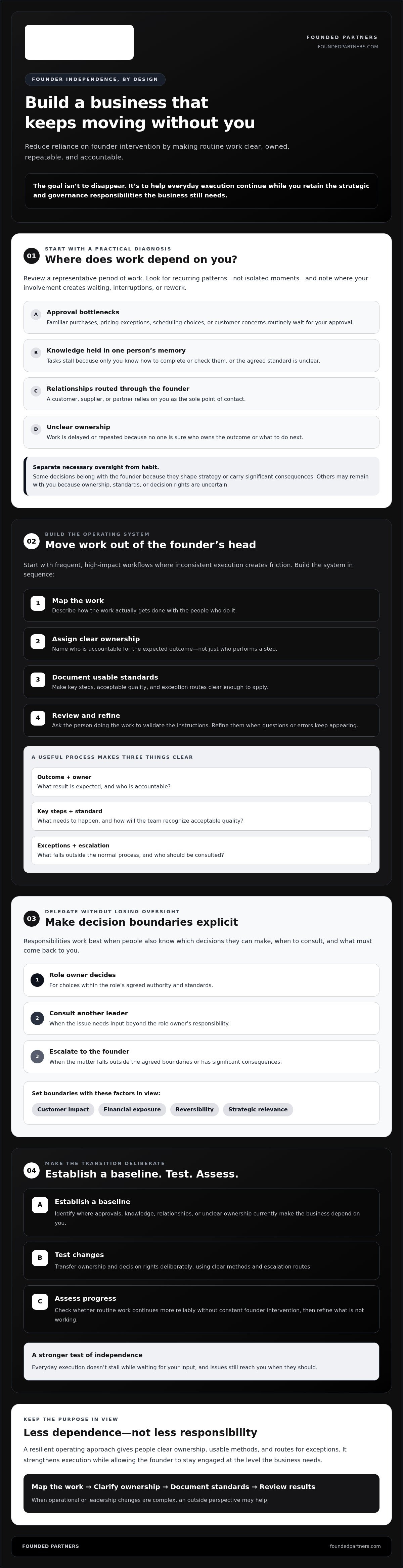
Reducing founder dependency takes more than handing off a task. The operating system must make clear how work moves, who owns each outcome, what good execution looks like, and which issues need to be raised. Build it in sequence: map the work, assign ownership, document standards, then review results.
How do you document work so others can repeat it?
Start with frequent, high-impact workflows where inconsistent execution creates friction, such as preparing a customer proposal or handling a recurring service issue. Map the actual steps with the people who do the work. Keep the documentation useful rather than exhaustive. For each process, record:
- Outcome and owner: What result is expected, and who is accountable for it?
- Key steps and standard: What needs to happen, and how will the team recognize acceptable quality?
- Exceptions: What falls outside the normal process, and who should be consulted?
Ask the person doing the work to validate the instructions. A polished guide that doesn’t reflect reality won’t help the next person do the job. Review the process after it’s used, too. If the same questions or errors keep appearing, refine the steps or clarify the standard.
How should you delegate decisions without losing oversight?
Assign decision rights alongside responsibilities. Define what a role can decide independently, when it should consult another leader, and what must be escalated to you. Set boundaries according to customer impact, financial exposure, reversibility, and strategic relevance. A reversible choice with limited customer impact may sit with the role owner. A decision that could materially affect the company’s direction may warrant founder involvement.
When several teams share a workflow, use a simple responsibility matrix to name one accountable decision owner and identify who contributes or needs to be informed. This prevents shared involvement from turning into shared ambiguity. Harvard Business School Online’s guidance on how to delegate effectively can also help leaders think through a handoff.
Documented decision ownership turns routine founder escalations into clear, bounded decisions the right person can resolve. Review results against the agreed standard, then adjust the boundaries when the team demonstrates sound judgment or new risks emerge. That is oversight by design, not approval of every detail.
These operating foundations support business scalability consulting and help turn the question of how to build a business that can run without you into practical organizational work. If changes touch several functions or leadership roles, explore Founded Partners’ advisory support as one option for navigating complex operational change.
Delegation Without Losing Control: Protect Quality While Reducing Founder Dependence
It’s reasonable to worry that handing off work could weaken quality. But keeping every decision for yourself isn’t the only way to protect standards. Control can come from clear expectations, appropriate authority, and a review rhythm that catches problems without requiring you to monitor every action.
Consider a routine customer refund request. If you approve every case, the team may wait even when the situation is familiar. If you simply tell someone to handle refunds without defining limits or principles, they may be unsure when to act. A stronger handoff explains the desired customer outcome, the role’s authority, and which exceptions need escalation.
| Approach | Likely consequence | Healthier alternative |
|---|---|---|
| Founder approves every detail | Decisions queue up, and team members have little room to exercise judgment. | Set decision boundaries and review outcomes against clear standards. |
| Unsupported handoff | Expectations and escalation points remain unclear, increasing the risk of inconsistent execution. | Transfer context, authority, and an agreed result along with the task. |
| Delegation with guardrails | People can act within defined limits, while exceptions remain visible. | Agree on quality criteria, escalation triggers, and a planned review cadence. |
What is the difference between delegation and abdication?
Delegation transfers responsibility with context and authority. Abdication withdraws support while leaving expectations unclear. For the refund workflow, delegation might mean a team lead can resolve requests within agreed limits, knows how to handle unusual cases, and can raise patterns that suggest a wider issue. The founder remains accountable for setting sound boundaries and adjusting them when needed.
How can a founder maintain standards without micromanaging?
Make quality observable. For customer responses, that might mean accuracy, respectful language, and clear next steps. Agree in advance which exceptions require consultation, such as a sensitive complaint or a request outside the team’s authority. Then review completed cases and recurring patterns at a planned cadence, rather than checking each message before it goes out.
Use what the reviews reveal. If the same exception keeps surfacing, the boundary may be too narrow or the guidance incomplete. If quality concerns appear, clarify the standard and support the role owner before taking the work back. Teams need context and authority together; assigning tasks alone doesn’t create ownership.
This balance is central to how to build a business that can run without you. You don’t need to surrender oversight. You need to move it from constant intervention to deliberate standards, escalation routes, and learning.
A Practical Founder-Transition Plan: Test Progress Before Stepping Back
Founder independence is built through evidence, not confidence alone. A team may feel ready to take on more, but the transition should match the company’s complexity, capability, and risk. Start with a clear baseline, make targeted changes, then test what happens when you’re not the default decision-maker.
Which milestones show that the business is becoming less founder-dependent?
Begin by recording the decisions, recurring tasks, and ownership gaps that still rely on you. Note how often work waits for your input, where rework occurs, which issues escalate, and whether customer concerns recur. These measures aren’t arbitrary targets. They help you compare the company’s actual operating patterns over time.
Use the baseline to set a sequence that fits your organization:
- Clarify ownership: Give routine decisions an accountable owner, defined boundaries, and a clear escalation path.
- Strengthen continuity: Check that critical workflows have usable documentation and a trained backup who can follow it.
- Review operating outcomes: Track decision delays, rework, escalations, and customer issues to see whether the changes hold up in practice.
Look for repeatable results, not a single smooth week. A process may appear stable until an unusual request or absence reveals that essential knowledge still rests with one person. For a related measurement approach, see measuring business transformation success.
How can you test whether the company operates well in your absence?
Choose a bounded, planned period when the team knows you won’t be the default point of contact. The right scope depends on the business. You might first step out of a routine workflow, then test a broader area once the team has the authority and support to manage it. Beforehand, agree on what qualifies as a genuine emergency, who should raise it, and how the team will record decisions and delays.
After the test, debrief without treating every problem as a failure. Ask what broke, what waited, what was unclear, and which decisions the team handled confidently. A recurring escalation may point to a missing decision boundary; rework may signal that a standard or training needs attention. Adjust the system, then repeat the test when the company is ready.
This is a practical way to learn how to build a business that can run without you: make the transition gradual, observe the evidence, and improve the operating model before widening your distance from daily execution. For support shaping a transition around your company’s needs, explore Founded Partners’ advisory support.
When to Hire Help to Build a Self-Running Business
You can make meaningful progress internally before bringing in an advisor. Map the work that still depends on you, identify the recurring bottleneck with the greatest operational impact, and choose one role, decision boundary, or workflow to clarify first. Record what you’ve tried, what changed, and what remains unresolved. This gives your team a practical starting point and helps any outside discussion focus on the real constraints.
What can a founder improve before seeking an advisor?
Begin with a contained problem. For example, if routine customer issues keep reaching you, clarify who owns them, what decisions that person can make, and which cases require escalation. Observe what happens as the team applies the change. Note where responsibility remains unclear, where decisions still stall, and what evidence would help determine the next step.
When might outside perspective be useful?
Consider additional perspective when the issue crosses functions or resists a straightforward internal fix. A workflow may involve several teams with different priorities, while no one has clear accountability for the overall result. A leadership transition can also expose gaps in decision-making, operating practices, or team capacity. In these situations, the challenge may be less about one task and more about how the organization is designed to work together.
Advisory support can help diagnose those connections and strengthen the operating model. It shouldn’t be framed as a shortcut or a promise that the company will operate effortlessly without its founder. Founded Partners advises founder-led organizations and offers business transformation consulting and operations optimization. The firm’s perspective may be relevant when operational changes need to align with broader organizational priorities. For a related discussion, explore business transformation consulting.
What should you look for in operational advisory support?
Choose a partner who understands founder-led organizations and has experience with consequential operational change. Ask how they would assess accountability, workflows, leadership capacity, and progress. Listen for clear questions about your company’s actual constraints, along with an honest explanation of trade-offs. Be cautious of anyone promising effortless independence; durable change takes sound judgment, shared ownership, and continued attention from leadership.
Learning how to build a business that can run without you starts with understanding what the company needs, not with committing to a predetermined solution. If you’d like an outside perspective, discuss your company’s constraints and next steps with Founded Partners. A focused conversation can help clarify where to begin and whether additional support makes sense.
Build Independence One Deliberate Step at a Time
Learning how to build a business that can run without you isn’t about stepping away before the company is ready. It’s about reducing reliance on your constant involvement through clear decision ownership, usable operating practices, and accountability that helps people act with confidence.
Start by identifying where work still depends on your approval or knowledge. Then strengthen one part of the operating model at a time: clarify who owns decisions, define what quality looks like, and test progress before widening your distance from daily operations. Review what the team handles well and where guidance or authority still needs attention. The aim isn’t founder absence. It’s a more resilient business with room for you to focus on the responsibilities that matter most.
Founded Partners advises founder-led organizations on business transformation and operations optimization. Led by partners Adam and Matt, the firm can offer an outside perspective when operational change feels complex. Discuss how to strengthen your business operations with Founded Partners, and take the next step at a pace that fits your company.
Frequently Asked Questions
How do you build a business that can run without you?
Build a business that can run without you by identifying where work depends on your involvement. Map recurring decisions and tasks, then assign owners and decision limits. Document the steps and quality standards others need to repeat the work. Test progress through a planned period of reduced founder involvement, recording delays and gaps. Adjust the sequence to your company’s risks, leadership capacity, and readiness.
Can a small business really run without its owner?
A small business can run routine operations with less owner involvement, but that doesn’t mean the owner must disappear. You may still hold responsibility for strategy, ownership, governance, or exceptional decisions. The practical aim is to reduce dependence on your constant input so work doesn’t routinely stall when you’re unavailable. The right level of involvement depends on the business, its leadership, and the decisions it needs you to make.
What should a business owner delegate first?
Start with frequent, repeatable tasks or decisions that consume your attention and have a clear, observable outcome. Before handing one off, document the expected standard, name the person responsible, and explain what they can decide independently. Set boundaries for exceptions, too. Avoid transferring sensitive work without context or authority. A sound first handoff gives someone a defined result to own, not merely a list of steps to follow.
How do you delegate without losing control of your business?
Delegate by agreeing on the outcome, decision limits, service standards, and a review rhythm before work transfers. Oversight should focus on results, recurring patterns, and exceptions, rather than checking every action. Make escalation routes clear so the team knows when to bring an issue forward. Review what happens and adjust guardrails based on evidence, such as rework or repeated questions. Communicate changes clearly so authority and expectations stay aligned.
What systems does a business need to operate without its founder?
A business needs usable process documentation, clear role ownership, decision rights, relevant performance measures, and escalation routes. These systems should reflect the company’s actual work, including common exceptions, rather than prescribe an ideal process people don’t follow. Ask the employees doing the work to review and maintain the guidance. Then use operating results and recurring issues to identify what needs clarification. Systems support execution; they don’t eliminate the need for judgment.
How do you know if your business is too dependent on you?
Look for routine approvals waiting for you, repeated interruptions, key knowledge that isn’t documented, and customer issues that escalate unnecessarily. Track these patterns over time, including work delays, rework, and recurring questions. Then separate responsibilities that genuinely require founder judgment from tasks that remain with you through habit or uncertainty. If routine work regularly pauses until you respond, that’s a useful signal to examine ownership and decision boundaries.
How long does it take to make a business run without its founder?
There’s no fixed timeline. The work depends on company size and complexity, leadership depth, and how much operational knowledge is undocumented. Set staged milestones instead of choosing an arbitrary deadline. You might begin with one recurring workflow, clarify its ownership, then test a planned period of reduced involvement. Review what waits, breaks, or remains unclear, and use those observations to decide what to strengthen before expanding the transition.
When should a founder hire an advisor to reduce their involvement?
Outside guidance may help when accountability remains unclear across teams, internal changes stall, or a leadership transition creates difficult operational trade-offs. First, identify what you want to improve and gather evidence, such as recurring delays, unresolved ownership questions, or rework. Then assess whether an advisor has relevant experience with founder-led organizations and organizational change. Ask how they would examine workflows, leadership capacity, accountability, and progress, without promising effortless independence.