
Signs You’ve Outgrown Your Startup Processes: A Founder’s Checklist

Process friction is a scaling signal, not automatically a people problem. If decisions keep waiting on your approval, work stalls when one person is away, or the same handoff creates a new exception each time, you may be seeing signs you've outgrown your startup processes. The answer isn’t necessarily to add more rules. First, find where the way work gets done no longer fits the team you have.
As a founder, you’ve likely relied on quick conversations, flexible roles, and individual initiative to get the business moving. Those habits can still be strengths, but they’re harder to sustain when teams use different tools, follow inconsistent procedures, or keep key information in their heads.
This checklist will help you spot consequential warning signs, distinguish useful structure from bureaucracy, and choose one manageable improvement to make first. You’ll also learn when process friction points to a problem that crosses teams or needs outside perspective, so you can strengthen the operating foundation without slowing the business down.
Key Takeaways
- Spot the signs you've outgrown your startup processes by looking for recurring delays, workarounds, and inconsistent outcomes.
- Understand how growing teams and more cross-functional work can expose the limits of informal coordination.
- Diagnose whether a bottleneck stems from process design, capacity, role clarity, or technology before adding rules.
- Choose one recurring constraint, map how work moves, and test a focused improvement before expanding it.
- Assess when process challenges cross teams or resist internal fixes, and when outside strategic support may help.
Signs You’ve Outgrown Your Startup Processes: What to Look For
Informal ways of working can help a startup move quickly, then become hidden constraints as the team and workload grow. A founder’s quick approval, a note in someone’s inbox, or a workaround everyone understands may be efficient once. When the same habits govern routine work, they can slow decisions and make outcomes less reliable.
Look for patterns that recur across projects or weeks. One mistake or a temporary workload spike isn’t proof that a process is broken. The signs you've outgrown your startup processes may include:
- Routine decisions waiting for founder approval.
- Team members repeatedly asking where information lives or what a task requires.
- Work being delayed, duplicated, or sent back for clarification.
- Exceptions and manual workarounds becoming the normal route.
- Different people completing the same task in noticeably different ways.
Process maturity means work can be repeated with clear ownership and useful controls, without relying on one person’s memory or adding needless steps. That’s the practical aim of business process management: understanding how work happens so it can be improved deliberately.
When work depends on founders or individual memory
Notice whether routine choices, such as approving a standard customer request or confirming who handles the next step, keep returning to you. Strategic decisions may rightly need founder oversight; recurring operational questions often point to unclear boundaries or missing guidance. If only one employee knows how to complete a task, delegation and onboarding become fragile. Ask whether a capable colleague could follow the work without seeking that person out.
When handoffs, rework, and exceptions become routine
Repeated clarification requests, missed handoffs, duplicate entry, and work sent back for correction become more than isolated annoyances when they recur in the same workflow. Frequent exceptions can mean the process was designed for an earlier team size or a narrower range of work. Keep a brief record of examples, where work stalled, and the consequence, such as a delayed decision or a customer needing to follow up. Specific evidence makes the constraint easier to assess than frustration alone.
One rough week may call for capacity support, not a redesigned workflow. But if the same friction resurfaces under ordinary conditions, across different people or projects, treat it as a signal worth investigating. The pattern tells you where to look, not whether the cause is process design, ownership, workload, or tools.
Why Startup Processes Stop Scaling as the Team and Workload Grow
Early on, a founder can coordinate work through quick conversations and shared context. As headcount and workload increase, more people need to contribute to the same outcome, often across functions. A decision that once took one conversation may now depend on input from sales, operations, and finance. Informal coordination still matters, but it becomes harder to keep everyone aligned without clear ownership and reliable handoffs.
Growth alone doesn’t mean a process is broken. Look for recurring friction and its consequences: decisions repeatedly stall, work must be redone, or different teams reach different outcomes from the same information. These patterns suggest the way work is organized may no longer fit its volume or dependencies. They’re among the signs you've outgrown your startup processes, but they’re also a prompt to diagnose the cause before adding controls.
Scaling requires repeatable outcomes, not identical rules for every situation. A sound process makes the expected path clear while leaving room for judgment when context genuinely changes.
How founder dependency and unclear ownership create bottlenecks
When decision rights aren’t clear, team members often escalate routine choices to the founder to avoid overstepping. Define three distinct roles: the owner is accountable for the outcome, the approver makes a required decision, and the consulted person provides input. Not every process needs all three. For recurring work, document who owns it, which decisions they can make, and when an issue should be escalated. This preserves founder attention for strategic choices and gives teams clearer direction.
Why adding software rarely fixes a poorly designed workflow
A new platform can make a sound workflow easier to manage, but it won’t clarify a missing decision, remove an unnecessary approval, or resolve conflicting inputs on its own. Before considering automation or a tool change, map the work from request to completion. Note where information is entered twice, where requirements arrive incomplete, and where a task waits without a clear next owner. Fix the workflow first, then assess what technology, if any, would support it.
This measured approach is useful in rapid scaling for startups, where added complexity can weigh on teams as quickly as added structure can help them. For a broader view of how operational foundations support growth, explore this business scalability consulting guide. If workflow challenges cross team boundaries or resist internal fixes, operations optimization consulting may offer a useful outside perspective.
Is More Process Always Better? Diagnose the Constraint Before You Add Rules
No. More documentation, approvals, or meetings don’t automatically make work more reliable. If a task is delayed because no one has time to complete it, another approval step may deepen the queue instead of fixing it. Before changing procedures, identify whether the friction comes from process design, capacity, role clarity, or technology. The signs you've outgrown your startup processes are clues, not a diagnosis by themselves.
Use this comparison to gather evidence and decide what to investigate next:
- Process design: Work loops back or requires repeated clarification. Compare completed tasks and ask, “Are the steps or inputs unclear?”
- Capacity: A queue builds even when the workflow is understood, or work stops when one person is unavailable. Review where work waits and ask, “Is there enough time and coverage to do this reliably?”
- Role clarity: Routine decisions move upward or stall between teams. Track who makes each decision and ask, “Who owns the outcome, and who has authority to act?”
- Technology: People duplicate data, rely on manual transfers, or can’t find current information. Trace where information is entered and retrieved, then ask, “Is the tool creating friction, or is the workflow itself unclear?”
How to tell a process problem from a capacity problem
Recurring queues, uneven workloads, and tasks that pause whenever one person is away can indicate a capacity constraint. First check whether the team has a clear workflow and enough authority to move work forward. Ask the people doing the work where tasks wait, what they need to proceed, and whether the pattern occurs under ordinary conditions. Their direct experience helps distinguish a flawed procedure from a sound process that lacks time or coverage.
What lightweight process structure looks like
Useful structure can be brief. Capture the owner, the trigger that starts the work, the essential steps, decision points, and intended outcome. A short checklist may be enough for a task performed by one person with few variations. A workflow shared across functions needs clearer handoffs, inputs, decision rights, and escalation points, but not necessarily an enterprise system, committee, or lengthy standard operating procedure.
After making a change, check whether it reduced the original friction without creating new steps or delays. Choose a practical signal, such as fewer clarification loops or more predictable handoffs, and review it with the team. This is also the focus of measuring business transformation success: connect the change to observable outcomes, then refine it based on what the work reveals.
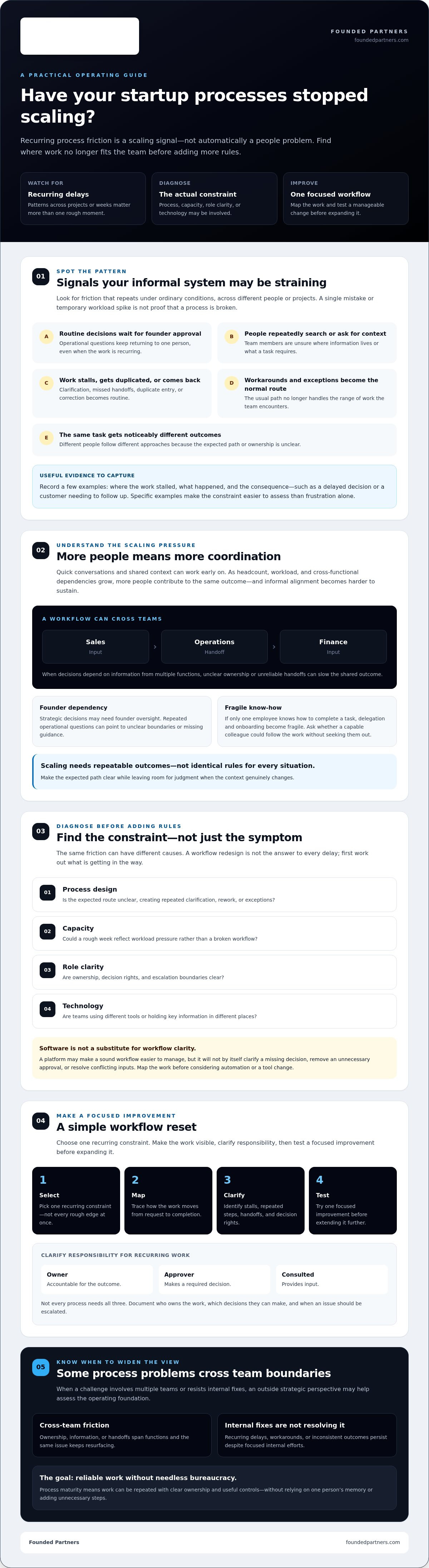
A Practical Checklist for Updating Startup Processes Without Slowing Teams
You don’t need to redesign every workflow at once. Start with one recurring constraint, learn how the work actually happens, and make a measured change. A focused effort makes it easier to see whether the new approach helps.
Prioritize workflows by how often they occur, how much delay or rework they create, their impact on customers, and their importance to the company’s strategy. The signs you've outgrown your startup processes can help identify candidates, but choose the workflow where improvement would matter most.
- Select one recurring constraint. Choose a frequent, consequential workflow rather than a one-off frustration or a company-wide overhaul.
- Map the current work. Ask the people who perform it to outline the trigger, steps, handoffs, decisions, wait points, and exceptions. Capture what happens, not just what the procedure is supposed to be.
- Set a baseline and assign an owner. Record one or two useful measures, such as cycle time or rework. Name the person accountable for the intended outcome, and agree on a review date before changing the workflow.
- Test a focused revision. Pilot the change with a representative team or workstream. Keep what clarifies responsibilities or removes avoidable steps, and question any new approval that doesn’t improve the outcome.
- Review, refine, and communicate. Compare results with the baseline, invite feedback, and record exceptions. Explain what changed, who owns the process, and how future updates will be made.
Choose the first workflow and establish a baseline
Look for work that happens often and has a visible consequence when it stalls, such as delayed customer responses or repeated corrections. Before adjusting the workflow, agree on what a better outcome means and how you’ll recognize it. A simple record of elapsed time or rework can provide a useful comparison without creating a new reporting burden.
Test, refine, and communicate the new way of working
Include the people closest to the work in the pilot. They can identify unclear steps, unnecessary approvals, and exceptions the initial map missed. Treat an exception as information: ask what condition prompted it and whether the process should accommodate it or keep it as a deliberate exception. A process is useful when it reduces avoidable variation without blocking sound judgment.
Share the revised workflow where the team already works, and make the owner responsible for keeping it current. If recurring constraints affect several teams or are difficult to resolve internally, explore operations optimization consulting with Founded Partners.
When Startup Process Problems Call for Strategic Outside Support
A focused internal fix is often enough when one team can identify a clear owner and adjust a workflow. Outside perspective may help when a constraint crosses functions, returns after local changes, or reflects deeper disagreement about priorities and accountability. These signs you've outgrown your startup processes may point to an operating challenge, not simply a procedure that needs rewriting.
Before deciding, consider three questions: Does the team have capacity to examine and improve the workflow alongside its day-to-day work? Are leaders aligned on the outcome and who can make decisions? What happens if the friction continues, such as delayed customer work, repeated rework, or leadership attention pulled away from strategic priorities? If the answers are unclear, the issue may need broader diagnosis.
Signals that a focused internal fix may not be enough
Look beyond one task or department. The same handoff problem may appear between sales and delivery, or a change in one team’s process may create delays elsewhere. If several local fixes haven’t resolved the pattern, or leaders disagree about who owns the outcome and what the operating model should support, a neutral strategic perspective can help clarify the shared constraint and sequence decisions.
Be clear about the kind of help required. Specialist legal or tax questions belong with appropriately qualified providers. Software configuration or implementation also requires the right technology provider; strategic operations advice can help frame the business need, but it isn’t a substitute for that work.
What to expect from a strategic advisory conversation
Bring specific examples: the workflow involved, where it stalls, who is affected, what has already been tried, and which business priorities are at stake. This gives the discussion a practical starting point instead of a general conversation about “needing more process.” For founder-led organizations, Founded Partners’ business transformation and operations optimization advisory may help frame cross-functional constraints, clarify priorities, and identify a manageable sequence of improvements. It isn’t a universal requirement; the right next step may still be an internal adjustment.
Consider outside guidance when recurring friction is consuming time, weakening coordination, or resisting a clear internal fix. A measured conversation can help you understand the problem before committing to a broader change. To discuss your company’s growth and operating challenges, connect with Founded Partners and bring the workflow or decision that’s proving hardest to resolve.
Build Processes That Grow With Your Startup
Recognizing the signs you've outgrown your startup processes is a chance to strengthen how the business works, not a reason to add rules everywhere. Look for recurring friction, identify whether the constraint is process, capacity, role clarity, or technology, then improve one consequential workflow at a time. The aim is reliable outcomes with room for people to use sound judgment.
When bottlenecks span teams or persist despite focused internal changes, an outside perspective may help clarify priorities and next steps. Founded Partners advises founder-led organizations through business transformation and operations optimization consulting, alongside leadership advisory and scalability strategy. Discuss your company’s growth and operating challenges with Founded Partners, starting with the process or decision that’s proving hardest to resolve.
Frequently Asked Questions
How do I know when my startup has outgrown its processes?
Look for recurring friction rather than one-off mistakes. If routine work repeatedly waits for founder approval, gets redone, or stalls during handoffs, track how often it happens and what it delays. These may be signs you've outgrown your startup processes, especially if the pattern persists as workload or team size grows. Review the workflow, ownership, and decision rights before concluding that people simply need to work harder.
What are the most common signs of poor processes in a startup?
Common signs include unclear ownership, inconsistent results, duplicate work, repeated exceptions, and decisions that depend on one person. These symptoms don’t prove the process itself is the problem. A team may lack capacity, clear roles, or suitable tools. Ask the people doing the work for recent examples, then trace where tasks slow down, get repeated, or change hands without enough context. That evidence can help identify the underlying constraint.
Does every growing startup need formal processes?
Every growing startup needs enough shared clarity to produce reliable work, but not every task needs a formal procedure. Begin with workflows that happen often, have meaningful consequences, or are difficult to hand off. A short checklist, a named owner, and a clear escalation point may be sufficient. Add detail only when the current approach causes avoidable confusion, delay, or inconsistent outcomes.
How can a startup improve processes without creating bureaucracy?
Choose one recurring bottleneck and involve the people closest to the work before changing it. Remove steps that don’t serve the intended outcome, then document only what helps the team complete the task consistently: ownership, key steps, decision points, and the expected result. Test the change on a limited scale and ask what improved or became harder. Keep exceptions visible so the process can learn from them without becoming rigid.
Should a startup buy new software to fix process problems?
Not until you understand how the work moves from start to finish. New software may support a clear workflow, but it can also automate confusion or make unnecessary steps harder to remove. Map the current process and look for duplicate data entry, missing information, and unclear ownership. Then determine whether the constraint is genuinely technological. If it is, compare potential tools against defined needs and the business outcome you want.
When should a startup bring in an operations advisor?
Consider outside support when bottlenecks affect multiple teams, internal fixes keep failing, or leaders can’t align on priorities and ownership. An advisor may help clarify the operating constraint and sequence practical improvements. Bring examples of affected workflows, what the team has tried, and the business priorities involved. Founded Partners advises founder-led organizations through business transformation and operations optimization. Confirm that an advisor’s scope and experience match your needs before deciding how to proceed.