
How to Overcome Founder Syndrome: A Practical Guide for 2026

What if reducing a company’s dependence on its founder didn’t mean asking the founder to step aside? When routine decisions wait for approval and leaders hesitate to take ownership, growth can rely too heavily on one person’s time and attention. Learning how to overcome founder syndrome starts with a practical question: are decision rights and operating structures keeping pace with the business?
It’s understandable that founders stay close to decisions. Their judgment, commitment, and vision helped build the company. But habits that served an early-stage business can become bottlenecks as it grows. The answer isn’t to diminish the founder’s contribution. It’s to help others act with clarity and accountability while keeping the founder’s perspective central.
This guide explains how to identify the behaviors and structures creating bottlenecks, clarify which decisions belong to which leaders, and delegate outcomes rather than just tasks. You’ll also learn how stronger processes and leadership can support sustainable growth without erasing the vision that shaped the business.
Key Takeaways
- Spot founder dependence by tracing where decisions, approvals, and essential context still collect around one person.
- Distinguish consequential choices that need founder oversight from recurring decisions leaders can own.
- Learn how to overcome founder syndrome through a phased decision-rights reset, starting with a small set of routine decisions.
- Give leaders clear authority, useful context, and accountability so they can own outcomes rather than simply complete tasks.
- Consider an objective review of roles and operating structures when bottlenecks persist, while keeping internal leaders responsible for change.
How to Overcome Founder Syndrome Starts with Recognizing the Pattern
Founder syndrome describes an organizational pattern: the company depends on its founder to make decisions, approve work, or provide direction, even when other leaders could reasonably take responsibility. The Founder's syndrome reference describes common symptoms and challenges. Within a growing business, a useful test is practical: what can’t move forward without the founder?
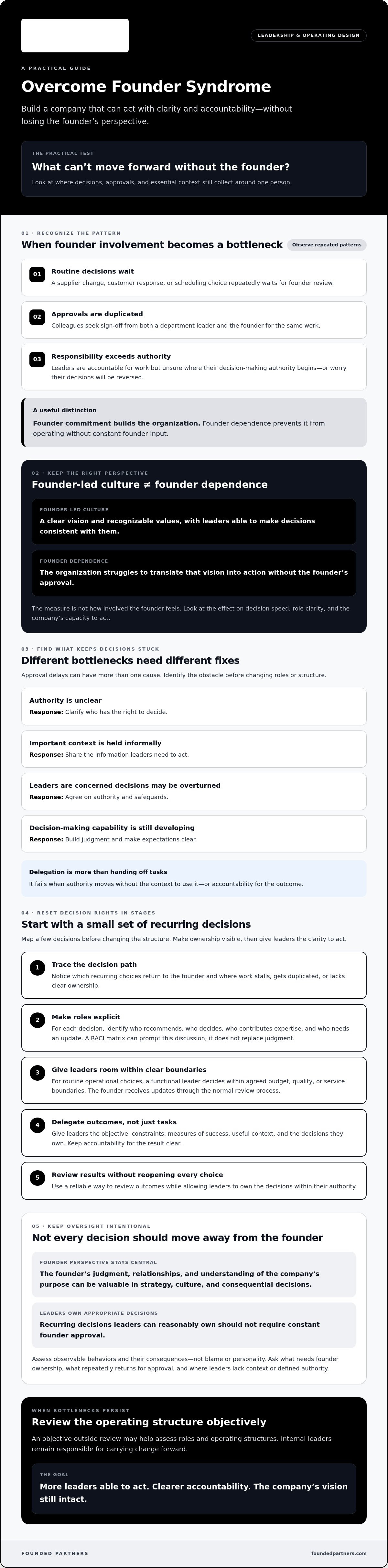
Strong founder involvement isn’t automatically a problem. A founder’s judgment, relationships, and understanding of the company’s purpose can be especially valuable in strategy, culture, and consequential decisions. Concern arises when that involvement limits the organization’s capacity to act. A useful distinction is: Founder commitment builds the organization; founder dependence prevents it from operating without constant founder input.
What does founder syndrome look like in a growing company?
Look for repeated patterns, not one-off decisions. A team might wait for the founder to approve a routine supplier change, review a customer response, or settle a scheduling choice. Department leaders may seek sign-off on decisions they were hired to own, while colleagues ask for approval from both the leader and the founder. Work slows, and accountability becomes difficult to locate.
Authority can be unclear for understandable reasons. The founder may hold essential context in conversations rather than documented processes. Leaders who aren’t sure where their authority begins may defer, escalate, or avoid committing because a decision could later be reversed. As responsibilities spread across a larger team, informal knowledge that once enabled speed can become a bottleneck.
- Delayed decisions: Routine choices wait for founder review.
- Duplicated approvals: More than one person signs off on the same work.
- Limited leadership ownership: Leaders carry responsibility but lack clear authority to act.
Is founder syndrome the same as a founder-led culture?
No. A founder-led culture can have a clear vision and recognizable values while giving leaders room to make decisions consistent with them. Founder syndrome is more evident when the organization can’t translate that vision into action without the founder’s approval. The distinction isn’t how involved the founder feels; it’s how that involvement affects decision speed, role clarity, and company capacity.
To understand how to overcome founder syndrome, assess observable behaviors and their consequences rather than assigning blame or diagnosing a person. Ask which decisions genuinely benefit from the founder’s direct ownership, which repeatedly return for approval, and where leaders lack context or defined authority. Those patterns show whether the business needs the founder’s guidance or a clearer structure for others to act within.
Why Founder Bottlenecks Persist: Decision Rights, Trust, and Operating Design
Approval delays rarely have a single cause. A leader may not know whether they can commit the company, lack context the founder holds, or worry that a decision will be overturned. In other cases, the capability to decide hasn’t been developed yet. Each issue calls for a different response: clarify authority, share information, build judgment, or agree on safeguards.
Hiring experienced leaders won’t resolve these issues if knowledge and processes remain informal. A new executive may own an outcome on paper but still need the founder to explain customer history, approve exceptions, or interpret unwritten standards. Delegation then transfers tasks, not the ability to make decisions.
Delegation fails when authority moves without the context to use it or accountability for the outcome. Leaders need to understand the objective, constraints, and measures of success, along with the decisions they own. The founder needs a reliable way to review results without reopening every decision.
How unclear decision rights keep the founder in every loop
Map a few recurring decisions before changing the structure. For each one, identify who recommends an action, who decides, who contributes expertise, and who needs an update. A simple RACI matrix can make these roles visible, but it’s a prompt for discussion, not a substitute for judgment.
- Routine operational choices: A functional leader decides within agreed budget, quality, or service boundaries. The founder receives updates through the normal review process.
- Cross-functional changes: Relevant leaders contribute, one named owner decides, and affected teams are informed.
- High-consequence or strategic choices: The founder may retain ownership, with defined input from leaders or formal governance where appropriate.
Keep legitimate controls. Financial commitments, material customer risks, quality standards, and other consequential decisions may warrant approval or escalation. The goal isn’t to remove oversight; it’s to set clear thresholds so routine choices don’t inherit controls designed for exceptional ones. Stanford Social Innovation Review discusses how governance can serve as an antidote to founder syndrome by providing structure for accountability and oversight.
Why founders and teams may resist changing the pattern
Founders may worry that delegation will compromise quality, customer relationships, reputation, or execution. Teams may hesitate if earlier decisions were reversed or accountability has been assigned inconsistently. Those concerns aren’t proof that change can’t work. They point to conditions that may be missing: clear boundaries, access to context, or a dependable review process.
To see how to overcome founder syndrome in practice, treat resistance as information. If decision rights and operating processes remain difficult to untangle internally, an objective review may help clarify roles and responsibilities. Founded Partners’ business transformation and leadership advisory may be relevant to founder-led organizations assessing those structures.
Founder Syndrome or Necessary Oversight? Compare the Risks Before Changing Roles
Not every founder approval is a bottleneck. The key question is whether the founder’s involvement adds distinctive judgment or simply adds another step. Before changing roles, compare the risks of acting without oversight with the cost of delaying decisions that leaders are equipped to make.
Strategy, mission, major commitments, and responsibilities tied to the founder’s unique relationships may call for direct founder ownership. By contrast, recurring operational choices with clear objectives and known risks are often candidates for delegated authority. The right boundary depends on the company’s context, its controls, and the consequences of getting a decision wrong.
Compare decision ownership before changing it
Use a simple decision register to make assumptions visible. The examples below are starting points, not universal rules. Set the escalation trigger and review cadence for your organization, then communicate them to everyone involved.
| Decision type | Current owner | Appropriate owner | Escalation trigger | Review cadence |
|---|---|---|---|---|
| Mission and long-term direction | Often the founder | Founder, informed by leadership and governance | A material change to purpose or strategic direction | At planned strategy reviews |
| Major commitment or material risk | Founder or shared approval | Named executive or governing body, based on agreed authority | Commitment exceeds an agreed threshold or risk boundary | At approval and scheduled oversight reviews |
| Routine functional operations | Founder or functional leader | Functional leader within agreed goals and limits | Quality, customer, or financial risk exceeds defined limits | Through regular operating reviews |
Document thresholds rather than relying on unwritten expectations. For example, a leader might own ordinary supplier decisions, while commitments beyond an agreed limit require escalation. Financial controls and material risks should retain deliberate oversight; autonomy doesn’t mean removing safeguards. If board responsibilities shape those boundaries, explore founder board management strategies.
Distinguish delegation from abdication
Before moving a decision, confirm the leader has the information, skills, and authority to own it. If the founder’s context is essential, share it. If capability needs strengthening, address that directly instead of keeping approval centralized by default. Agree on which outcomes to report and how often, so accountability stays clear without reopening every choice.
That distinction is central to how to overcome founder syndrome: preserve founder ownership where it contributes unique value, and give leaders defined space to deliver. Oversight should protect the organization, not become a reflexive second approval for every decision.
How to Overcome Founder Syndrome with a Phased Decision-Rights Reset
Changing decision ownership works best as a deliberate reset, not a sudden withdrawal of the founder. Start with recurring decisions where founder input adds limited value. Then clarify who can act, what boundaries apply, and how results will be reviewed. A phased approach lets the company build confidence while preserving appropriate oversight.
- Diagnose: Track decisions that return to the founder and note where delays, uncertainty, or repeated approvals occur.
- Prioritize: Choose a small set of frequent, lower-risk decisions to address first, such as routine scheduling or standard supplier choices.
- Assign authority: Name one accountable decision owner and define the outcome they’re expected to deliver.
- Communicate boundaries: Set escalation rules, specify what information the leader can access, and agree on check-in timing.
- Review: Assess results and exceptions, then refine the decision boundaries before expanding the reset.
How to delegate without losing quality or control
Authority needs context. Explain the objective, relevant history, quality expectations, and limits the leader must work within. For example, a leader might be empowered to resolve routine customer issues while escalating a case that could materially affect a key relationship. Agree on acceptable trade-offs in advance, such as speed versus customization, so the leader can make informed choices without guessing at the founder’s preferences.
Set a check-in cadence that supports learning without creating another approval gate. Use review conversations to examine outcomes, decisions, and lessons. If a leader’s judgment needs development, coach against clear criteria; don’t silently take back ownership after an imperfect call. That distinction makes accountability credible.
How to make new decision rights stick
Record owners, boundaries, and escalation triggers where people will use them, such as role descriptions, operating routines, or team documentation. Ask leaders to flag decisions that still return to the founder. Each repeat is useful evidence. It may point to missing information, a capability gap, an overloaded role, or an unclear process that needs attention.
Keep the reset adjustable. Review whether decisions are moving at the right level, safeguards remain effective, and leaders have enough context to deliver. For ideas on assessing organizational change, explore measuring transformation success for founder-led firms. This is how to overcome founder syndrome without treating delegation as a one-time handoff: make authority visible, learn from the results, and refine the operating design as the organization grows.
If decision rights or operating processes need an objective review, explore Founded Partners’ business transformation and leadership advisory.
When Outside Advisory Can Help a Founder-Led Company Build Autonomy
Sometimes the leadership team understands the need for clearer decision rights but can’t resolve recurring bottlenecks within the existing structure. Decisions may keep returning to the founder despite agreed ownership, leaders may lack the context to act, or processes may have developed informally across teams. These patterns can signal a need for an objective review of roles, operating processes, and how accountability works in practice.
Outside support shouldn’t take ownership away from the founder or leadership team. Business transformation or leadership advisory can help clarify the current operating model, identify where authority and responsibility don’t align, and guide the people who must make new arrangements work. The founder and leaders remain responsible for decisions and implementation. For a broader view of scaling support, see this guide to growth consulting for founders.
What to look for in a founder-syndrome advisor
Look for relevant experience with founder-led organizations and complex leadership transitions, along with a method that connects strategy to daily operations. An advisor should help examine decision rights, information flow, processes, and accountability together, rather than treating each approval delay as an isolated issue.
Ask how founders and leaders will participate in diagnosis and sustain the changes. Useful questions include: How will you distinguish essential oversight from avoidable approvals? How will leaders build the context and authority to own decisions? How will we review progress and adjust if responsibilities prove unclear or unworkable? Clear answers help keep advisory focused on strengthening the organization, not creating dependence on an external party.
A practical next step for the founder and leadership team
Start with one recurring bottleneck. Write down how the decision currently moves, who contributes, where it waits, and what happens as a result. Then discuss which parts genuinely require founder judgment and which might benefit from clearer team ownership. This gives the team a specific operating problem to examine together, rather than turning the conversation into a judgment about the founder.
That focused review can help determine whether the issue calls for a simple clarification of authority or a broader look at leadership roles and operating structure. If outside perspective would be useful, Founded Partners advises founder-led organizations through business transformation and leadership advisory. Explore Founded Partners’ advisory services as one possible next step in considering how to overcome founder syndrome while preserving the founder’s contribution and vision.
Build a Company That Carries the Vision Forward
Reducing founder bottlenecks isn’t about stepping away from what you’ve built. It’s about shaping an organization where the founder’s judgment remains valuable and capable leaders can carry work forward with clear authority. The practical path is to make decision ownership visible, preserve oversight where it matters, and learn from how new responsibilities work in practice.
That’s the heart of how to overcome founder syndrome: strengthen the operating structure without losing the purpose and perspective that brought the company this far. Start with one recurring bottleneck, then use what you learn to guide the next decision-rights adjustment.
Founded Partners advises founder-led organizations on business transformation, operations optimization, and leadership. If an objective perspective could help clarify roles and support organizational change, explore Founded Partners’ advisory services.
Your vision can remain central while your organization grows its capacity to act.
Frequently Asked Questions
What is founder syndrome?
Founder syndrome is an organizational pattern in which decisions, approvals, or direction depend disproportionately on the founder. It differs from committed founder leadership: a founder can stay active in strategy and culture while leaders own appropriate work. Common signs include routine decisions waiting for approval, duplicated sign-offs, key knowledge held informally, and leaders hesitating to take accountability. The concern isn’t founder involvement itself, but whether that dependence restricts organizational capacity.
How do you know if a company has founder syndrome?
Assess the pattern by tracing repeated decisions from proposal to approval and noting where they pause. Look for leaders who escalate routine choices, overlapping sign-offs, or unclear accountability after outcomes. Then compare observations with the people doing the work: ask which decisions feel safe to own, what context is missing, and whether past decisions were reversed. Repeated patterns across roles are stronger evidence than a single frustrating delay.
Can a founder overcome founder syndrome without leaving the company?
Yes. A founder can remain central to mission, strategy, culture, and key relationships while shifting recurring decisions to leaders with the relevant authority and context. The practical work is to clarify role boundaries, define escalation conditions, and review outcomes without reclaiming ownership by default. Learning how to overcome founder syndrome doesn’t require the founder to leave; it requires an operating structure that supports both the founder’s contribution and the leadership team’s autonomy.
How can a founder delegate without losing control?
Delegate authority alongside the context leaders need: the desired outcome, relevant constraints, quality standards, and access to information. Define decision boundaries and escalation rules in advance, including which risks or commitments require founder input. Agree on reporting and check-in timing so oversight remains visible without becoming constant approval. Start with recurring decisions, review results together, and use exceptions to refine judgment and boundaries rather than automatically taking the decision back.
What happens if a founder refuses to delegate?
If a founder refuses to delegate, decisions may continue to bottleneck around their time, limiting what the organization can handle and leaving leadership capacity underused. Dependence can also make future leadership or ownership transitions harder to prepare for, though it doesn’t make failure inevitable. Discuss the pattern candidly with examples, such as delayed decisions, duplicated approvals, or work only the founder can authorize. Focus on business effects and options, not blame.
Is founder syndrome the same as micromanagement?
Not exactly. Micromanagement describes a way of managing, such as closely directing details or repeatedly checking work. Founder syndrome is broader: the organization relies on the founder for decisions, approvals, or direction. The two can overlap when close oversight encourages leaders to defer, but dependence can persist without overt micromanagement, especially if authority, information, or processes remain centralized. Examine both individual behaviors and the structures that keep decisions flowing back to the founder.
When should a founder-led company seek outside advisory?
Consider outside advisory when bottlenecks recur across functions, leaders remain unsure who owns outcomes, or a consequential transformation requires clearer roles and operating processes. An objective perspective can help examine how decision rights, information flow, and accountability fit together, while the founder and team retain ownership of change. Founded Partners advises founder-led organizations, with business transformation, operations optimization, and leadership advisory relevant to reviewing these structures.