
Organizational Health for Startups: Scaling Guide (2026)

Scaling a business is often mistaken for an exercise in pure volume, yet adding more people to a fractured system only accelerates its decline. If your growth feels increasingly heavy, it's likely because the invisible architecture of your company is reaching its breaking point. You've probably felt the friction of operational bottlenecks stalling your momentum or noticed a growing gap between your strategic vision and the team's daily output. These aren't just growing pains; they're symptoms of a core deficit in organizational health for startups that can quietly erode even the most innovative products.
We understand the pressure to move fast, but true durability requires a more measured, strategic perspective. This guide explores why organizational health is the structural integrity that prevents scaling firms from collapsing and how to build it into your company's DNA. We'll examine how to align leadership, optimize operations for investor readiness, and cultivate a high-performance team that executes with precision. By the end, you'll have a clear roadmap to transform your startup into a resilient enterprise that's ready for its next major capital round.
Key Takeaways
- Differentiate between the rigid stability of legacy corporations and the dynamic alignment needed to sustain agility in a scaling environment.
- Discover how a healthy organizational engine serves as a force multiplier for enterprise value, commanding higher multiples during capital raises and exits.
- Execute a founder’s diagnostic to pinpoint exactly where decision-making stalls and where communication creates friction rather than clarity.
- Master the four pillars of structural integrity to ensure organizational health for startups becomes a permanent feature of your operational DNA.
- Adopt the "Strategic Architect" framework to build a durable foundation that empowers your team to execute flawlessly without constant founder intervention.
What is Organizational Health for Startups?
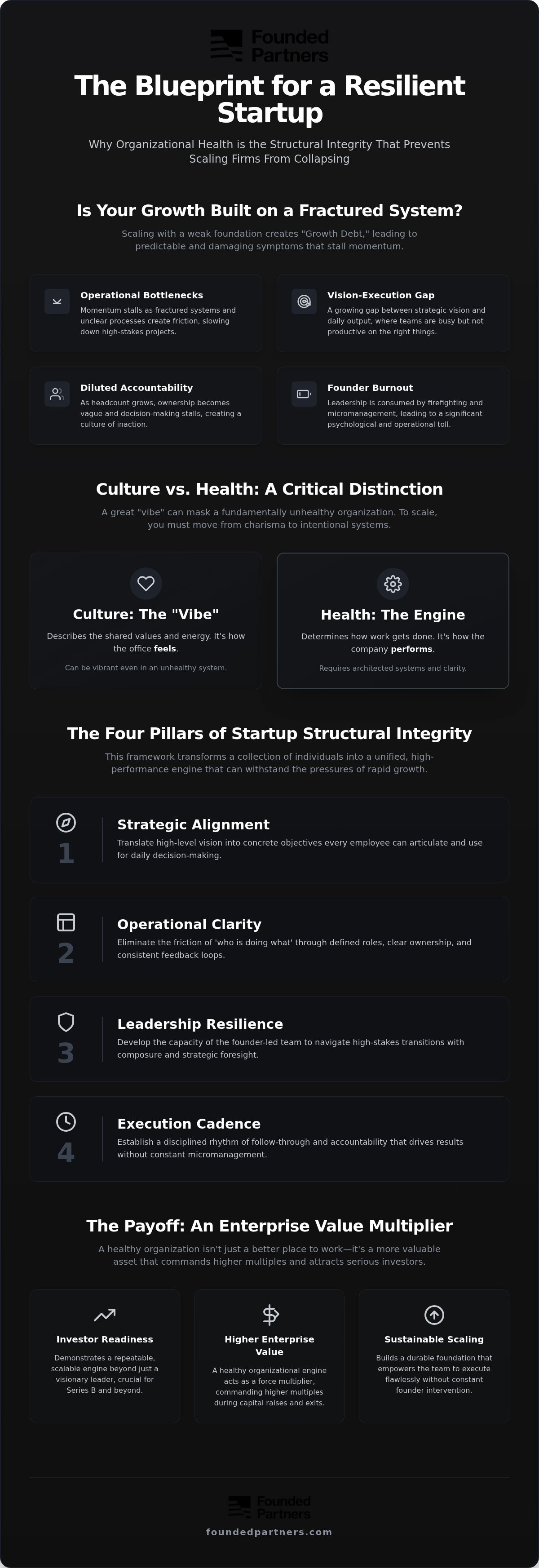
In the high-velocity environment of early-stage growth, founders often focus exclusively on product-market fit and capital acquisition. However, organizational health for startups is the silent engine that powers these outcomes. It isn't a vague concept of employee happiness; it's the precise alignment of strategy, operational systems, and leadership behavior. Organizational health is the structural integrity of a founder's vision. While corporate health often prioritizes long-term stability and rigid compliance, startup health demands a unique blend of agility and radical alignment. It is the invisible infrastructure that allows a team to pivot without fracturing and scale without losing its core identity.
Founders should view this through the lens of Organizational Development Principles, which emphasize that a system's effectiveness depends on how its various parts interact under pressure. In a startup, this means ensuring that as headcount grows, the clarity of purpose remains intact. Without this foundation, the very systems designed to support growth often become the weights that drag it down.
The Difference Between Culture and Health
Culture and health are frequently conflated, yet they serve distinct functions in a scaling firm. Culture describes the shared values and the "vibe" of the office—often cultivated through initiatives from specialists like Culture Of Belonging Global INC. to build engagement and connection. Health, by contrast, determines how well the work actually gets done. It's possible to have a vibrant, high-energy culture within an organization that is fundamentally unhealthy. You might have a team that enjoys working together but lacks clear decision-making protocols, defined ownership, or consistent feedback loops. To scale successfully, a firm must transition from a founder-led vibe to an architected state of health. This shift requires moving beyond charisma and toward intentional systems that reward performance and maintain operational clarity.
Why Startups Ignore Health at Their Peril
Ignoring these foundational elements creates "Growth Debt." Much like technical debt, growth debt occurs when you scale on a broken or non-existent operational foundation. This drift often goes unnoticed until a team attempts to reach Series B readiness, where investors look for a repeatable, scalable engine rather than just a visionary leader. The cost is not just financial. Poor organizational health for startups leads to operational bottlenecks that stall high-stakes projects, diluted accountability as teams grow larger, and a significant psychological toll on leadership. By focusing on refining systems, guiding leaders, and strengthening foundations, founders can avoid the burnout that kills so many promising ventures.
The Four Pillars of Startup Structural Integrity
Building a company that lasts requires more than a great product; it demands a framework that can withstand the pressures of rapid growth. We view organizational health for startups as being supported by four essential pillars. These pillars provide the structural integrity needed to scale without the common pitfalls of operational drift or leadership burnout. When these elements are in place, the organization moves from a collection of individuals to a unified, high-performance engine. It's the difference between a firm that reacts to the market and one that shapes it through disciplined execution.
- Strategic Alignment: Ensuring every team member understands the 'why' and the 'when' of your current objectives.
- Operational Clarity: Eliminating the friction of 'who is doing what' through defined roles and ownership.
- Leadership Resilience: Developing the capacity of the founder-led team to navigate high-stakes transitions with composure.
- Execution Cadence: Establishing a disciplined rhythm of follow-through that doesn't rely on constant micromanagement.
Strategic Alignment: Moving Beyond the Pitch Deck
Strategy is often treated as a static document used only for board meetings or fundraising. In a healthy startup, strategy is a living guide for daily decision-making. Strategic alignment means translating your high-level vision into concrete, operational objectives that every employee can articulate. Without this connection, teams often suffer from 'vanity alignment,' where everyone nods in agreement during a meeting but returns to misaligned tasks. True alignment requires constant refinement and a commitment to measuring business transformation success through objective outcomes rather than just activity levels. It's about ensuring that every unit of energy spent moves the needle toward your ultimate exit or expansion goals.
Operational Clarity and the Role of Systems
In many scaling firms, 'busyness' is often a mask for poor organizational health. When roles are blurred and systems are absent, founders find themselves pulled back into the 'doing' rather than the 'architecting' of the business. Operational clarity is about building an execution backbone where accountability is structured and visible. It's the transition from founder-led intervention to system-led performance. By refining these systems, you create a foundation that attracts capital and maximizes your potential exit value. If you're ready to move beyond the chaos of rapid hiring, a tailored Scalability Strategy can help you reclaim your focus on long-term growth and leadership durability.
Why Organizational Health is the Ultimate Multiplier for Enterprise Value
Many founders view valuation as a purely financial metric, yet professional investors understand that numbers only tell half the story. During due diligence, the focus shifts from your product's performance to the durability of your organizational engine. Acquirers aren't just buying your current revenue; they're purchasing the systems that will generate future revenue without your constant intervention. In this context, health is the premium an acquirer pays for a self-sustaining business. High-level organizational health for startups acts as a force multiplier, transforming a fragile growth curve into a resilient asset that commands significantly higher multiples.
Operational optimization is directly linked to capital raising efficiency. When your internal systems are refined and your team is aligned, the narrative you present to the market is one of stability and low risk. This clarity allows you to negotiate from a position of strength, as the business is no longer dependent on the next round of funding to survive, but rather to accelerate a proven, healthy model.
Health as Investor Readiness
When transitioning from seed stages to Series A and B, the scrutiny on internal systems intensifies. Institutional investors look for signs of operational friction that could stall the deployment of new capital. If your leadership team is misaligned or your decision-making processes are opaque, these appear as significant red flags in financial and operational audits. A lack of structural integrity suggests that additional funding might be wasted on inefficient workflows rather than scaling a proven model. Utilizing a comprehensive capital raising for founders guide to sustainable growth helps you identify these gaps early, ensuring your firm presents as a mature, low-risk investment.
Maximizing Value for the Final Transition
The ultimate test of a startup's health is its ability to thrive without its founder. Exit planning is not merely a legal or financial event; it is an architectural one. Acquirers discount firms where "key person risk" is high, specifically where the founder is the sole repository of strategic knowledge and operational authority. To maximize enterprise value, you must build a founder-independent team capable of high-level execution.
Strengthening your organization's health involves several key actions:
- Refining operational workflows to ensure consistency across every department.
- Guiding middle management to take full ownership of tactical execution.
- Strengthening the communication loops that prevent information silos as headcount grows.
This deliberate approach to exit planning for founders ensures that your business is seen as a turn-key operation. By prioritizing organizational health for startups years before a potential sale, you ensure that the final transition is a celebration of the firm's durability rather than a frantic attempt to patch structural holes.
A Founder’s Diagnostic: Identifying Silent Operational Drift
Growth often masks underlying dysfunction. As a founder, you may feel the business becoming harder to manage without seeing the specific point of failure. This is silent operational drift. To restore organizational health for startups, you must look past the revenue charts and examine the actual mechanics of your team's interaction. It requires a clinical, objective look at how information flows and how authority is exercised across the firm. This diagnostic process is the first step toward reclaiming the structural integrity of your vision.
- Audit the 'meeting-to-output' ratio: In healthy firms, communication accelerates execution. If your calendar is full but progress is incremental, your communication systems are likely creating friction rather than resolving it.
- Assess decision-making speed: Identify where choices go to die. In many scaling firms, a bottleneck forms at the top because authority hasn't been effectively delegated, leading to a paralysis that stalls momentum.
- Measure the 'Founder Reliance' index: Test the durability of your systems by stepping away. If the business cannot function for a single week without your direct intervention, you haven't built a company; you've built a job.
- Check for 'culture dilution': Middle management is the bridge between vision and execution. If this layer is misaligned or lacks the tools to lead, your core values will never reach the daily operations of the front-line team.
The Red Flags of Stalled Growth
Scaling startups often fall into the 'busy-but-stagnant' paradox. Teams are working harder than ever, yet key milestones remain out of reach. This is usually accompanied by a rise in internal politics. When incentives aren't aligned, individuals begin to optimize for their own departments rather than the firm's collective health. Perhaps the most critical warning sign is high turnover within the first 90 days. This isn't a hiring problem; it's an organizational health crisis. It suggests that your onboarding and cultural integration systems are failing to anchor new talent in a meaningful way.
From Diagnostic to Transformation
Identifying the drift is only the first step in restoring organizational health for startups. The challenge lies in prioritizing the fix. You must distinguish between the symptom, such as low morale, and the bottleneck, such as poor operational clarity. Engaging a business scalability consulting partner provides the objective, external perspective needed to see these gaps clearly. A seasoned advisor acts as a strategic architect, helping you build a cadence for regular health check-ups at the leadership level. This ensures that alignment isn't a one-time event but a permanent feature of your growth model. If you're ready to stabilize your foundation, explore our Operations Optimization services to turn these diagnostic insights into a durable scaling engine.
Partnering for Performance: The Founded Partners Approach
Building a resilient enterprise is an architectural challenge that requires more than just tactical adjustments. At Founded Partners, we utilize a 'Strategic Architect' framework to ensure that organizational health for startups is woven into the firm's DNA. We don't believe in temporary fixes or surface-level changes. Instead, we focus on building durability. Our role is to bridge the gap between a founder's high-level vision and the granular operational reality of daily execution. This process transforms the frantic energy of a scaling firm into a measured, high-performance engine.
Our approach is characterized by 'calm expertise.' In the often chaotic landscape of rapid growth, we provide a steady hand and a long-term perspective. We are character-led and partner-oriented, valuing the integrity of the process as much as the final outcome. We don't position ourselves as distant consultants but as deeply invested peers who have navigated these complexities before. This relationship allows us to provide the psychological security and strategic clarity needed to make difficult, foundational choices. We help you refine your systems, guide your leaders, and strengthen your foundation.
Beyond Traditional Consulting
Traditional consulting often culminates in a static report that gathers dust on a shelf. We operate differently. We refine the architectural foundation of your firm, focusing on the systems that allow for sustainable, repeatable success. Our partnerships are built on shared values and grounded empathy. We understand the unique pressures of the founder-led journey because we've walked that path. This empathy allows us to guide you through business transformation that feels supportive rather than intrusive.
A significant part of our work involves identifying and attracting the right capital. By prioritizing organizational health for startups, we help you present a business that is ready for institutional scrutiny. Investors aren't just looking for growth; they're looking for the structural integrity that ensures that growth can be sustained. Our capital raising support focuses on highlighting the health of your organizational engine, making your firm a more attractive and lower-risk prospect for the next round.
Start Your Transformation Journey
The transition from founder-centric to system-centric growth is the most consequential shift a scaling firm will make. It requires an honest assessment of your structural integrity and a willingness to refine your leadership advisory protocols. This journey isn't about losing your identity; it's about architecting a version of your firm that can execute flawlessly without your constant intervention. It's about moving from a state of constant urgency to a state of disciplined momentum.
If you're ready to move past the bottlenecks and build a business that commands higher value, the first step is a conversation. We'll help you assess your current health and design a roadmap for sustainable, high-performance growth. Schedule a conversation with Founded Partners today to begin refining your firm's future.
Architecting the Durable Enterprise
Scaling is a test of structural integrity. As we've explored, organizational health for startups is the invisible engine that determines whether a firm accelerates or fractures under pressure. By aligning strategy with operational clarity and building leadership resilience, you move beyond the chaos of rapid hiring toward a self-sustaining model. This transformation doesn't just improve daily execution; it creates a high-value asset that commands premium multiples during capital rounds or exit negotiations.
True durability requires a partner who understands the unique psychology of founder-led firms. Founded Partners is a boutique advisory led by seasoned partners Adam and Matt, bringing a proven track record in business transformation and capital strategy. We provide the calm expertise needed to bridge the gap between your vision and operational reality. If you're ready to move from founder-reliance to architected growth, it's time to stabilize your foundation and prepare for the next stage of your journey.
Refine your foundation with a Strategic Architect at Founded Partners. Building something substantial is a shared journey. With the right systems in place, your firm's potential for sustainable growth is limitless.
Frequently Asked Questions
What is the difference between organizational health and company culture?
Culture is "how we work," while organizational health for startups is "how well the work gets done." While culture focuses on shared values and the employee experience, health is an architectural metric. It measures the alignment of strategy, operations, and leadership behavior. You can have a vibrant culture in a misaligned, unhealthy firm. True health ensures that your team executes with precision and remains resilient during growth.
How do you measure organizational health in a remote-first startup?
In remote environments, you measure health through digital coherence and asynchronous execution speed. You should track the "meeting-to-output" ratio to see if communication is solving problems or creating them. High-performing remote teams exhibit clear ownership and minimal friction regarding who is doing what. We look at the quality of digital conversations and the speed of decision-making as primary indicators of structural integrity in decentralized organizations.
Can organizational health really impact our startup's valuation?
Absolutely, as organizational health is a significant multiplier for enterprise value. During due diligence, investors look past the product to the durability of the organizational engine. A healthy startup commands a higher multiple because it carries less "key person risk" and demonstrates a repeatable execution model. Acquirers pay a premium for a self-sustaining business that doesn't require constant founder intervention to maintain its current momentum.
How often should a founder conduct an organizational health audit?
Founders should conduct a high-level health audit at least once every six months, though quarterly reviews are better for rapidly scaling teams. These check-ups ensure that your operational foundation is keeping pace with your headcount growth. Regular assessments help identify silent operational drift before it becomes a crisis. Setting a consistent cadence for these audits allows leadership to refine systems and guide the team toward long-term durability.
What are the first signs that a startup's organizational health is failing?
The first signs often include operational bottlenecks that stall growth and an increase in internal politics. You might notice that your leadership vision is no longer aligning with daily execution. High employee turnover within the first 90 days is another critical red flag. These symptoms suggest that your internal systems are fracturing under pressure, indicating a need for organizational health for startups intervention to restore structural integrity.
Is organizational health only important for large companies, or does it matter at the seed stage?
It is critical at every stage, including the seed stage. While large companies focus on stability, seed-stage startups need health to build a foundation that supports rapid scaling. Ignoring health early on creates "Growth Debt," where you scale on a broken system. Establishing healthy patterns in the early days ensures that you don't lose your core identity or operational efficiency as you move toward future funding rounds.
How does leadership advisory help improve organizational health?
Leadership advisory provides the external, objective perspective needed to identify hidden structural gaps. A seasoned advisor acts as a strategic architect, helping founders transition from doing the work to architecting the business. This partnership focuses on refining decision-making protocols and strengthening communication loops. By guiding the leadership team through consequential transitions, advisory services ensure that the firm's health remains a priority over vanity metrics or short-term gains.
What role does a COO play in maintaining organizational health vs. the CEO?
The CEO is primarily responsible for strategic alignment and the "why" of the organization. They ensure the vision is clear and the leadership team is unified. Conversely, the COO builds the execution backbone and focuses on operational clarity. While the CEO looks outward toward the market and investors, the COO looks inward to ensure the organizational engine is running smoothly. Both must collaborate closely to maintain overall structural integrity.