
Improving Gross Margins in a Scaling Business: A Founder’s Guide

Revenue can rise while each new customer becomes harder to serve profitably. That’s why improving gross margins in a scaling business takes more than selling more. As hiring, delivery complexity, and rework grow, the cost of fulfilling each sale can climb alongside revenue.
If growth isn’t strengthening your delivery economics, cutting costs or slowing expansion may not be the answer. First, identify where gross profit is created, where it is eroded, and which changes can improve the model without diminishing customer value or strategic momentum.
This guide shows you how to diagnose margin pressure across products, customers, and services, then identify practical ways to make delivery more efficient. You’ll also learn how to monitor costs and improve margins as the business scales. The goal is an operating foundation that supports durable growth, not growth at any cost.
Key Takeaways
- Separate gross margin from operating margin, net margin, and cash flow to understand what delivery costs reveal.
- Compare margins across offerings, customer groups, channels, or projects to find where gross profit is gained or lost.
- Assess pricing, delivery design, capacity, and offering mix as distinct levers, weighing each against customer value and execution demands.
- Make improving gross margins in a scaling business a measured process: establish a baseline, test one driver, and track results with clear ownership and customer safeguards.
- Align leadership, operating processes, and measurement around stronger delivery economics to support more durable growth.
Why gross margins can stall even as a business scales
Revenue growth can make a business look stronger even when the economics of delivering each sale remain flat or weaken. For founders focused on improving gross margins in a scaling business, start by separating what gross margin tells you from the wider picture of profitability and cash health.
What gross margin reveals about the economics of delivery
Gross margin is the share of revenue left after subtracting the direct costs of delivering a product or service. The formula is (revenue − direct delivery costs) ÷ revenue × 100. Revenue is income earned from sales; direct delivery costs are expenses tied to fulfilling those sales. The result shows how much revenue remains as gross profit for each dollar earned. For a wider overview of the calculation and terminology, see Understanding Gross Margin.
For example, if a business earns $100,000 in revenue and spends $60,000 on direct delivery costs, it has $40,000 in gross profit and a 40% gross margin. This is an illustration, not an industry benchmark. Gross profit is the dollar amount; gross margin expresses it as a proportion of revenue.
Gross margin doesn’t include every expense. Operating margin accounts for operating expenses such as administration and sales costs, while net margin reflects profit after additional expenses, including interest and taxes. Cash flow tracks when money enters and leaves the business. A company can report a healthy gross margin and still face cash pressure if customers pay late or expenses come due earlier.
Why economies of scale do not guarantee higher margins
Scale creates the possibility of efficiency, not a promise of it. Yale’s research challenges the assumption that larger companies automatically achieve lower average costs and higher margins. The practical lesson for founders is to assess how capacity and costs behave as sales increase, rather than treating size as proof of better economics.
When additional sales use existing delivery capacity, revenue may grow faster than direct costs. But if new demand requires hiring, additional tools, more management coordination, or greater customization, delivery costs can rise at a similar pace or faster. Underused capacity can also weigh on margins: a team hired ahead of demand still carries delivery costs while its available time goes unfilled.
Complexity can quietly erase expected gains. More product variations, customer-specific work, handoffs, and rework may increase the effort required for each delivery. Ask: Are new sales using existing capacity or requiring more? Which customers or offers involve extra customization? Is rework becoming more common as volume grows? These questions connect the margin figure to operational causes you can investigate.
Growth may create efficiencies when work becomes more repeatable and capacity is used well. Until then, treat the margin trend as something to measure, not an outcome to assume. Improving delivery economics starts with understanding which costs rise with volume, how much capacity is used, and where complexity absorbs the gains.
How to find the real sources of gross-margin pressure
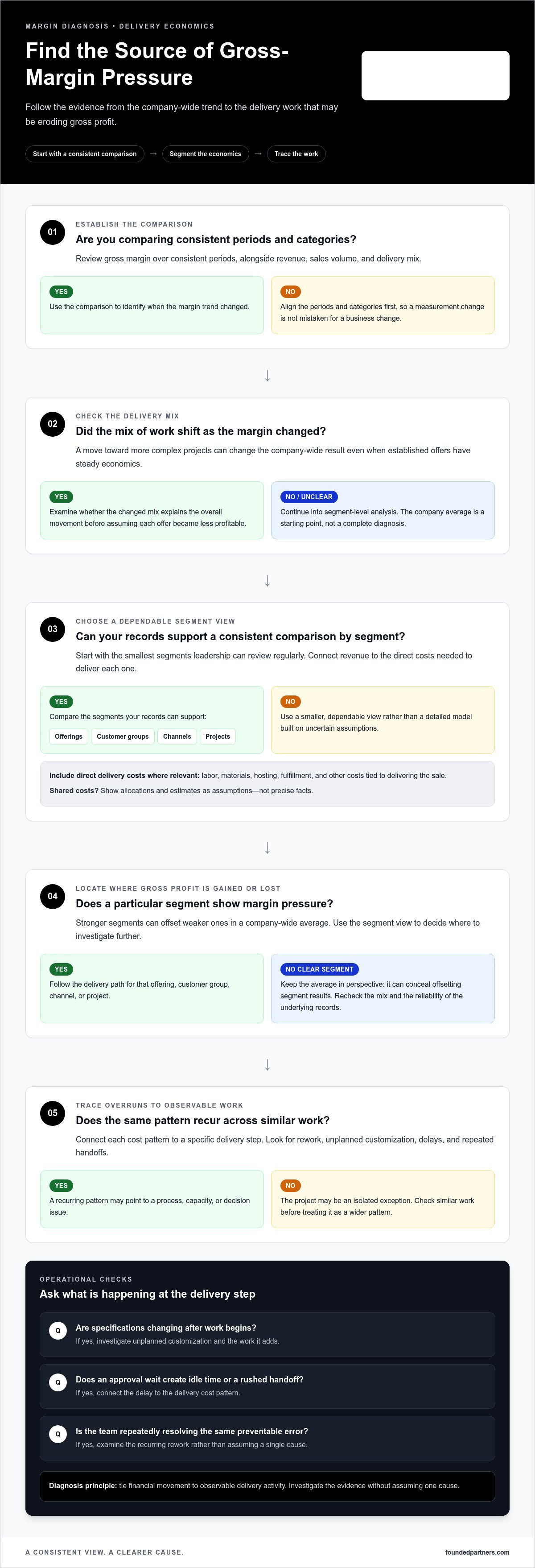
A company-wide margin trend shows that delivery economics have changed, but not where or why. Compare gross margin over consistent periods, alongside revenue, sales volume, and delivery mix. A shift toward complex projects, for example, may change the overall result even if the economics of each established offer remain steady.
Company-level gross-margin averages can conceal weak offerings, customer groups, channels, or projects when stronger segments offset their costs. The average is a useful starting point, not a complete diagnosis. Segment the analysis only as far as your records allow you to do consistently. A smaller, dependable view is more useful than a detailed model built on uncertain assumptions.
For a sector-specific perspective on measurement, the Bureau of Labor Statistics’ Gross Margin Analysis in Retail examines gross margins in retail. The broader lesson is to make the basis of comparison explicit, then investigate how the underlying work and costs change.
Build a margin view by offering and customer
Start with the smallest segments leadership can review regularly, such as a key offering or customer group. Connect each segment’s revenue to the direct labor, materials, hosting, fulfillment, or other costs required to deliver it. Use the same categories and time periods across comparisons so a change reflects the business, not a change in measurement.
Some costs serve several segments. Show shared-cost allocations and estimates as assumptions, not precise facts. This keeps a useful directional view from creating false certainty.
Trace delivery overruns to their operational causes
Once a segment looks pressured, follow the delivery path. Look for rework, unplanned customization, delays, and repeated handoffs. A project review may reveal an isolated exception; a recurring pattern across similar work may point to a process, capacity, or decision issue.
Connect each cost pattern to an observable step. Are specifications changing after work begins? Does an approval wait create idle time or a rushed handoff? Is a team repeatedly resolving the same preventable error? This makes margin analysis actionable by linking financial movement to delivery activity without assuming a single cause.
- Compare periods: Review margin alongside revenue, volume, and changes in the mix of work.
- Compare segments: Track offerings, customer groups, channels, or projects where records support a consistent view.
- Trace the work: Tie delivery costs and overruns to specific steps, decisions, or recurring exceptions.
This diagnostic discipline gives leaders a stronger basis for improving gross margins in a scaling business. Founded Partners’ operations optimization advisory helps founder-led teams connect delivery patterns with the operating choices behind them, grounding improvement efforts in evidence rather than guesswork.
Which gross-margin improvement levers fit your business model?
Once you’ve identified where margin pressure sits, match the response to its cause. A price change won’t solve delivery rework, and a process redesign won’t correct an offering that requires more effort than its pricing recognizes. For improving gross margins in a scaling business, compare each lever against the evidence, customer value, and strategic role of the work.
Signal: Delivery effort has grown, but customer value and expectations remain strong.
Possible lever: Review pricing or packaging.
Evidence to monitor: Delivery effort by package, customer response, and changes in sales mix.
Key risk: A price or package change may reduce customer choice or misalign expectations.
Signal: Repeatable work contains unnecessary steps, handoffs, or rework.
Possible lever: Redesign delivery.
Evidence to monitor: Time spent on recurring tasks, rework, and delays.
Key risk: Simplifying the process could weaken quality if essential work is removed.
Signal: Capacity is unevenly used or bottlenecked.
Possible lever: Adjust capacity planning and allocation.
Evidence to monitor: Workload, unused capacity, and delivery delays.
Key risk: Changes may create new bottlenecks or leave the team unable to meet demand.
Signal: Offerings have different delivery economics or strategic importance.
Possible lever: Refine the offering mix.
Evidence to monitor: Segment-level margins, customer demand, and strategic contribution.
Key risk: Shifting focus may weaken valuable customer relationships or future growth options.
When pricing or service mix may be the right lever
Look for a gap between what an offer costs to deliver and what its price or packaging accounts for. Consider complexity, customization, and the value customers receive, not just the time involved. If offerings differ in direct cost, review their margins alongside their strategic importance. Packaging can clarify what’s included, but it can also change customer choice and raise expectations. Test whether a revised offer preserves value before making it standard.
When delivery redesign or capacity changes may matter more
For repeatable work, map the steps and identify avoidable handoffs, duplication, and rework. Improve the process before assuming fewer people are the answer. Review where capacity is constrained and where it sits idle, then consider whether work can be scheduled or allocated differently. In SaaS, infrastructure usage and customer-success effort may shape delivery economics; other models have different cost drivers, so don’t transfer SaaS assumptions wholesale.
Use benchmarks as context, not as a universal target. A margin level that fits one business model may be unsuitable for another because delivery structures, customer expectations, and strategic priorities differ. Choose the lever that addresses a demonstrated cause, then weigh its likely margin effect against customer experience and execution demands.
How to improve gross margins without sacrificing healthy growth
Margin improvement should strengthen how the business delivers value, not weaken the customer experience that supports growth. Treat each change as a focused test: define the problem, make a deliberate adjustment, and check both the financial result and operational consequences. This helps leaders learn what works before embedding a change across the business.
Choose a focused margin experiment
Start with a material, evidence-backed cause rather than launching several initiatives at once. State how the proposed action is expected to improve economics, such as reducing repeated work or making delivery effort more predictable. Name a countermeasure that would reveal harm, such as worsening quality, retention, or on-time delivery. A clear mechanism and safeguard keep the test grounded in both margin and customer value.
- Establish a baseline. Record the relevant segment’s gross margin and the operational measures connected to its delivery. Note revenue, volume, and work mix so you can distinguish the test’s effect from a change in what the business sold.
- Select one driver. Choose a cause the team can influence, such as a recurring handoff or avoidable customization. Assign an owner who can coordinate the work and explain how the change is expected to affect direct costs or revenue quality.
- Test an action. Define the scope and review period before implementation. Track an operational measure tied to the change, such as rework or time spent on a repeatable step, alongside a customer safeguard such as service quality or delivery reliability.
- Review the results. Compare observed performance with the baseline, account for mix and volume, and assess whether the safeguard held. Decide whether to adopt, refine, or stop the change based on the evidence.
Review results and adjust the operating model
A useful review records what changed, what stayed the same, and which assumptions proved uncertain. If costs fall but delays rise, redesign the intervention rather than rolling it out more broadly. If the apparent margin improvement came from a shift in sales mix, don’t attribute it to the operational change. For a wider framework on evaluating change, see measuring transformation success.
Keep the learning visible to the people who shape delivery. Share the test’s owner, measures, customer safeguard, and decision with relevant leaders and teams. This makes it easier to spot unintended effects and helps successful changes become repeatable practices rather than isolated wins. A strong business scalability consulting approach connects operational choices to the foundations the organization needs as it grows.
Improving gross margins in a scaling business is not a one-time cost-cutting exercise. It is a disciplined cycle of measuring, testing, and adapting while protecting the value customers rely on. Founded Partners’ business transformation and operations optimization services support founder-led teams working through complex operational change.
Make gross-margin improvement part of a stronger scaling foundation
Sustainable margin gains come from improving delivery economics, not from revenue growth alone. A business needs to understand how work is performed, how decisions affect the cost of fulfilling it, and whether teams can maintain quality as demand changes. That takes alignment between leadership priorities, operating processes, and the measures used to assess progress.
For founders, the goal is not to pursue margin at the expense of valuable customers or strategic opportunities. It’s to build an operating foundation where growth can be supported more consistently. Growth consulting for founders can help leaders consider how margin priorities fit alongside wider growth plans.
When margin challenges point to a wider transformation need
If margin pressure keeps appearing across teams or offerings, the cause may extend beyond an isolated expense. It can point to an operating-model issue: unclear ownership, processes that don’t support the work, or leadership decisions that create complexity without a shared view of trade-offs.
Accounting changes can improve how costs are categorized, but they can’t replace operational diagnosis. Leaders need to connect strategy with process ownership and day-to-day decisions, then establish how teams will review the effects. That creates a clearer basis for action without assuming a particular financial outcome.
A measured next step for founder-led leadership teams
Bring the questions that matter most to your organization: which delivery patterns are putting pressure on margins, what must remain strong for customers, and where should leadership focus first? A considered discussion can connect those questions to transformation, operations optimization, and scalability strategy.
Founded Partners advises founder-led organizations through complex operational change, with business transformation and operations optimization focused on building stronger operating foundations. Its leadership guidance and scalability strategy help teams align priorities, clarify ownership, and approach change with discipline. The work is grounded in each organization’s operating realities, not a promise of a particular margin result.
Improving gross margins in a scaling business is a leadership and operating challenge as much as a financial one. Progress depends on connecting what the business wants to achieve with how work gets delivered and how results are understood. Business scalability consulting supports leaders as they consider how to strengthen that foundation for the next stage of growth.
To bring your margin questions and operating priorities into a strategic discussion, explore Founded Partners’ advisory approach.
Build the next stage on stronger economics
The next stage of growth is a chance to make deliberate choices about what the organization should become, not simply expand the current model. Margin discipline can be part of that design: clarify which work creates durable value, what capabilities need strengthening, and how leaders will keep learning as conditions change. That makes improving gross margins in a scaling business an ongoing leadership priority rather than a short-term correction.
For founders, a useful next move is to examine the operating decisions shaping delivery today and the foundation needed for tomorrow. Founded Partners advises founder-led organizations through business transformation and operations optimization, bringing those questions into a broader view of how the business can scale with intention. The aim is greater clarity on choices, ownership, and direction, not a promised margin result. Strong operating foundations are built one sound decision at a time.
When you’re ready to discuss how to strengthen your operating foundation, explore Founded Partners’ advisory approach.
Frequently Asked Questions
What is the difference between gross margin and contribution margin?
Gross margin subtracts direct delivery costs from revenue, while contribution margin typically subtracts variable costs tied to a unit, customer, or transaction. Those categories may not match exactly: a variable cost might be classified differently in a company’s accounts. For example, a team could include transaction-specific support time in a contribution calculation. Define which costs each measure includes, document the choice, and apply it consistently before using either figure to compare decisions.
Do gross margins differ by industry and business model?
Yes. A manufacturer, software company, and professional-services firm have different delivery activities and cost structures, so comparing their margins directly may offer little insight. Even companies in the same industry can differ because of service levels, sales channels, customer requirements, and accounting policies. Use peer figures as context, not a verdict. For internal comparisons, check that offers use consistent cost definitions and account for differences in delivery.
Can a growing company have declining gross margins?
Yes. Margins can decline as revenue rises if delivery costs grow faster, perhaps because new work requires more customization, capacity is added ahead of demand, or the business sells a larger share of lower-margin offerings. A short-term dip doesn’t automatically mean the growth plan is unsound. For improving gross margins in a scaling business, compare similar customer or product segments over time, then investigate what changed before revising prices or slowing growth.
Should founders prioritize gross margin over revenue growth?
Neither should be the sole priority. Revenue growth can advance a company’s strategy, while gross margin helps assess the economics of delivering that revenue. The right balance depends on factors such as stage, capacity, customer value, and capital needs. For instance, a founder may accept temporarily weaker margins to support a strategically important launch, but should make that choice deliberately, set a review point, and understand the implications for delivery capacity and cash planning.
Should founder compensation be included in gross-margin calculations?
It depends on the company’s accounting policy and whether a founder’s work is directly involved in delivering the product or service. If founders provide delivery work, excluding that effort from internal analysis could make an offer appear more economical than it is. Keep the chosen treatment consistent and distinguish management reporting from formal financial reporting. Don’t change classifications simply to improve a displayed result; consult a qualified accounting professional about reporting decisions.
Does a stronger gross margin mean the business has better cash flow?
No. Gross margin and cash flow answer different questions. A business may earn more gross profit relative to revenue but still have cash constraints if customers pay after supplier or payroll obligations fall due. For example, a long collection period can delay incoming cash even when delivery costs are well controlled. Review receivables, payment timing, and working-capital needs alongside margin trends so operating decisions reflect both profitability and liquidity.
How often should a scaling business review gross margins?
Set a review rhythm that fits the company’s sales cycle, reporting reliability, and pace of change. A regular leadership review can surface emerging shifts, while a deeper analysis may be useful after a pricing, capacity, or delivery-process change. Keep comparisons consistent: use the same cost definitions and segment boundaries, explain unusual movements, and assign someone to follow up. If the underlying records arrive late, improve their timing before relying on frequent reviews.