
Improving Startup Productivity: The Strategic Guide to Scaling Operational Velocity

Adding more people to a sluggish workflow doesn't accelerate output; it simply magnifies the structural fractures in your organization. If you've expanded your headcount only to watch calendar invites proliferate while product velocity grinds to a halt, you aren't imagining the friction. When founders remain the primary bottleneck for routine technical approvals and daily decisions, improving startup productivity requires far more than urging your team to hustle harder.
Between disconnected SaaS tools, relentless context switching, and endless alignment calls, real momentum gets swallowed by operational noise. You already know your company can't achieve durable scale if every cross-functional initiative depends on your personal intervention to move forward. In this guide, you'll discover how founder-led companies eliminate operational drag, overcome bottlenecked decision-making, and build scalable systems for enduring productivity. We'll explore how to institute disciplined operating rhythms, transition your leadership focus from tactical firefighting to high-leverage strategy, and align daily execution directly with capital efficiency and investor readiness.
Key Takeaways
- Redefine organizational output by measuring the speed of delivering validated customer and enterprise value rather than raw tactical activity.
- Uncover how unspoken founder dependencies stall execution, and learn why improving startup productivity requires deliberate architectural design rather than added headcount.
- Implement a battle-tested, five-pillar framework that installs disciplined operating rhythms without introducing bureaucratic drag.
- Replace misleading vanity metrics with high-signal throughput benchmarks that directly reflect product momentum and investor readiness.
- Pinpoint the exact operational inflection points that signal it is time to transition from patchwork fixes to strategic operations optimization.
Rethinking Startup Productivity: Why Activity Does Not Equal High-Leverage Output
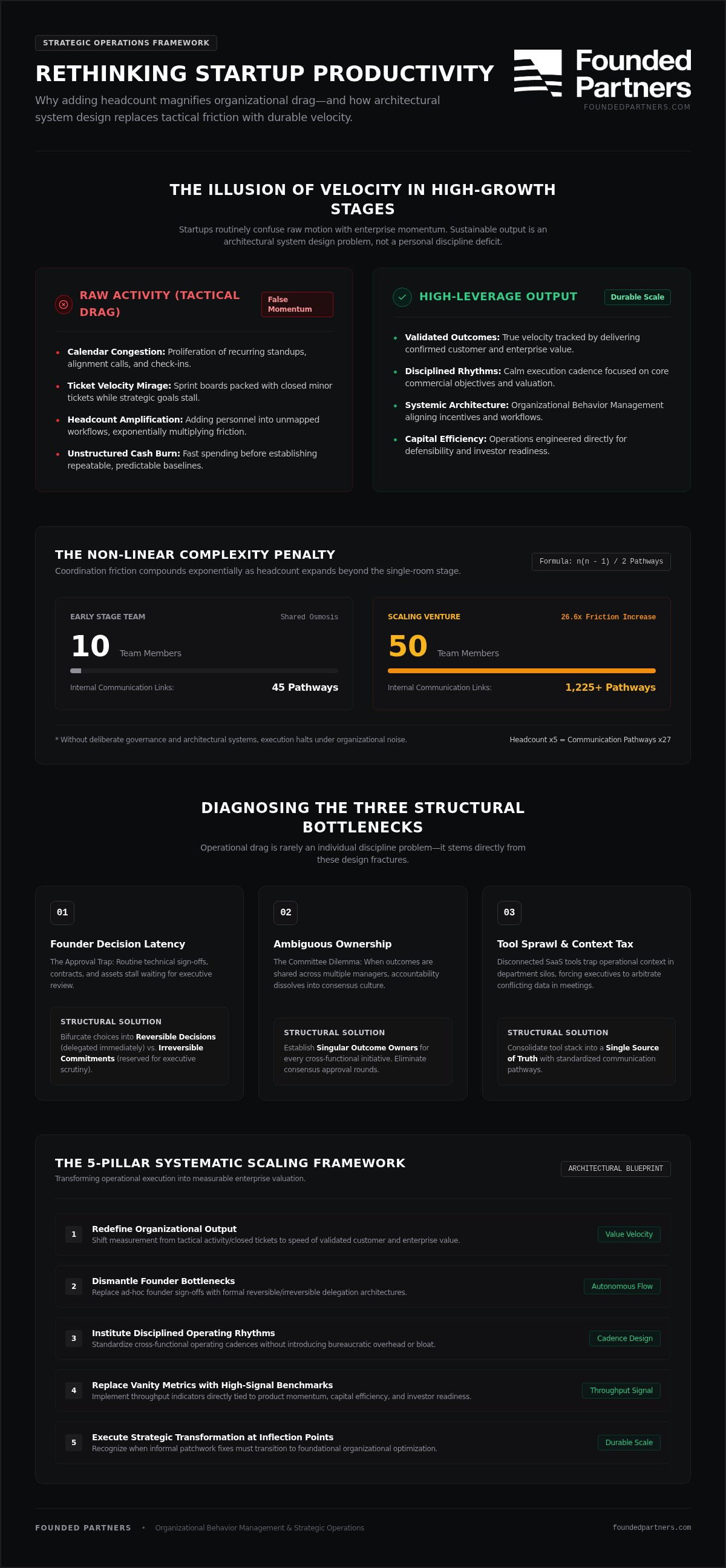
Startups frequently confuse motion with momentum. A calendar dense with recurring standups and a task board brimming with closed tickets feel productive, yet raw activity rarely equates to enterprise value. In scaling ventures, genuine productivity represents the velocity of generating validated customer outcomes and strategic commercial milestones. When leadership attempts to solve execution drag by simply adding headcount, communication channels multiply exponentially while true output stalls. Without clear operating systems, new hires amplify organizational drag rather than expanding capacity.
Sustainable execution is an architectural system design problem, not a personal discipline deficit. Generic productivity hacks like time-blocking or morning routines fail because they treat individual symptoms while ignoring systemic coordination costs. By applying Organizational Behavior Management principles to operational design, leadership teams can align workplace environments, incentives, and everyday workflows. The focus shifts from heroic individual effort to durable institutional performance.
The Illusion of Velocity in High-Growth Environments
Full sprint boards and rapid release cycles often mask stagnant strategic growth. Perceived operational urgency routinely masquerades as deliberate business momentum. Cross-functional teams scramble to ship minor updates or clear ticket queues while core commercial objectives slip from quarter to quarter. Unstructured expansion burns through cash reserves, leaving the enterprise vulnerable before repeatable baselines take root. Meaningful momentum requires calm, disciplined prioritization, ensuring every operational cycle strengthens valuation and long-term defensibility.
The Compounding Cost of Context Switching and Tool Sprawl
Growth without governance breeds chaotic software adoption. Different departments independently adopt disconnected platforms, trapping vital context inside siloed apps. When employees must juggle disparate task trackers, chat channels, and document wikis, the cognitive switching tax severely erodes deep, complex work.
Tool proliferation also creates conflicting internal realities. Executives end up burning valuable meeting hours arbitrating discrepancies between sales pipeline figures and product delivery timelines. Systematically improving startup productivity demands consolidating fragmented communication, establishing single sources of operational truth, and building structured decision pathways that keep teams moving in unison.
Diagnosing Root Causes: The Three Structural Bottlenecks Paralyzing Scaling Teams
Operational drag is rarely an effort problem. It is the visible symptom of underlying structural design flaws. When a business expands beyond the single-room stage where shared context happened by osmosis, informal alignment breaks down entirely. Internal coordination friction doesn't grow linearly with your team; it compounds exponentially. If ten team members share 45 communication pathways, fifty team members create over 1,200. Without deliberate governance, execution naturally grinds to a halt under the weight of its own complexity.
Diagnosing these systemic fractures is essential for leaders focused on improving startup productivity. Left unaddressed, structural bottlenecks quietly erode margins, stall product momentum, and undermine investor readiness before core business milestones are met.
Founder Decision Latency and the Approval Trap
Founders frequently create the very bottlenecks they complain about. When every commercial contract, feature branch, or marketing asset requires executive review, decisions stall. Highly capable leaders become hesitant, waiting for direction instead of taking ownership. While established productivity strategies for entrepreneurs often advise strict time audits, real relief requires clear delegation architecture. Categorizing choices into reversible decisions (empowering teams to move immediately) and irreversible commitments (reserving executive review for critical risks) dismantles this logjam.
Ambiguous Ownership and the Committee Dilemma
When multiple managers own an outcome, no one truly does. Consensus-driven cultures emerge from good intentions, but they cripple velocity during urgent growth windows. Committees default to the safest common denominator, blunting ambitious market positioning and stretching delivery timelines. Every critical company initiative demands a single-threaded owner with the authority, resources, and direct accountability to execute without seeking committee sign-off at every turn.
Communication Debt and Unstructured Meeting Cadences
Just as technical debt accrues from hasty coding, communication debt accumulates when organizations rely on ad-hoc conversations to drive alignment. Recurring status meetings and broad check-ins rarely solve coordination issues. Instead, they expose a lack of structured documentation and baseline trust. Moving to asynchronous, written briefing memos ensures that discussions center on decisions rather than status recaps.
Pinpointing where operational friction originates helps leadership transition from reactive firefighting to building durable systems. Engaging experienced partners in operations optimization allows founder-led teams to resolve these architectural bottlenecks, restoring execution velocity while laying the foundation for scalable enterprise value.
The Five-Pillar Framework for Systematically Improving Startup Productivity
Sustainable execution does not stem from heavy-handed corporate bureaucracy. It emerges from disciplined governance designed to liberate your team rather than restrict them. Improving startup productivity requires a deliberate architecture that provides clear operating guardrails while preserving speed. When structured thoughtfully, standardized workflows actually accelerate business agility by eliminating the daily confusion of who decides what and where information lives. This structural baseline serves as the core foundation in rigorous business scalability consulting engagements.
Pillars 1 and 2: Single-Threaded Ownership and Decision Architecture
Every operational domain requires a single accountable leader with clear decision rights. Establish this working rule across your leadership team: department heads maintain full autonomy over operational choices within their agreed budget and roadmap, requiring escalation only when a decision alters company burn, product scope, or brand positioning.
- Single-Threaded Mandates: Assign one explicit owner for every core commercial and operational initiative to eliminate diffuse accountability.
- Decision Logs: Document key trade-offs and decisions in shared written records to prevent circular debates when new personnel join.
- Escalation Triggers: Clarify the precise boundary between independent departmental execution and choices requiring founder sign-off.
Pillars 3 and 4: Asynchronous Cadences and Technology Stack Rationalization
Real-time chat and constant syncs fracture team focus. Move operational updates to structured, asynchronous briefing memos delivered at set intervals. Pairing this communication shift with software consolidation restores deep work. Early-stage teams often spend an average of $180 per month on five to six disparate software tools, accumulating technical clutter that creates operational friction. Audit your software inventory quarterly, decommissioning overlapping project boards and chat add-ons in favor of unified platforms with standardized data flows.
Pillar 5: Institutionalizing Scalable Operating Rhythms
Operational health requires an intentional heartbeat. Replace ad-hoc sprint reviews with structured quarterly planning cadences connected directly to measurable enterprise milestones and capital efficiency targets. Aligning internal reviews with board-level expectations ensures the company builds enduring value rather than chasing peripheral features. Most importantly, systematic operational discipline preserves founder energy, freeing executive focus for high-leverage market strategy and long-term enterprise growth.
Measuring Meaningful Velocity: Operational Output Benchmarks Versus Vanity Metrics
Measuring raw activity creates an optical illusion of progress. Tracking hours logged, tickets resolved, or lines of code written tells leadership nothing about commercial impact. In software development, for example, generative AI tools can inflate code volume overnight, but more code often just means more technical debt without increasing enterprise value. True throughput reflects how swiftly your organization converts capital and focus into customer validation, enterprise resilience, and revenue growth. This distinction is foundational when measuring business transformation success across scaling firms.
Replacing vanity tracking with high-signal operational indicators requires looking at friction through a clear lens:
- Meeting Volume vs. Decision Turnaround: Shift focus from how many hours teams spend talking to how quickly cross-functional proposals receive binding approval.
- Task Volume vs. Cycle Time: Disregard total tickets closed in favor of measuring total duration from strategic brief to production release.
- Headcount Growth vs. Revenue Throughput: Stop treating hiring targets as progress; evaluate capital efficiency and net revenue generated per employee.
Tracking Delivery Cycle Times and Decision Turnaround
Cycle time exposes organizational drag faster than any quarterly retrospective. Elite product organizations track pull request turnaround and delivery cycle times because these benchmarks reveal execution latency directly. Even more telling is executive decision turnaround time. When leadership takes days to approve commercial proposals or strategic roadmaps, team momentum dies. Improving startup productivity requires auditing the time initiatives spend waiting in review queues, identifying where departmental handoffs break down.
Assessing Team Cognitive Load and Retention of Critical Talent
Operational drag leaves unmistakable human footprints long before it triggers formal resignations. With payroll often accounting for over 75% of a startup's total operating expenses, losing key builders to process fatigue severely degrades enterprise value. Monitor context fragmentation by evaluating meeting-to-focus ratios across core technical and commercial teams. If senior talent spends more than a third of their calendar in status check-ins, your operational architecture is actively suffocating deep work.
When internal clarity drops, high performers walk out the door first. To protect your capital efficiency and install enduring operating benchmarks, engage Founded Partners for leadership advisory and operations optimization to realign your team for scalable velocity.
Scaling Operational Capacity: When to Engage Strategic Transformation Advisory
Every founder-led business reaches an invisible ceiling where informal agility turns into operational inertia. Tactical problem patching, such as hiring another project manager or signing up for another SaaS tier, only masks systemic issues. True operational optimization requires deliberate structural redesign. For leadership teams committed to improving startup productivity, recognizing when internal workflows can no longer support commercial ambitions marks the difference between hitting venture scale and burning through valuable capital reserves.
Strategic advisory bridges the gap between chaotic day-to-day triage and durable organizational design. Rather than applying rigid corporate templates, experienced partners help founders construct bespoke frameworks tailored to their growth stage. Reviewing a comprehensive growth consulting buying guide can clarify how external guidance strengthens internal leadership capabilities while preserving team autonomy.
Recognizing Critical Operational Inflection Points
Informal coordination systems reliably collapse when headcount crosses roughly 25 team members or annual revenue accelerates past initial product-market fit. At this stage, founders find their entire week swallowed by tactical firefighting, leaving zero bandwidth for overarching vision or strategic partnerships. Another critical inflection point occurs when operational friction begins impacting client deliverables, leading to missed product commitments or degraded service delivery. These breakdowns signal that your internal architecture is failing to scale alongside demand.
The Long-Term Dividend: Valuation, Scalability, and Founder Freedom
Durable operational architecture pays substantial financial dividends well beyond daily execution ease. Institutional investors scrutinize organizational resilience during due diligence; a business crippled by key-person dependencies on its founder trades at a severe valuation discount. Establishing systematic governance directly protects margins and supports capital raising or long-term exit planning.
Systemic operational discipline transforms fragile startup velocity into enduring enterprise value.
Founded Partners serves as a calm, seasoned peer for founder-led firms navigating these pivotal growth transitions. Led by Adam and Matt, who bring proven private market transaction records, the boutique advisory pairs hands-on operations optimization with high-level leadership advisory. By aligning internal operating rhythms with institutional investor standards, founders liberate their personal capacity while building an enterprise engineered for durable, profitable scale.
Transforming Operational Friction into Scalable Enterprise Value
Scaling velocity is never the byproduct of frantic effort or unchecked headcount. Real organizational momentum requires establishing single-threaded ownership, replacing meeting sprawl with structured asynchronous cadences, and measuring throughput by decision speed rather than activity volume. When you approach improving startup productivity as a deliberate architectural discipline, you eliminate founder bottlenecks and construct a business engineered to execute smoothly.
Making this transition doesn't mean adopting heavy corporate bureaucracy. It means building enduring systems that protect team focus and expand enterprise margins. Founded Partners brings seasoned, calm expertise through partners Adam and Matt, delivering deep specialization in operations optimization and business transformation for founder-led businesses. You don't have to navigate scaling frictions alone. Explore how Founded Partners helps founder-led firms build resilient operational architecture and turn operational velocity into your greatest strategic advantage.
Frequently Asked Questions
Why does adding more employees often decrease overall startup productivity?
Adding employees increases communication pathways exponentially, which rapidly magnifies operational friction. When a team expands without structured operating architecture, new hires spend more time seeking context and synchronizing schedules than producing work. Instead of accelerating output, unmanaged hiring dilutes institutional focus, fragments alignment, and drives up overhead. Without documented workflows and single-threaded ownership, expanding headcount inevitably slows execution speed rather than improving startup productivity.
How can a founder stop being the primary operational bottleneck?
Founders eliminate bottlenecks by instituting a clear decision framework based on reversibility. Reversible operational decisions should belong entirely to functional leads, reserving executive review strictly for irreversible strategic risks. Documenting clear operational boundaries allows leadership to transition from micromanaging daily approvals to setting core commercial outcomes. Pairing this delegation with transparent decision logs gives department heads full autonomy while keeping executive oversight focused on high-leverage company milestones.
What is the difference between operational motion and meaningful startup velocity?
Operational motion measures internal activity, whereas meaningful velocity measures the speed of creating validated customer and enterprise value. Motion looks like packed calendars, rapid-fire chat threads, and cleared task boards that generate little strategic progress. True velocity directly advances revenue targets, capital efficiency, and product milestones. High-performing organizations prioritize throughput that strengthens competitive defensibility and investor readiness rather than celebrating the sheer volume of daily busywork.
Which metrics best track operational productivity in early and growth-stage companies?
The best operational metrics evaluate execution latency and capital efficiency rather than raw hours logged. Focus on end-to-end delivery cycle time, executive decision response turnaround, and net revenue generated per employee. Monitoring context fragmentation, such as the ratio of meeting hours to uninterrupted focus blocks, also reveals operational strain before it causes talent attrition. These high-signal indicators provide an accurate assessment of organizational health and actual execution throughput.
How do we eliminate unnecessary internal meetings without sacrificing team alignment?
Replace verbal status check-ins with concise, asynchronous written briefing memos delivered on a strict cadence. Meetings should never serve as information broadcasts; reserve synchronous calls exclusively for complex problem-solving and consequential decisions. Establishing a shared repository of project updates and documenting operational choices preserves cross-functional clarity. This discipline protects deep work time for core builders while systematically improving startup productivity across the entire organization.
When should a founder seek external advisory for operations optimization and transformation?
Founders should seek advisory when internal coordination issues routinely consume executive bandwidth and stall commercial delivery. This inflection point typically surfaces around 25 to 50 employees or shortly after raising growth capital. Engaging seasoned transformation partners helps leadership implement scalable operating rhythms, remove structural bottlenecks, and prepare for institutional due diligence. Outside expertise provides the objective architectural guidance needed to support sustainable expansion and long-term exit planning.