
Leadership Advisory for Founders: Navigating Organizational Scale and Transition in 2026

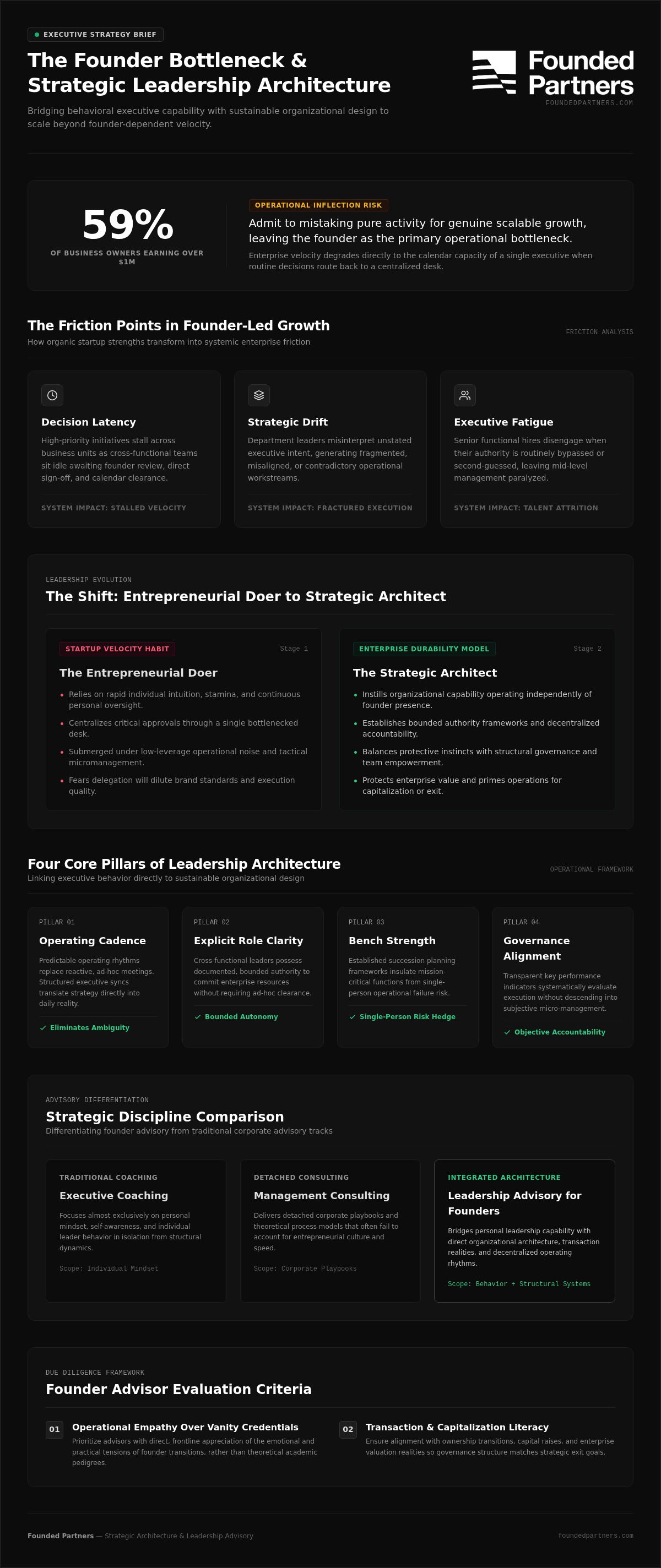
According to a March 2026 study, 59% of business owners earning over $1 million admit to mistaking activity for growth, with the founder remaining the primary operational bottleneck. You built the business through sheer determination, yet every major decision still routes back to your desk. When executive team misalignments slow momentum and stall execution, it's easy to feel trapped between the agile entrepreneurial doer you were and the enterprise chief executive your organization now requires. This inflection point is where leadership advisory for founders becomes vital.
Unlike standalone executive coaching that focuses solely on personal mindset, or management consulting that delivers detached corporate playbooks, this strategic discipline directly bridges leadership capability with organizational architecture. Discover how leadership advisory equips founders to break operational bottlenecks, evolve their executive capability, and scale sustainably. Ahead, we explore how to restore your operating rhythm, decentralize decision-making, and align your executive team to build enduring enterprise value for future capital raising or exit.
Key Takeaways
- Recognize the critical inflection point where centralizing decisions shifts from an entrepreneurial advantage into an organizational bottleneck.
- Discover how leadership advisory for founders builds disciplined operating rhythms and role clarity to decentralize authority without eroding culture.
- Differentiate leadership advisory from traditional executive coaching and management consulting to address systemic operational and transaction realities.
- Master a structured framework to evaluate potential advisors, prioritizing operational empathy and transaction literacy over vanity credentials.
- Learn how establishing leadership independence insulates enterprise valuation and positions the company for successful capital raises or exits.
The Founder Bottleneck: Why Organic Leadership Stalls at Scale
Every high-growth company reaches an inflection point where the founder's greatest strengths, rapid intuition, personal oversight, and relentless execution, transform into organizational friction. In the classic organizational life cycle, this crisis of autonomy marks the boundary between startup velocity and enterprise durability. Without deliberate structural evolution, organic leadership habits begin to produce predictable operational liabilities:
- Decision latency: High-priority initiatives stall as cross-functional teams wait for founder review and clearance.
- Strategic drift: Department leaders misinterpret unstated executive intent, generating fragmented or conflicting workstreams.
- Executive fatigue: Senior hires disengage when their functional authority is routinely bypassed or second-guessed.
At its core, leadership advisory for founders is a structured strategic and behavioral partnership designed to resolve this tension. Enterprise expansion demands more than sheer personal stamina; it requires building organizational capability that no longer depends on founder presence to function effectively.
Recognizing the Friction Points in Founder-Led Growth
When operational choices route back through a single office, enterprise velocity drops to the speed of one executive's calendar. Department heads hesitate to act without explicit clearance, leaving mid-level management paralyzed and disempowered during routine execution. This bottleneck drains strategic momentum and submerges the founder under low-leverage operational noise. Resolving this constraint requires aligning leadership habits with functional systems. By integrating targeted business scalability consulting, organizations establish explicit decision-making frameworks that replace centralized gatekeeping with disciplined, decentralized accountability.
The Psychological Shift from Entrepreneur to Enterprise Leader
Relinquishing tactical control is rarely just an operational challenge; it's an acute psychological transition. Founders often equate hands-on execution with enterprise stewardship, fearing that delegating authority will dilute product quality or operational standards. Enterprise maturity, however, requires shifting from an entrepreneurial doer into a strategic architect. Engaging with dedicated leadership advisory for founders provides the grounded perspective needed to make this leap. Leaders discover how to balance protective instincts with genuine empowerment, creating the governance necessary to scale sustainably without losing the agility that fueled early growth.
Core Pillars of Leadership Advisory: Architectural and Operational Support
Many traditional search firms reduce leadership support to recruitment checklists, yet sustainable scale requires operational architecture. Comprehensive leadership advisory for founders links executive behavior directly to organizational design. It integrates four core structural pillars: operating cadence, explicit role clarity, executive bench strength, and governance alignment. When grounded in practical business transformation consulting, this discipline constructs a resilient enterprise rather than imposing detached corporate mandates.
Leadership clarity doesn't destroy an entrepreneurial culture; it protects it. You can evaluate your leadership foundation using this essential checklist:
- Cadence: Predictable operating rhythms replace reactive, ad-hoc meetings.
- Autonomy: Cross-functional leaders possess documented, bounded authority to commit resources.
- Bench Strength: Established succession planning best practices shield critical operational functions from single-person risk.
- Accountability: Transparent key performance indicators measure execution without subjective micro-management.
Establishing Operating Rhythm and Executive Accountability
Operating cadences translate strategic intent into daily reality. Disciplined communication rhythms, such as weekly executive syncs and quarterly business reviews, eliminate ambiguity across business units. Modern leadership teams use operational frameworks to define clear boundaries, ensuring leaders know precisely where their ownership begins and ends. When tracking progress, founders rely on measuring business transformation success to monitor operational alignment and strategic velocity objectively.
Board Governance and Strategic Investor Relations
Venture-backed and private equity-backed firms face heightened scrutiny around corporate governance. Boards often default to compliance exercises rather than acting as strategic assets. By applying focused founder board management strategies, founders structure board interactions to generate genuine leverage. This operational discipline ensures governance workflows align with long-term enterprise value and capital raising milestones.
Transitioning from founder-dependent execution to systemic leadership requires proven methods. If you're looking to clarify executive roles and build a sustainable operating rhythm, exploring bespoke leadership advisory support can provide the steady external guidance your leadership team needs.
Leadership Advisory vs. Executive Coaching vs. Management Consulting
Founders confronting scale often recognize the need for external counsel, yet confusing distinct professional disciplines leads to misallocated capital and delayed growth. While executive coaching, management consulting, and leadership advisory share common ground, their scopes, execution models, and organizational outcomes differ significantly:
- Executive Coaching: Focuses inward on individual psychology, emotional intelligence, and interpersonal communication. The engagement centers on personal development rather than enterprise mechanics.
- Management Consulting: Focuses outward on technical business problems, financial models, and departmental processes. Engagements frequently deliver comprehensive diagnostic reports without embedding behavioral accountability.
- Leadership Advisory: Synthesizes individual executive evolution with organizational architecture. It directly aligns founder capabilities with workflow design, operating cadences, and transaction readiness.
True leadership advisory for founders serves as the strategic bridge between personal leadership maturity and structural organizational health.
The Limits of Standalone Executive Coaching
Executive coaching offers profound benefits for individual introspection, yet self-awareness alone cannot repair broken operational systems. A founder can master active listening and stress management, but if cross-functional delegation rules remain undefined, operational bottlenecks persist. Standalone coaching rarely addresses balance sheet pressures, board dynamics, or capitalization milestones. When behavioral changes occur in an operational vacuum, leaders often revert to instinctual firefighting the moment enterprise pressure intensifies.
Why Traditional Management Consulting Misses the Founder Context
Legacy consulting firms typically apply enterprise-scale playbooks that introduce heavy bureaucratic overhead, alienating agile teams and diluting speed. Furthermore, these firms frequently delegate delivery to junior associates who lack firsthand operating experience. Effective leadership advisory for founders requires seasoned partners who act as trusted peers. Experienced advisors understand that sustainable scale does not mean stifling innovation; it means constructing the operational clarity required to protect founder vision while accelerating execution.
How to Evaluate and Select a Founder Leadership Advisor
Choosing an advisor is an enterprise decision, not a personal luxury. Selecting the wrong partner wastes momentum, drains executive bandwidth, and leaves operational bottlenecks intact. When evaluating prospective partners for leadership advisory for founders, organizations should follow a disciplined five-step framework:
- Isolate core constraints: Pinpoint whether your primary friction lies in delegation, executive accountability, or long-term succession.
- Screen for direct operating experience: Prioritize advisors who have managed growth in founder-led companies over career theorists.
- Assess transaction literacy: Verify their capacity to connect governance frameworks with capital structures and exit horizons.
- Test behavioral candor: Present a live internal challenge during interviews to evaluate whether they offer courageous peer critique or deferential agreement.
- Define clear milestones: Establish measurable deliverables tied directly to decentralized decision-making and operational cadence.
Key Criteria: Track Record, Partnership Chemistry, and Holistic Scope
Proven advisors bring grounded operational empathy. They understand the visceral pressure of payroll, market timing, and founder identity. Beyond cultural chemistry, evaluate how their advisory informs broader enterprise initiatives. Strategic leadership development cannot exist in an administrative silo. It must connect seamlessly with operational performance and upcoming capital raising for founders, ensuring executive capabilities scale ahead of capitalization milestones.
Red Flags to Avoid When Choosing a Strategic Advisor
Avoid practitioners who lean entirely on inspirational slogans or standard executive coaching templates without operational depth. Be cautious of advisors who apply rigid, multi-layered enterprise playbooks that drown lean executive teams in bureaucracy. Finally, reject engagements that resist structural accountability. Effective leadership advisory for founders ties strategic guidance to tangible improvements in execution speed, team retention, and executive autonomy.
If you're ready to break through operational bottlenecks and build an enduring executive infrastructure, partner with Founded Partners to architect your enterprise transition with proven clarity.
Preparing the Enterprise for Capitalization and Ownership Transitions
Institutional investors don't buy personal genius; they invest in durable, repeatable systems. When an enterprise cannot operate smoothly without the founder's daily intervention, buyers and capital partners apply a severe key-person risk discount. Integrated leadership advisory for founders systematically resolves this vulnerability, transforming founder-dependent momentum into transferable enterprise equity that withstands scrutiny.
De-risking the Business to Unlock Premium Valuation Multiples
During acquisition or growth capital due diligence, investors evaluate operational continuity above all else. They examine whether strategic execution, client relationships, and team retention will hold after a liquidity event. Research shows that when a founder exits without structured management, up to 60% of the senior leadership team can depart within 12 months. Establishing an autonomous C-suite eliminates this risk and unlocks premium valuation multiples. Building this organizational independence is a core requirement for disciplined exit planning for founders who want to maximize enterprise value.
Building a Multi-Year Succession and Transition Roadmap
Sustainable transitions don't happen in the final weeks before signing a term sheet; they require multi-year roadmaps. Founders must design gradual governance handoffs that transfer genuine authority to internal leaders while safeguarding company culture. By stress-testing the leadership team through real operational milestones well ahead of a transaction, you protect performance and preserve team morale throughout diligence and closing.
Shifting from central operator to enterprise architect requires intentional design. Engaging in specialized leadership advisory for founders equips you with the operating rhythm, bench strength, and strategic clarity necessary to protect your equity and lead with confidence. When you're ready to explore how integrated advisory can prepare your business for scale or liquidity, start a strategic dialogue with Founded Partners.
Evolving from Central Operator to Strategic Architect
Scaling past the founder bottleneck isn't about putting in longer hours; it's about building an organization that thrives through decentralized execution. When you establish predictable operating rhythms, clarify decision boundaries, and cultivate an autonomous executive bench, you convert individual stamina into transferable enterprise value. Engaging specialized leadership advisory for founders delivers the strategic partnership needed to navigate this evolution, protecting your company's core culture while permanently eliminating operational choke points.
Founded Partners provides boutique advisory led directly by experienced transformation partners Adam and Matt. Relying on proven frameworks designed specifically for founder-led and privately owned companies, we connect executive leadership directly with operations optimization, capital raising support, and long-term exit planning. Sustainable scale isn't a solitary burden you have to carry alone. Partner with Founded Partners for strategic leadership advisory to steady your operational cadence and build an enduring enterprise ready for what lies ahead.
Frequently Asked Questions
What is leadership advisory for founders, and how does it work?
Leadership advisory for founders is an integrated partnership that connects personal executive development directly with organizational design and operating rhythm. Rather than delivering passive advice, an advisor works alongside the founder to diagnose operational bottlenecks, clarify decision-making authority, and establish structured management cadences. Engagements operate through regular strategic briefings, behavioral feedback, and hands-on governance alignment, ensuring the leadership team can execute independently without requiring constant founder intervention.
When is the right time for a founder to engage a leadership advisor?
The right time arrives when organic communication begins to fracture and the founder becomes a choke point for operational execution. Specific catalysts include preparing for growth capital, navigating executive team friction, or feeling overwhelmed by daily tactical decisions. Engaging an advisor before critical growth milestones ensures the enterprise builds scalable governance and executive bench strength, preventing the operational drag that frequently stalls expanding organizations.
How does leadership advisory differ from traditional executive coaching?
Traditional executive coaching centers almost exclusively on personal introspection, interpersonal communication, and leadership psychology. In contrast, leadership advisory bridges individual behavioral growth with organizational architecture, operational workflows, and capital strategy. While a coach helps a leader reflect on personal management habits, an advisor actively helps design the operating cadence, governance structures, and accountability systems needed to run an expanding business effectively.
Can leadership advisory help prepare a founder-led company for sale or capital raising?
Yes, establishing leadership independence is essential for maximizing valuation in capital raises or acquisitions. Institutional investors systematically discount firms where operational execution depends entirely on founder presence. An advisor helps build an autonomous executive bench, codifies operating cadences, and resolves key-person dependency risks well before formal diligence begins. This structural maturity protects performance and demonstrates sustainable enterprise value to prospective buyers.
How do leadership advisors resolve conflicts between co-founders or executive teams?
Leadership advisors resolve team conflict by separating emotional friction from structural operational ambiguity. They clarify overlapping functional responsibilities, establish transparent decision rights, and implement objective accountability frameworks. Acting as an impartial, trusted peer, the advisor facilitates candid executive dialogue that addresses strategic disagreements directly. This process realigns the leadership team around shared enterprise objectives rather than competing personal or functional agendas.
What metrics demonstrate the return on investment of leadership advisory?
Return on investment reveals itself through operational velocity and measurable leadership autonomy. Core indicators include decreased decision latency, higher executive team retention, and fewer daily tactical issues escalating to the founder's desk. Over time, financial returns appear in faster execution of strategic initiatives, smoother capital rounds, and higher valuation multiples driven by the elimination of critical key-person operational risk.
How long does a typical leadership advisory engagement last?
A typical engagement in leadership advisory for founders spans six to eighteen months, reflecting the time required to build and embed durable behavioral and operational changes. Early phases focus on diagnosing bottlenecks and establishing operating cadences, while subsequent months support executive delegation, governance refinement, and transaction preparation. The ultimate objective isn't perpetual reliance, but equipping the founder and executive team to steer sustainable growth independently.