
Sustainable Growth Strategies: The Founder’s Blueprint for Durable Scaling in 2026

According to research from the Startup Genome Project, 74% of high-growth businesses fail because of premature scaling. When top-line revenue climbs while operating profitability quietly erodes, founders don't feel empowered; they feel trapped in relentless daily firefighting. Building an enduring company requires disciplined sustainable growth strategies that balance commercial velocity with operational capacity.
You already know the familiar frustration: adding headcount doesn't automatically resolve execution bottlenecks. Instead, uncoordinated expansion often strains client delivery, bloats overhead, and leaves you tethered to every internal decision. When commercial momentum outpaces internal infrastructure, simply pushing harder increases the risk of leadership exhaustion and compromises strategic independence.
This guide shares how founder-led firms design resilient operational architecture, protect baseline unit economics, and secure compounding enterprise value without burning out. Ahead, we examine the practical methodology for synchronizing your operational capacity, capital readiness, and executive focus for durable scale in 2026.
Key Takeaways
- Learn how disciplined sustainable growth strategies safeguard operating profitability by balancing commercial momentum with genuine operational capacity.
- Examine the four structural architectural pillars required to establish autonomous workflows that operate smoothly without constant founder oversight.
- Identify the critical operational warning signs that distinguish healthy expansion from premature, margin-diluting scaling.
- Review a sequential four-phase execution roadmap that filters out non-core distractions and concentrates organizational energy on high-leverage outcomes.
- Discover how eliminating founder bottlenecks builds durable enterprise value, institutional investor trust, and multi-year exit readiness.
What Are Sustainable Growth Strategies for Founder-Led Companies?
Sustainable growth represents compounding enterprise value through operational resilience, disciplined capital allocation, and leadership endurance. For founder-led firms, sustainable growth strategies prioritize durable unit economics over undisciplined customer acquisition velocity. Rather than chasing headline expansion, this methodology synchronizes commercial demand with delivery capacity.
Unbridled top-line acceleration frequently destabilizes cash flow and strains company culture. When new business floods in faster than your delivery engine can execute, working capital compresses quickly. Receivables lag behind rising payroll, client satisfaction dips, and key employees absorb the structural friction until morale breaks. Growth ceases to be an asset when it cannibalizes the operational health of the enterprise.
Durable Scaling vs. Growth-at-All-Costs
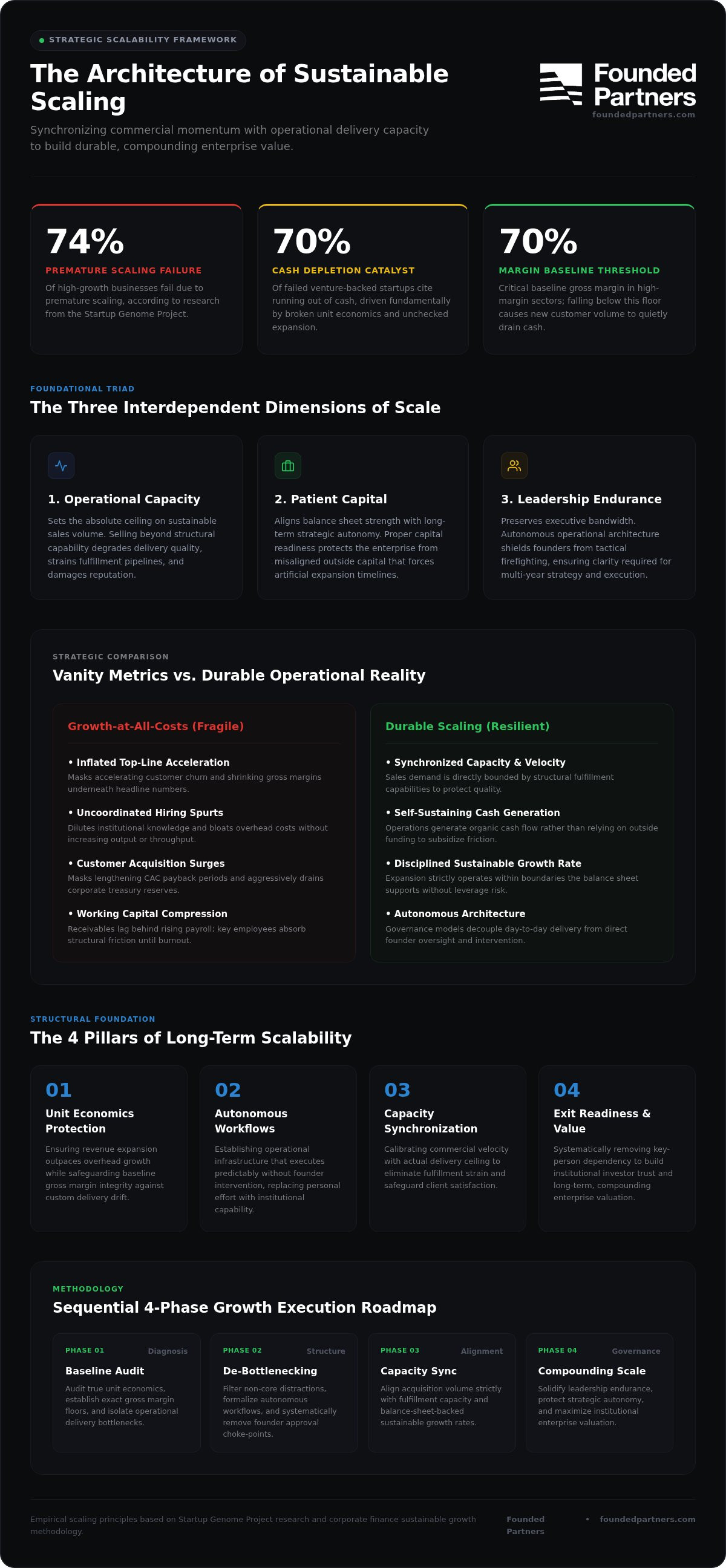
Burn-heavy scaling relies on continuous outside funding to subsidize operational inefficiencies. In contrast, durable expansion trajectories generate self-sustaining cash flows. Research indicates that 70% of failed venture-backed startups cite running out of cash as their terminal event, but the underlying catalysts are broken unit economics and premature expansion. In classic corporate finance, calculating your sustainable growth rate establishes the exact boundary of expansion your balance sheet can support without depleting working capital or taking on destabilizing leverage.
Vanity metrics routinely mask severe operational risks:
- Inflated top-line revenue often hides accelerating customer churn and shrinking gross margins.
- Rapid hiring spurts frequently dilute institutional knowledge and drive up overhead costs without improving throughput.
- Acquisition surges mask lengthening customer acquisition cost (CAC) payback periods, draining treasury reserves.
Macroeconomic shifts disproportionately punish businesses built without strong operational fundamentals. When capital costs rise, organizations running lean, cash-generative operations retain their strategic independence, while fragile peers face forced restructuring.
The Core Triad: Capacity, Capital, and Culture
Durable scalability operates across three interdependent structural dimensions:
Operational Capacity: Delivery capacity sets the absolute ceiling on sustainable sales volume. Selling beyond your structural capability degrades service quality, strains fulfillment pipelines, and damages market reputation.
Patient Capital: Sustainable expansion aligns balance sheet resources with long-term strategic autonomy. Proper capital readiness protects the enterprise from misaligned outside funding that forces unnatural expansion timelines.
Leadership Endurance: Company culture reflects leadership bandwidth. When founders remain trapped in tactical firefighting, execution suffers. Building autonomous operational architecture shields leadership from exhaustion, preserving the clarity needed for multi-year strategy.
The 4 Architectural Pillars of Long-Term Business Scalability
Sustainable enterprise expansion rests on four structural pillars built directly into the operating framework. Without these supports, top-line gains create organizational friction rather than compounding equity. Founders must design systems capable of running predictably without direct owner intervention. When addressing structural growing pains, partnering with specialists in business scalability consulting helps leadership establish true operational leverage rather than relying on raw headcount additions.
As outlined in the classic Harvard Business Review analysis on the five stages of business growth, companies must systematically adapt their governance and delegation models to bypass common expansion bottlenecks. Sustainable growth strategies convert idiosyncratic personal effort into reliable institutional capability.
Predictable Unit Economics and Margin Protection
Expanding sales volume must consistently fund overhead expansion. If gross margins slip below 70% in high-margin sectors or erode under custom delivery requests, each new customer quietly drains cash. Protect profitability by monitoring contribution margins closely, auditing hidden operational overhead, and establishing pricing power tied to differentiated client results rather than volume discounting.
Repeatable Operating Systems and Process Infrastructure
Converting individual craft into systemic capability eliminates single-point-of-failure risks. When essential processes live only in the founder's head, delivery breaks down during demand spikes:
- Codify core workflows: Map standard operating procedures to empower teams to execute independently.
- Decentralize decision rights: Establish clear operational thresholds so managers make calls without executive sign-off.
- Implement lightweight rhythms: Run weekly operational syncs to catch delivery defects before clients notice them.
Capital Efficiency and Strategic Funding Alignment
Growth capital should match balance sheet realities rather than create unnecessary dilution. Disciplined founders assess non-predatory growth paths through structured capital raising for founders, preserving both governance control and equity upside. Maintaining a healthy cash conversion cycle ensures receivables convert into liquidity before payroll and operational commitments come due.
Modular Leadership and Governance Architecture
Durable scalability requires evolving from a centralized founder hub into an autonomous leadership structure. When an enterprise operates smoothly across finance, operations, and commercial delivery without day-to-day owner direction, its underlying equity value multiplies. If you are assessing whether your organizational infrastructure can support your next growth horizon, reviewing your roadmap alongside an experienced partner at Founded Partners can clarify your high-leverage priorities.
Navigating Bottlenecks: Sustainable Scaling vs. Premature Expansion
Premature expansion creates an illusion of progress while silently compounding operational debt. Many leadership teams assume every new commercial opportunity warrants immediate hiring and capital outlay. Yet, according to findings from the Startup Genome Report, 93% of startups scaling prematurely fail to break through the $100,000 monthly revenue mark ($1.2M ARR). When organizations pursue aggressive growth targets before perfecting service delivery, structural cracks appear across every operational department.
Understanding these operational signals separates high-performing organizations from fragile competitors. The table below illustrates the contrasting realities of disciplined execution versus undisciplined expansion:
| Operational Dimension | Sustainable Scaling Profile | Premature Expansion Hazards |
|---|---|---|
| Delivery Capacity | Workflows absorb client volume smoothly | Onboarding friction and SLA breaches spike |
| Executive Focus | Founders steer strategic vision and capital | Founders referee routine tactical approvals |
| Operating Margin | Margins expand or hold steady as revenue rises | Negative economies of scale reduce net income |
| Team Morale | High retention through clear accountability | Exhaustion and turnover among key operators |
Recognizing the Operational Breaking Point
Operational bottlenecks rarely announce themselves overnight. They begin with subtle delivery friction: onboarding timelines slip, client tickets escalate, and senior managers jump into frontline firefighting. Harvard Business Review highlights the dangers of growing faster than organizational capabilities allow, showing how unmanaged speed erodes baseline client value. When top-line numbers increase but net earnings drop, the enterprise suffers from negative economies of scale.
Preserving Organizational Health and Company Culture
Rapid growth exposes cultural fragility. When work exceeds structural capacity, operational debt accumulates, team trust fractures, and top performers leave. Disciplined sustainable growth strategies protect company culture through deliberate boundaries:
- Eliminate ambiguity: Define measurable performance metrics so middle management acts without hesitation.
- Balance workloads: Guard your core team against systemic overtime to preserve institutional memory.
- Evolve rituals: Update foundational operating habits as headcount expands, keeping core standards intact without clinging to obsolete processes.
How to Execute a Sustainable Growth Strategy in 4 Phases
Execution fails when leadership treats expansion as a calendar exercise rather than an operational discipline. Moving from one expansion phase to the next must hinge on verified operational stability, not arbitrary dates. True strategic execution requires saying no to non-core opportunities so your enterprise can concentrate resources where it possesses a definitive advantage. Executing disciplined sustainable growth strategies demands an intentional, four-phase sequence.
When leadership teams seek experienced external partners to guide this transition, reviewing growth consulting for founder-led companies provides useful benchmarks for scoping outside advisory support against concrete operational milestones.
Phase 1: Operational Diagnostic and Foundation Hardening
Begin by conducting a rigorous audit across current service delivery pipelines, actual gross margins, and team capacity constraints. Prune unprofitable client accounts and non-core offerings that drain management focus. Stabilizing cash conversion cycles and building working capital reserves provides the runway needed to overhaul internal infrastructure without immediate financial distress.
Phase 2: Management Infrastructure and Role Delegation
Shift the founder from frontline firefighter to strategic architect. This evolution requires installing accountable functional managers across operations, finance, and client delivery:
- Establish clear delegation thresholds: Empower leaders with documented spending and contractual authorities.
- Implement operational scorecards: Track weekly delivery velocity, SLA adherence, and customer satisfaction instead of purely financial retrospectives.
- Protect strategic time: Remove the founder from recurring daily status syncs to restore executive focus.
Phase 3: Controlled Commercial Acceleration
Target customer profiles that maximize contribution margin while fitting cleanly into existing fulfillment capabilities. Refine sales qualification criteria to shorten deal cycles and prevent complex, customized commitments that derail delivery teams. Commercial spend should expand only as downstream onboarding capacity proves its ability to absorb volume smoothly.
Phase 4: Continuous Optimization and Feedback Loops
Build quarterly operational audits to detect administrative bloat and margin degradation early. Cross-examine overhead expenses against net revenue retention, benchmarking targets at 110% or higher to drive efficient expansion from current clients. Once operations run reliably, assess whether targeted growth capital can safely unlock validated market opportunities.
If operational bottlenecks are currently limiting your firm's potential, partner with Founded Partners to build your scaling roadmap and unlock durable enterprise value.
Building Enduring Enterprise Value: Aligning Growth with Exit Readiness
Sustainable growth strategies inherently maximize enterprise valuation by systematically removing company-founder dependence. Strategic acquirers and institutional investors don't pay premium multiples for volatile revenue spikes built on founder heroics. Instead, they reward predictable, transferable operating engines. Data from GF Data shows that lower-middle-market transactions command median multiples around 7.3× EBITDA, but platforms demonstrating operational maturity and size command substantial valuation premiums over fragile peers.
Exit readiness isn't a transactional project saved for the final year of operations. Building transferable value requires integrating long-term exit planning for founders into everyday scaling decisions. Every workflow codified, leadership role decentralized, and margin defended today directly expands your future liquidity options.
De-risking the Business for External Stakeholders
Institutional acquirers evaluate operational vulnerability long before they assess market potential. Mitigating structural exposure requires disciplined governance across three core operational areas:
- Institutionalize client relationships: Transition account management from founder charisma to structured account teams so no individual departure jeopardizes contract retention.
- Diversify revenue streams: Ensure no single customer represents more than 15% of annual revenue to shield gross margins from sudden churn.
- Maintain institutional financial rigor: Establish transparent reporting, clean reconciliations, and documented SOPs to pass rigorous due diligence without surprises.
Partnering with Strategic Advisors to Navigate Growth
Transactional consultants deliver slide decks and generic playbooks, then leave internal teams to manage the fallout. In contrast, experienced advisory partners act as strategic architects who walk alongside leadership through execution. Real operational transformation requires aligning day-to-day workflow optimization with multi-year ownership goals and balance sheet durability.
Founded Partners works directly with ambitious founders to design resilient operational architectures, refine leadership structures, and optimize capital strategies. Led by experienced partners Adam and Matt, the advisory brings calm expertise to mid-market organizations preparing for their next major evolution. When you are ready to build an enduring enterprise that grows predictably without consuming your life, explore how Founded Partners guides founders toward durable, self-sustaining scale.
Architecting Your Path to Durable Scale
True scale isn't about sprinting faster or chasing vanity revenue spikes. It's about engineering an enterprise where systems execute reliably, profit margins remain intact, and value compounds without constant founder intervention. When you execute disciplined sustainable growth strategies, you replace daily operational firefighting with enduring structural resilience.
Constructing this operational maturity requires seasoned, objective guidance. At Founded Partners, experienced partners Adam and Matt advise leadership teams directly, drawing on decades of collective experience navigating critical founder-to-CEO transitions. Their boutique advisory takes a holistic approach, aligning day-to-day workflow optimization with capital strategy, operational scalability, and long-term exit optionality. You don't have to navigate the friction of scaling alone. Partner with Founded Partners to build your sustainable growth architecture, and take confident, methodical steps toward building a business that thrives for years to come.
Frequently Asked Questions
What is the primary difference between sustainable growth and rapid scaling?
Rapid scaling prioritizes acquisition speed and headline revenue, often tolerating high cash burn and operational friction. Sustainable growth strategies, by contrast, synchronize commercial acceleration with actual delivery capacity and healthy unit economics. Instead of subsidizing expansion with constant outside capital, a sustainable approach ensures each new client relationship contributes positive cash flow, protects baseline margins, and strengthens the firm's underlying operational architecture.
How do I know if my business is growing too fast for its operational capacity?
Warning signs emerge first in delivery friction, client onboarding delays, and sudden spikes in customer support inquiries. Internally, you will notice employee burnout, eroding gross margins, and an executive calendar consumed by routine tactical firefighting. When increasing top-line revenue correlates with shrinking operating profit or operational quality lapses, commercial velocity has surpassed the delivery capability of your organizational infrastructure.
Can a founder-led business scale sustainably without raising venture capital?
Yes, many high-performing founder-led firms scale sustainably by reinvesting retained earnings and optimizing working capital cycles. Avoiding dilutive venture funding allows founders to retain governing control and make decisions aligned with multi-year enterprise health rather than artificial growth milestones. When outside funding is necessary, strategic capital support can help leadership evaluate non-predatory options that preserve equity upside and long-term autonomy.
How do sustainable growth strategies protect company culture during expansion?
Sustainable growth strategies protect culture by establishing predictable workflows, clear role accountability, and realistic delivery capacity thresholds. Uncontrolled expansion burns out key employees and causes high turnover, quickly diluting core operating values. By pacing commercial commitments to match operational throughput, leadership provides managers with the breathing room needed to mentor talent, maintain high execution standards, and preserve team morale over the long haul.
What key metrics should founders monitor to evaluate sustainable business growth?
Founders should look past vanity revenue and track net revenue retention (targeting 110% or higher), gross margin stability, and cash conversion cycles. Evaluating your customer acquisition cost payback period alongside operating margins confirms whether new accounts fund overhead expansion. A balanced scorecard pairs commercial velocity with delivery quality, tracking customer satisfaction and operational retention alongside balance sheet liquidity.
When should a business founder engage a strategic growth advisory firm?
Founders typically engage strategic advisors when internal bottlenecks stall execution, profitability declines despite rising revenue, or operations remain overly dependent on daily owner intervention. An experienced advisory partner provides the objective guidance needed to optimize workflows, restructure operational leadership, and align capital strategy, preparing the business for predictable, long-term scalability well before an eventual ownership transition or exit.