
Optimizing Internal Workflows: The Strategic Architect’s Guide to Scalable Operations

Most founders believe that hiring more people is the definitive cure for a growing workload, yet without a refined structure, you're often just adding more friction to an already strained system. It's exhausting to realize that you've become the primary bottleneck for every process, watching decision-making stall while operational debt quietly erodes your team's momentum. You deserve a firm that reflects your vision, not one that demands your constant intervention just to maintain the status quo.
We understand the weight of this transition. By focusing on optimizing internal workflows, you can shift your operations from a source of daily stress into a strategic asset that drives genuine enterprise value. This guide provides the clarity you need to professionalize your firm, refine your core processes, and strengthen your organizational health. You'll learn how to build a durable foundation that functions without your direct oversight, ensuring your business is prepared for its next major milestone, whether that's a capital raise or a successful exit.
Key Takeaways
- Shift your perspective from simple efficiency to organizational durability, building a firm that functions with precision regardless of your daily involvement.
- Follow a disciplined hierarchy of optimization by aligning your people and processes before investing in the digital platforms meant to accelerate them.
- Identify the specific operational red flags, such as the founder bottleneck, that quietly stall growth and prevent your team from delivering consistent outcomes.
- Discover how optimizing internal workflows directly increases enterprise value, positioning your business as a turnkey asset for future investors or acquirers.
- Adopt a methodical five-step framework to refine your operations with the long-term vision and discipline of a strategic architect.
Beyond Efficiency: Why Optimizing Internal Workflows is a Strategic Necessity
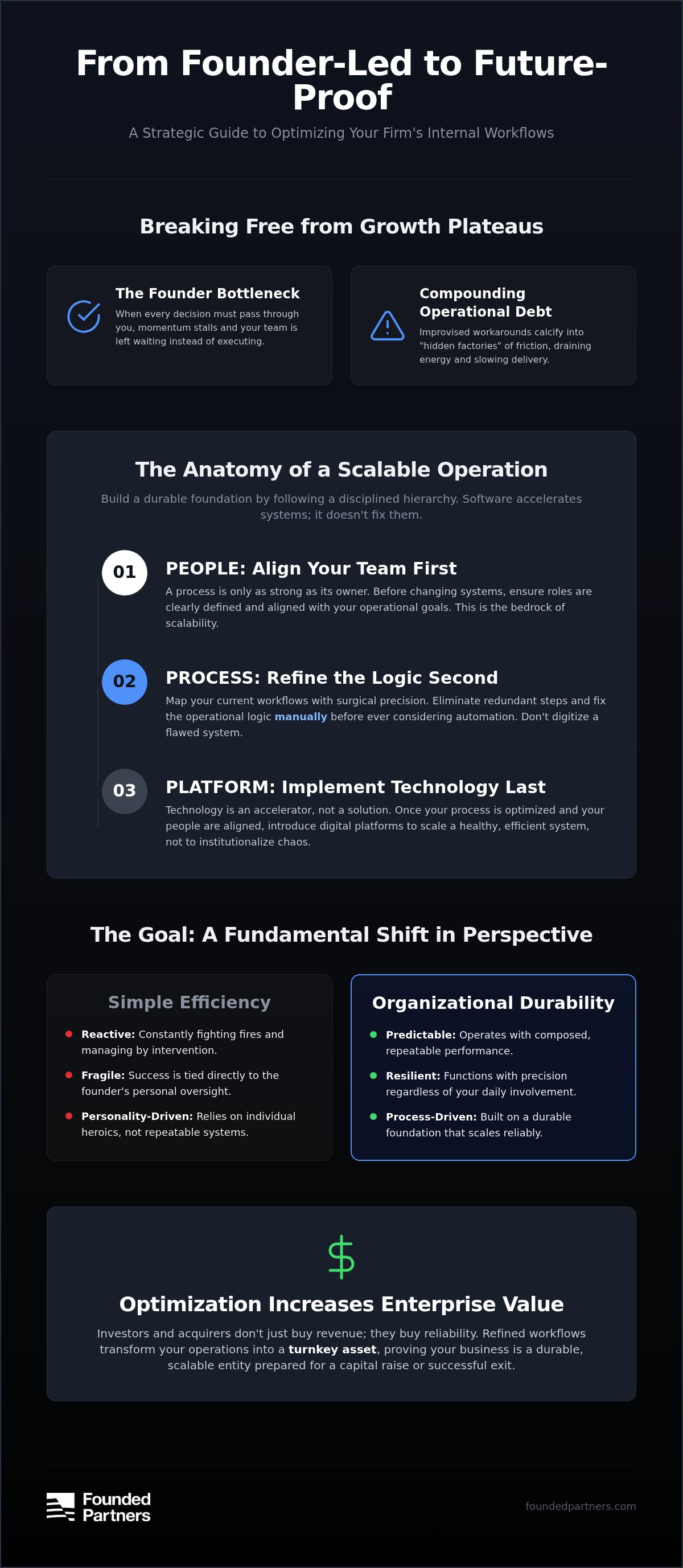
For many founder-led organizations, the initial surge of success is fueled by sheer willpower. You solve problems as they arise, often through manual intervention and personal oversight. However, as you scale, these improvised solutions begin to calcify into operational debt. This debt compounds just like financial interest, slowing down decision-making and creating a firm that is fragile rather than resilient. Optimizing internal workflows is the deliberate act of paying down this debt to ensure your business can withstand the pressures of rapid expansion.
We view this process not as a search for marginal gains, but as a fundamental shift toward organizational durability. While efficiency is a welcome byproduct, the true objective is to build a system that functions independently of its creator. This transition is a core component of Business Process Management (BPM), where the focus moves from individual tasks to the strategic orchestration of the entire enterprise. It's about moving from a state of constant reaction to one of composed, predictable performance.
The Cost of Brittle Processes
Brittle processes are often invisible until they break under the weight of a new contract or a Series A funding round. In these environments, a "hidden factory" often emerges, where your team spends more time managing the friction of a process than actually delivering value. This operational drag isn't just a matter of lost time; it's a drain on your most valuable asset: your people. Top-tier talent rarely leaves because the work is hard. They leave because the lack of clarity makes their jobs unnecessarily difficult. When your internal systems rely on manual workarounds, you risk losing the very experts you need to lead your next stage of growth.
Optimization as an Asset, Not an Expense
Investors and acquirers don't just buy your revenue; they buy the reliability of your future earnings. If your firm’s success is tied strictly to your personal intervention, its enterprise value is capped. Refined workflows transform your operations into a turnkey asset, making the business more attractive for a future exit or funding round. Ultimately, optimizing internal workflows is the architectural refinement of how value is created and delivered. By standardizing these pathways, you create repeatable outcomes that directly impact your exit planning for founders, proving to stakeholders that the firm is a durable, scalable entity rather than a personality-driven project.
The Anatomy of a Scalable Operation: People, Process, and Platform
Scalability is a structural challenge, not a software purchase. When optimizing internal workflows, founders often rush to the "Platform" layer, hoping a new project management tool or CRM will resolve deep-seated friction. This is a common strategic error. Software is merely an accelerator; if your underlying logic is flawed, technology only helps you make mistakes faster. A durable operation follows a strict hierarchy of needs: People first, then Process, and only then the Platform. Neglecting this order results in expensive digital tools that your team eventually abandons because the tools don't reflect the reality of how work actually gets done. Once you have achieved alignment across your people and processes, you can learn more about Trinity One and their AI-native operating system that integrates machine operations and people management into a unified platform.
Before introducing any automation, you must map your current "as-is" state with surgical precision. This means documenting every hand-off, every approval, and every manual workaround that currently exists. This exercise allows you to identify "value-add" steps versus "waste"—the redundant checks and balances that creep into a business during periods of rapid growth. There is a profound danger in automating internal business workflows that are fundamentally broken. By refining the sequence manually first, you ensure that the eventual digital solution scales a healthy system rather than institutionalizing chaos. True optimization requires the discipline to fix the logic before you buy the license.
Aligning Human Capital with Operational Flow
A process is only as strong as the person who owns it. As your operational architecture evolves, team roles must be recalibrated to match the new flow. This often requires a significant psychological shift, moving from a "hero culture" where individuals save the day through grit to a "system culture" where the workflow provides the security and the results. Professional Leadership Advisory can help navigate this transition, ensuring your culture remains intact while your operations gain the discipline required for a future capital raise or exit. We've seen that the most successful transformations occur when the team understands that optimizing internal workflows isn't about micromanagement. It's about creating the clarity they need to do their best work without constant founder intervention. When the right people are in the right seats, empowered by a clear process, the platform finally becomes the powerful asset it was intended to be.
Identifying the Operational Red Flags That Stall Founder-Led Growth
Growth often masks the underlying fragility of an organization. When revenue is climbing, it's easy to dismiss operational friction as "growing pains" or a temporary inconvenience. The most common objection we hear is that a team is simply too busy growing to focus on optimizing internal workflows. However, this perspective treats optimization as a distraction rather than the engine of growth itself. Without a disciplined approach to refinement, you aren't just scaling a business; you're scaling chaos. As your team grows beyond 20 people, the informal "hustle" that worked in the early days begins to produce inconsistent outcomes, threatening both your reputation and your organizational health.
The Founder Bottleneck: A Barrier to Scaling
The most visible red flag is the founder bottleneck. In the early stages, your personal oversight was a strength. Now, it's a liability. When every minor decision requires your approval, you've created a culture of permission rather than a culture of process. Your instinct for control, while originally a survival mechanism, now prevents your leadership team from stepping into their full potential. You'll know you've hit this wall when your team spends more time waiting for your feedback than executing their tasks. A successful business transformation requires a shift in identity from the "Chief Problem Solver" to the "Strategic Architect." By documenting operational frameworks, you delegate authority, not just tasks, allowing the organization to breathe and move without your constant presence.
Information Asymmetry and Communication Gaps
Information is the lifeblood of a scalable firm, yet in many founder-led businesses, it remains trapped as "tribal knowledge." This creates a dangerous data silo where critical insights live in the heads of a few veteran employees rather than in accessible systems. For a firm preparing for capital raising or an exit, this lack of transparency is a significant risk. Investors look for a "Single Source of Truth"—a clear, documented record of how the business operates. If your team relies on informal chats and memory to function, you face strategic misalignment and a massive duplication of effort. Moving toward optimizing internal workflows ensures that knowledge is institutionalized, protecting the firm’s durability and increasing its value to external stakeholders. This clarity is what allows a business to transition from a personality-driven project to a professionalized enterprise.
A Strategic Framework for Sustainable Workflow Refinement
Sustainable transformation isn't a one-time event; it's a disciplined practice of refinement. As a Strategic Architect, your goal isn't to fix every minor annoyance at once. Instead, you build for the long term by focusing on iterative improvements that compound over time. This methodical approach ensures that optimizing internal workflows becomes a core competency of your firm rather than a frantic response to a crisis. It's a journey that requires patience, clarity, and a commitment to the foundational health of your organization. By following a structured five-step framework, you can move from a state of friction to a state of flow.
Step 1: The Operational Audit
Success begins with an honest assessment of your current reality. Start by listening to the people on the front lines who navigate your systems daily. Conduct a "pain point" survey to identify the 20% of workflows that are responsible for 80% of your team's daily friction. This Pareto-driven approach allows you to focus your energy where it will have the most significant impact. During this audit, set clear KPIs for what "optimized" actually looks like. Whether you're targeting a reduced cycle time for client onboarding or a decrease in manual data entry, having a measurable goal ensures your efforts remain focused and productive.
Step 2: Mapping and Simplification
You can't fix what you can't see. Visualizing your current flow is the only way to reveal redundant hand-offs and the "hidden factory" of manual workarounds. Once the map is clear, apply the "Delete, Delegate, Defer" framework to every process. If a step doesn't directly contribute to value creation, delete it. If it doesn't require your specific expertise, delegate it. If it isn't a priority for your current stage of growth, defer it. Every remaining step in a workflow must have a clear owner and a measurable output, removing the ambiguity that often stalls progress in founder-led firms.
Step 3: Intentional Automation and Integration
Automation should be the final touch, not the first step. Once you've simplified the logic, select platforms that integrate seamlessly with your existing ecosystem to avoid creating new data silos. Focus on "low-hanging fruit" first, such as automated reporting or standardized data entry. Research indicates that automation initiatives can deliver an average ROI of 340% within the first year, but this value is only realized when the technology serves a healthy process. Keep your technology stack lean and purposeful to avoid "tool fatigue" and ensure your team remains focused on high-value work.
The final stages of this framework involve disciplined implementation and continuous refinement. You must monitor the new workflows against your established KPIs and remain ready to adjust based on real-world performance. This ongoing process is a vital part of your leadership advisory journey. If you're ready to professionalize your firm and build a durable foundation, our team can help you develop a tailored Scalability Strategy.
Transforming Operations into a Strategic Asset for Exit or Expansion
A business that relies entirely on its founder’s intuition is a job, not an asset. To build something of lasting value, you must transition from being the engine of the company to being its architect. By optimizing internal workflows, you create a firm that is transferable, measurable, and inherently more valuable. This shift is the cornerstone of effective exit planning for founders, as it proves to external stakeholders that your success is a result of a deliberate system rather than individual heroics.
Founded Partners acts as your guide through this vital transformation. We help you move beyond the daily friction of growth to build a foundation that supports your highest ambitions. Whether you're preparing for a transition or simply want a business that doesn't require your presence to thrive, the goal remains the same: creating a resilient organization that delivers consistent excellence. When your operations are professionalized, you aren't just improving efficiency; you're securing your legacy.
Operational Health as Investor Readiness
During due diligence, sophisticated investors look past the balance sheet to examine the "plumbing" of your organization. They want to see that your internal systems can handle a 10x increase in volume without collapsing. Documented, refined workflows serve as evidence of your business model's durability. This level of operational maturity is a prerequisite for successful capital raising for founders. When you can demonstrate that your processes are turnkey, you reduce the perceived risk of the investment and command a significant premium. You're selling a machine that works, not a problem that needs solving.
The Path Forward: From Founder-Led to System-Driven
The true reward of optimizing internal workflows is the psychological freedom it provides. When you no longer need to be the primary bottleneck for every decision, you can return to the high-level strategic work that inspired you to start the firm in the first place. This transition requires a business scalability consulting mindset that prioritizes long-term health over short-term shortcuts. It's about building a company that is both scalable and resilient, capable of thriving in any market condition.
Refining your foundation is a commitment to the future of your enterprise. It requires the discipline to look at the "how" as much as the "what." If you're ready to professionalize your operations and prepare for your next stage of growth, partner with a Strategic Architect at Founded Partners to begin your journey toward operational excellence.
Building a Legacy Beyond the Founder
Transitioning from a founder-led project to a system-driven enterprise is the ultimate test of leadership. We've explored how a refined operational foundation serves as a prerequisite for investor readiness and long-term durability. By focusing on optimizing internal workflows, you move beyond the daily friction of growth and start building a business that functions with precision. This shift doesn't just improve your team's morale; it directly compounds your enterprise value for a future exit or funding round.
Founded Partners is a boutique advisory specializing in this specific transformation for founder-led organizations. As Strategic Architects, we bring the expertise needed to build robust foundations for capital raising and successful transitions. You don't have to navigate this architectural refinement alone. It's time to trade the exhaustion of being a bottleneck for the security of a scalable operation. Partner with Founded Partners to architect your scalable future and ensure your business is ready for its next major milestone.
Frequently Asked Questions
What is the first sign that our internal workflows need optimization?
The founder becoming the primary bottleneck is the most definitive sign. When every decision stalls because it requires your personal approval, your firm's growth has outpaced its structure. You'll notice inconsistent outcomes despite hiring more staff, as new team members struggle without clear frameworks. This friction indicates that your current methods can't support higher volumes, suggesting it's time to begin optimizing internal workflows to maintain organizational health and scalability.
How long does a typical business transformation and operations optimization project take?
A meaningful transformation typically unfolds over three to six months, depending on the firm's complexity. We prioritize a methodical approach rather than rushing toward a superficial fix. The initial audit and mapping phase usually takes four weeks, followed by iterative refinement and implementation. This steady pace ensures that changes are durable and that your team has the psychological security needed to adopt new operational standards without feeling overwhelmed by the transition.
Can we optimize our workflows without losing the startup culture that made us successful?
You can preserve your culture by treating optimization as a way to empower your team rather than micromanage them. Discipline and agility aren't mutually exclusive; in fact, clear processes provide the freedom for your people to be more creative. By removing the stress of manual workarounds and "hidden factories," you allow the original passion of your startup to thrive within a more professionalized, sustainable framework that values character as much as competence.
Does optimizing internal workflows require hiring a full-time COO?
Optimizing internal workflows doesn't always necessitate a full-time COO, especially for mid-market firms. Many founders find that partnering with a boutique advisory provides the strategic architecture they need without the high overhead of a permanent executive hire. This approach allows you to professionalize your operations through targeted Scalability Strategy and Operations Optimization, giving you the steady hand of a seasoned advisor while you remain focused on the firm's long-term vision.
How does operational efficiency affect the valuation of a founder-led business during an exit?
Operational efficiency significantly increases your enterprise value by proving your business is a turnkey asset. Investors and acquirers pay a premium for firms that function independently of the founder, as this reduces their risk during the transition. A documented, system-driven organization suggests durability and predictable future earnings. In many cases, professionalized operations can lead to a higher multiple during an exit, effectively transforming your internal processes into a primary strategic asset.
What is the difference between process improvement and total business transformation?
Process improvement focuses on refining specific tasks for marginal gains, while business transformation is a fundamental shift in how the organization creates value. Transformation involves aligning your people, processes, and platforms to support a new stage of growth, such as capital raising. It's the difference between fixing a single leaky pipe and redesigning the entire architectural blueprint of the firm. Transformation ensures your business is healthy, resilient, and prepared for consequential transitions.
How do we identify which workflows are the biggest bottlenecks in our organization?
Identifying bottlenecks starts with an operational audit that measures cycle times and identifies where work most frequently stalls. You should look for "data silos" where information is trapped in individual heads or where approval loops are unnecessarily complex. Engaging your front-line team through surveys often reveals the 20% of workflows causing 80% of the friction. This clarity allows you to focus your refinement efforts on the areas that will drive the most immediate enterprise value.