
Scaling Operations Without Sacrificing Productivity: The Strategic Architect's Guide

What if the growth you've worked so hard to achieve is actually the very thing that breaks your business? While 74% of small business owners expect revenue growth in 2026, according to recent industry data from Baroganacsi, many will find that expansion introduces unexpected friction. You likely feel the weight of communication breakdowns and the creeping fear that you've become the ultimate bottleneck. Scaling operations without sacrificing productivity isn't about working harder. It's about refining the architecture of how work flows through your organization as it matures.
We understand the pressure of maintaining high-velocity execution while your team expands and new hires onboard rapidly. You want a business that thrives without your daily intervention, one that's genuinely ready for capital raising or a clean exit. This guide provides a strategic roadmap to build that resilient foundation. We'll examine how to document systems that protect your culture, eliminate operational friction, and transform your company into a self-sustaining engine of growth and performance.
Key Takeaways
- Identify the "Productivity Tax" and understand how communication pathways shift exponentially as your team expands beyond its initial core.
- Transition from individual heroics to architectural systems by adopting a Minimum Viable Process framework that balances operational discipline with creative freedom.
- Master the art of scaling operations without sacrificing productivity through high-level health checks that eliminate friction from lead generation to final delivery.
- Evolve your role from a hands-on founder to a strategic leader, ensuring the organization thrives without your constant daily intervention.
- Build a resilient operational foundation that satisfies the rigorous requirements of future investors and prepares the business for a successful exit.
The Scaling Trap: Why Productivity Declines During Growth
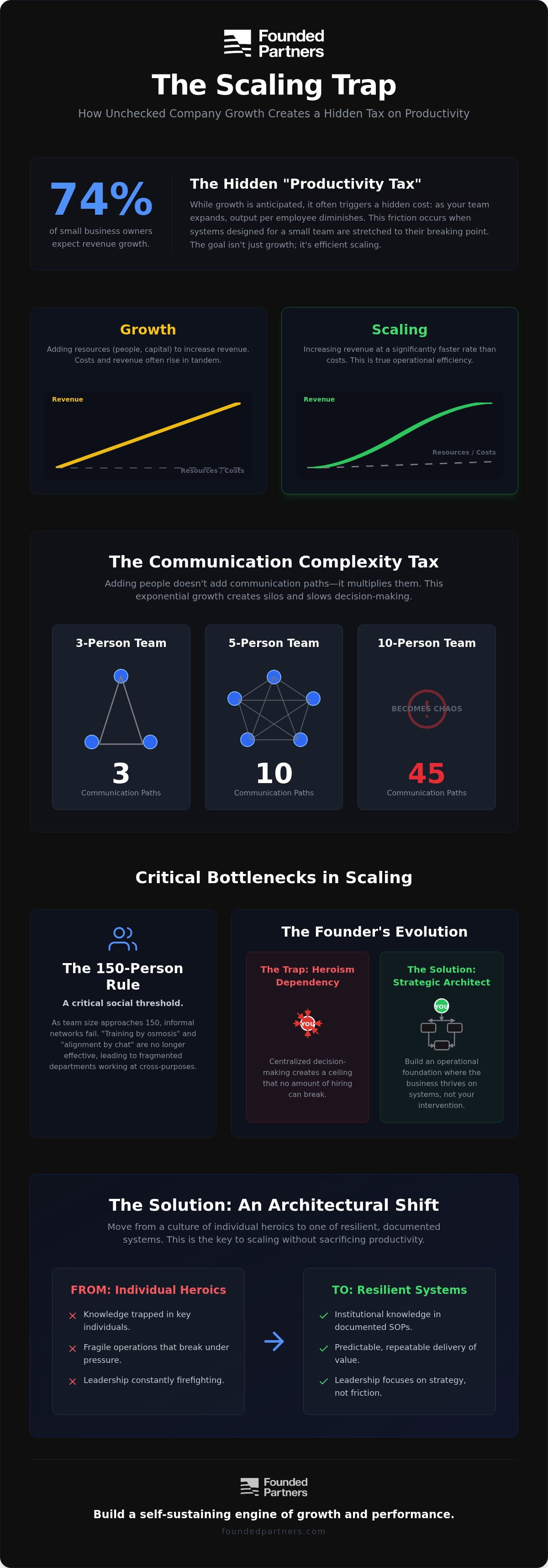
Growth is a double-edged sword. Most leaders view a rising headcount as a marker of success, but without a refined architecture, it often triggers a "Productivity Tax." This tax is the hidden cost where output per employee actually diminishes as the team expands. It's the friction that occurs when systems designed for five people are stretched to support fifty. True Scalability requires a fundamental shift in how you view expansion. While growth involves adding resources to increase revenue, scaling focuses on increasing revenue at a significantly faster rate than your costs. Mastering this distinction is the only way to ensure you're scaling operations without sacrificing productivity while maintaining your organization's health.
The "150-person rule" serves as a critical biological and social threshold. As you approach this size, the informal networks that previously held the company together begin to fail. You can't rely on "osmosis" for training or "alignment" through casual chats. If your operational health isn't prioritized, the organization becomes a collection of fragmented departments working at cross-purposes. This lack of cohesion is why many firms stall just as they seem poised for a breakthrough. You lose the agility of a small team without gaining the power of a large one.
The Complexity Tax of Communication
Communication doesn't grow linearly; it grows exponentially. When you add a fourth person to a three-person team, you don't just add one more conversation. You nearly double the potential pathways for information to travel. Information silos emerge when these pathways aren't managed. Decision-making velocity slows down as "more meetings" become the default symptom of poor structural design. These gatherings are rarely about long-term strategy. Instead, they're often desperate attempts to synchronize disconnected parts of a machine that's lost its rhythm.
The Founder as the Ultimate Bottleneck
Many founder-led firms suffer from a "Heroism Dependency." In the early days, your individual brilliance was an asset. Now, it's a liability. Centralized decision-making creates a ceiling that no amount of hiring can break through. It's a psychological hurdle. Delegating high-stakes tasks feels risky, yet clinging to them ensures you remain the ultimate bottleneck. You must transition from being the "Chief Problem Solver" to a "Strategic Architect." This shift isn't about working less. It's about building an operational foundation where the business thrives on systems rather than your constant daily intervention. Leadership advisory can be a vital partner here, helping you navigate the internal transformation required to let the organization breathe and grow.
The Architectural Shift: Moving from Heroics to Systems
Many founders believe that purchasing the latest project management software will solve their scaling woes. However, tools only execute strategy; they don't create it. A true architectural shift happens when you move away from a culture of individual heroics toward one of resilient systems. This is the essence of scaling operations without sacrificing productivity. It requires building a foundation that doesn't crumble when a key player leaves or when volume triples overnight. By engaging in business scalability consulting, you can define the long-term durability your organization needs to sustain its trajectory.
Documentation is often dismissed as a bureaucratic distraction, yet it's the most undervalued asset in a high-growth firm. Without it, knowledge remains trapped in heads rather than embedded in the organization. This creates a fragility that prevents true expansion. When you document your core processes, you aren't just writing manuals. You're institutionalizing your competitive advantage and ensuring that character and competence remain consistent as you grow. Systems provide the psychological security your team needs to perform at their peak without fear of failure.
Standardizing the 'How' to Protect the 'Why'
Standardizing your operations isn't about stifling creativity. It's about protecting the vision by creating repeatable playbooks for core business functions. These Standard Operating Procedures (SOPs) reduce the cognitive load on senior leadership, allowing them to focus on the future rather than the friction of the present. Operational Maturity is the predictable delivery of value at scale. By codifying the "how," you free your team to focus on the "why" that drives your brand's unique impact.
Automating for Human High-Performance
Automation should act as a force multiplier for your most talented people. Start by identifying low-value, repetitive tasks that drain team energy and stall productivity. Choosing technology that integrates with your existing workflows, rather than interrupting them, is vital. When machines handle the mundane, your talent is liberated for high-impact strategic thinking. This creates a virtuous cycle where efficiency leads to innovation, rather than exhaustion. If you're ready to refine these systems, our team offers operations optimization to help you build a more durable enterprise.
Designing Processes that Empower Rather Than Restrict
Process is often feared as the death of creativity. In reality, chaos is the true enemy of innovation. When your team spends significant energy wondering how to execute a task, they have less capacity to dedicate to the quality of the output itself. Designing processes that empower rather than restrict is the cornerstone of scaling operations without sacrificing productivity. It's about building the scaffolding that supports growth without creating a cage that stifles it. Structure should be the foundation that allows your talent to reach higher, not the ceiling that keeps them small. By refining these workflows, you replace frantic energy with a composed, strategic rhythm.
Bureaucratic bloat happens when organizations implement rules to solve one-time mistakes. This reactive approach leads to a thicket of constraints that paralyzes decision-making velocity. Instead, focus on building an operational architecture that prioritizes clarity over control. Fostering a culture where process is seen as an enabler allows your team to move with confidence. They don't have to ask for permission when the path is already clear. This shift transforms the organization from a collection of individuals into a unified, high-performance organism.
The MVP Approach to Operational Structure
The Minimum Viable Process (MVP) framework ensures you don't over-engineer your systems. Start by identifying the most critical bottlenecks that currently require your intervention. Document the essential steps needed to achieve a consistent outcome, then stop. You want to provide enough structure to ensure quality, reduce errors, and maintain standards without adding unnecessary friction. Iterative design is vital here. Refine your systems based on real-world feedback rather than theoretical ideals. When you empower teams to own and improve their own operational workflows, they become invested in the durability of the organization.
Maintaining Agility in a Growing Organization
As headcount rises, flat hierarchies often lead to hidden power dynamics and decision paralysis. We advocate for the "Commander’s Intent" model to maintain agility. Clearly define the objective and the constraints, then decentralize the decision-making process. This allows your team to adapt to changing conditions without waiting for a central command. Building feedback loops is equally important to catch operational errors before they scale into systemic failures. There's a profound connection between operational clarity and employee retention. Top talent thrives in environments where they can focus on high-impact work rather than navigating the exhaustion of poorly defined roles.
Operational Audits: Identifying and Eliminating Scaling Friction
You cannot refine what you haven't first diagnosed. While many leaders rely on anecdotal feedback or "checking in" with their teams, a true strategic architect uses a diagnostic approach to uncover systemic flaws. Scaling operations without sacrificing productivity requires a clear-eyed assessment of where energy is being wasted. An operational audit is not a performance review of individuals. It's a structural assessment of the environment in which they work. By identifying the friction points that slow down your organization, you can move from reactive firefighting to proactive optimization.
One of the most critical findings in any audit is "Shadow Work." This consists of the hidden, manual tasks employees perform to bypass broken or outdated systems. It might be a spreadsheet created to track data that the CRM should handle, or a redundant verification step because a previous error caused a crisis. Shadow work is a silent killer of organizational velocity. It consumes high-value talent on low-value activities, creating a drag on the entire enterprise that is often invisible until you look for it specifically.
The Value Stream Mapping Process
Mapping the value stream involves tracing the journey of a single unit of value from the initial lead generation to final delivery. You must identify every touchpoint where a human or a system interacts with that value. Pay close attention to "Wait States," which are the periods where work sits idle between departments or approval stages. Measuring the "Cycle Time" of your core deliveries provides a baseline for your current capacity. If your cycle time increases as your team grows, you've identified a scaling bottleneck that requires structural intervention rather than just more hiring.
Quantifying Friction and Opportunity
Productivity should be quantified through real output rather than vanity metrics like hours worked or emails sent. Use time-tracking audits to identify high-impact areas where optimization could yield the greatest return. In 2026, the cost of operational inefficiency is higher than ever, as competitors leverage automation to drive down their own delivery costs. Linking these audit findings to measuring business transformation success allows you to turn abstract improvements into concrete ROI. If your current systems feel like a collection of workarounds, our Operations Optimization services can help you rebuild for scale and durability.
The Founder’s Evolution: Leading the Scalable Organization
The final stage of expansion isn't found in a spreadsheet. It's found in the mirror. Transitioning from a hands-on founder to the CEO of a scaled enterprise requires a fundamental identity shift. You're moving from a state where you are the engine to one where you are the architect. This is the ultimate test of scaling operations without sacrificing productivity. It's about building an organization that reflects your values but doesn't require your pulse to function. Leadership advisory plays a vital role here, acting as a mirror to your own biases and helping you navigate the complex organizational changes that come with maturity.
Operational health is the silent driver of valuation. When you engage in capital raising for founders, sophisticated investors aren't just looking at your revenue. They're looking for a machine that produces revenue predictably. They're looking for evidence that the business can survive your departure. This same foundation is what makes exit planning for founders successful. A business that relies on your individual brilliance is a job. A business that relies on resilient systems is an asset.
The Psychological Shift of Scaling
The greatest barrier to scaling is often the "fear of losing control." It's a natural instinct to want to protect what you've built. However, clinging to every decision actually creates the very fragility you're trying to avoid. True leadership in a larger organization is built on systemic trust. You aren't trusting individuals to be perfect; you're trusting the systems you've designed to catch errors and guide performance. Character and integrity become your ultimate scaling multipliers. When your team trusts the intent behind the systems, they'll work within them to drive the organization forward. Developing this leadership stamina is what separates those who stall from those who truly scale. It requires the humility to admit you aren't the only one who can solve a problem and the discipline to let your team learn through execution.
Operational Maturity as an Asset Class
Investors and buyers pay a premium for "boring" operational excellence. They want predictability, sustainability, and durability. By reducing key-person risk, you're directly increasing your enterprise value. Every process you document and every workflow you automate adds a layer of security to your organizational foundation. This maturity transforms your company from a high-risk venture into a stable asset class. It demonstrates that you've built something substantial that can withstand market shifts and leadership transitions. You are no longer just a founder; you are the steward of a self-sustaining organism. Ready to build a durable foundation? Consult with a Strategic Architect at Founded Partners to begin your evolution.
Architecting the Future of Your Enterprise
Building a business that scales is fundamentally an act of architectural refinement. You've seen how the "Productivity Tax" can stall growth and why transitioning from individual heroics to resilient systems is essential for long-term health. By identifying shadow work through rigorous audits and evolving your own leadership approach, you create an organization that's durable, predictable, and ready for expansion. Scaling operations without sacrificing productivity requires a disciplined commitment to the "how" of your business, ensuring that your vision remains intact even as your headcount rises.
This structural clarity is the prerequisite for successful capital raising and a clean eventual exit. Founded Partners provides specialized advisory for founder-led firms, offering deep expertise in Series A+ scaling and exit readiness. Our boutique, partner-led approach ensures you have a trusted peer to guide you through every stage of organizational transformation. We focus on building the foundations that allow your enterprise to thrive without your daily intervention. Refine your operational architecture with Founded Partners and turn your organizational complexity into a competitive advantage. The road ahead is clear when your foundation is firm.
Frequently Asked Questions
What are the first signs that our scaling is hurting productivity?
Look for declining output per employee, increased wait states in project delivery, and a rise in shadow work. When team members spend more time in meetings than executing, or when the founder remains the primary bottleneck for every minor decision, your operational architecture is failing. These frictions indicate that your systems haven't evolved to match your headcount, leading to a productivity tax that drains your valuable resources.
How do I know if I need a Business Transformation Consultant or just better software?
Software is a tool for execution, while Business Transformation Consulting addresses the underlying organizational design. If your current friction persists despite having modern tools like Asana or Slack, the issue is likely structural rather than technological. You need a consultant when you require a strategic architect to redefine workflows, clarify roles, and build a resilient foundation that software alone cannot provide or fix.
Can we maintain our startup culture while implementing corporate-style processes?
You can protect your culture by focusing on Minimum Viable Processes that empower rather than restrict. Startup culture thrives on agility and autonomy, which are actually protected by clear operational standards. When you standardize the "how," you reduce the chaos that leads to burnout and frustration. Well-designed systems provide the psychological security your team needs to innovate, ensuring that scaling operations without sacrificing productivity doesn't result in cultural dilution.
How much should we invest in operations optimization vs. direct sales growth?
Investment must be balanced to ensure your delivery engine can handle the sales fuel. While sales drive immediate revenue, Operations Optimization ensures that revenue is profitable and sustainable. A common mistake is over-investing in growth while neglecting the foundation, which leads to service failures and reputational damage. Prioritize operational health as a prerequisite for any aggressive sales expansion to avoid the common scaling trap.
What is the 'Strategic Architect' approach to scaling?
The Strategic Architect approach views a business as a living organism that requires intentional design. Instead of reactive hiring, this method focuses on refining the workflows, communication pathways, and decision-making structures of the firm. It prioritizes long-term durability over frantic energy. By building a resilient operational foundation, the founder evolves from a daily problem-solver into a leader who directs a self-sustaining, high-performance organization.
Does operations optimization help with capital raising?
Investors pay a premium for operational maturity and reduced key-person risk. During due diligence, sophisticated investors look for evidence that your organization can scale operations without sacrificing productivity. They want to see documented systems and predictable outcomes rather than a business that relies solely on founder brilliance. Strong operational foundations demonstrate that your company is a stable, scalable asset rather than a high-risk venture.
How often should a growing firm conduct an operational audit?
Conduct a high-level operational audit at least once a year or whenever you hit major headcount milestones, such as 20, 50, or 150 employees. These thresholds typically trigger shifts in communication complexity and organizational dynamics. Regular audits help you locate shadow work and wait states before they become systemic. Proactive assessments ensure your architecture remains aligned with your current size and your future strategic objectives.
When is the right time to transition from founder-led heroics to systemic operations?
The transition should begin as soon as you find yourself involved in the daily minutiae of every department. If you've become the ultimate bottleneck for decision-making, it's time to shift toward systemic operations. Ideally, this evolution starts before a Series A round or a planned exit. Moving from heroics to systems ensures the business can thrive independently, which is vital for both your personal well-being and the firm's enterprise value.