
Business Transformation Consulting for Startups: Architecting Sustainable Scale

What if the operational bottlenecks slowing your startup aren’t a sign that the business is broken, but that its foundations need to evolve? Growth after funding can expose unclear decision rights, processes that depend on the founder, and pressure to move quickly without losing the culture that made the company distinctive. Business transformation consulting for startups helps founders address those structural challenges while keeping the original vision in view.
It can feel as though every important decision still runs through you. Sustainable scale, however, depends on building an organization that can act with clarity beyond the founder’s direct involvement. This article explores how strategic transformation can strengthen your operating model, clarify leadership roles, and protect the values that shape your culture. You’ll also learn how a more resilient business foundation can support future capital raising and exit planning. Transformation isn’t a repair job. It’s the considered work of preparing the company for the demands of its next stage.
Key Takeaways
- Identify where adding people or routing decisions through the founder may be creating friction instead of momentum.
- Think of transformation as strengthening the business foundation for sustainable growth, not making a collection of surface-level fixes.
- Use business transformation consulting for startups to assess strategy, operations, and leadership as connected parts of a scalable organization.
- Start with a practical assessment of decision bottlenecks, unclear responsibilities, and processes that need to support the next stage of growth.
- See how stronger operational health can support future capital raising and exit planning while helping preserve organizational value.
Why Rapid Startup Growth Demands Structural Transformation
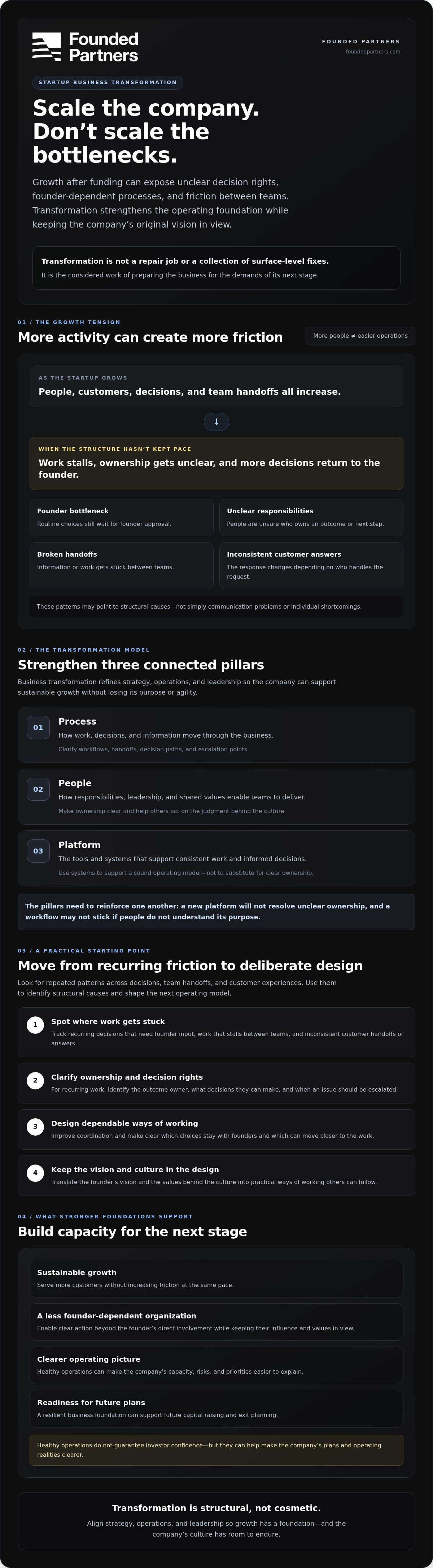
Funding can make growth look like mainly a hiring challenge. But when a startup adds people before clarifying how decisions are made, who owns outcomes, and how work moves between teams, complexity can grow faster than capacity. More people and activity do not automatically make a company easier to run. Without clear responsibilities and handoffs, more decisions may end up returning to the founders. Scaling means building the ability to serve more customers without increasing friction at the same pace.
The difference is structural. A founder who once resolved every customer issue and approved every priority can become the organization’s unintentional bottleneck. The answer isn’t to remove the founder’s influence or replace the company’s early culture with rigid processes. It’s to make the values and judgment behind that culture clear enough for others to act on them. Business transformation consulting for startups can help founders examine the operating model, leadership responsibilities, and decision pathways as one connected system. The Business Transformation concept provides a useful foundation: transformation reaches beyond isolated fixes to reshape how an organization works.
The Symptoms of Structural Strain
Strain often appears gradually. Teams begin solving problems in separate channels, information stops reaching the people who need it, and routine choices wait for founder approval. Customers may also receive different answers depending on who handles a request or which team owns the next step. These may be signs that roles, processes, or decision rights haven’t kept pace with growth, not just communication problems.
Founders can experience decision fatigue as they move from setting direction to reviewing details throughout the day. A practical first step is to track recurring decisions that still require founder input, where work stalls between teams, and where customers encounter inconsistent handoffs or answers. Look for repeated patterns across these examples. They can point to structural causes rather than individual shortcomings.
Transformation as a Proactive Strategy
Structural transformation replaces recurring firefighting with deliberate design. That can mean clarifying ownership, establishing dependable ways for teams to coordinate, and deciding which choices should stay with founders and which can move closer to the work. The aim is not process for its own sake. It’s an organization that can adapt while retaining the principles that shaped its culture.
Operational resilience matters when a company is planning its next stage of growth. Investors may look beyond headline growth to understand whether the company’s people, processes, and leadership can support its plans. Healthy operations don’t guarantee investor confidence, but they can make the company’s capacity, risks, and priorities easier to explain. Build the foundation intentionally, and growth has somewhere durable to go.
Defining Business Transformation Consulting for Startups: Beyond Surface-Level Fixes
Business transformation isn’t simply a new software platform, an accounting adjustment, or a broad change mandate handed down from the top. For a startup, it’s the connected work of refining strategy, operations, and leadership so the organization can grow without losing its purpose or agility.
Business transformation is the refinement of a company’s strategy, operations, and leadership foundation to support sustainable growth.
That refinement can be understood through three connected pillars:
- Process: How work, decisions, and information move through the business.
- People: How responsibilities, leadership, and shared values enable teams to deliver.
- Platform: The tools and systems that support consistent work and informed decisions.
These pillars need to reinforce one another. A new platform won’t resolve unclear ownership, and a revised workflow may not stick if teams don’t understand its purpose. Transformation should start with the founder’s vision, then translate it into practical ways of working. That helps a company strengthen its operations without treating culture as an afterthought.
Refining the Operational Core
Start by listing recurring work that depends on the founder, such as approvals, customer escalations, or decisions no one else feels authorized to make. For each, identify the outcome owner, what decisions that person can make, and when an issue should be escalated. Business transformation consulting can help founders assess whether workflows and responsibilities can support a larger organization. Automation may help with repeatable tasks, but human attention should remain where context, trust, and customer care matter.
Aligning Strategy with Vision
A strategy creates value when daily choices reflect it. An advisor can help connect long-term priorities to the decisions teams make, while surfacing where leadership direction doesn’t match frontline realities. For a startup, this needn’t mean imposing heavyweight corporate processes. It means setting clear priorities, feedback paths, and accountability so people understand how their work advances the company’s direction while retaining room to adapt.
In practice, business transformation consulting for startups should bring these elements together: strengthen operations, clarify leadership, and keep the founder’s intent visible as the organization evolves. Founders looking to develop that kind of foundation can explore strategic advisory for founder-led organizations.
Strategic Architect vs. Generalist: Choosing Your Advisor
The right advisor doesn’t just bring a framework. They understand when to adapt it. Some consulting engagements apply a defined approach to a defined problem, while advisory work may be shaped more closely around the company’s context, leadership, and stage of growth. Neither model is automatically right for every business. The question is whether the advisor can address your startup’s specific constraints without obscuring the founder’s vision beneath a standard playbook.
For business transformation consulting for startups, technical competence matters. An advisor should be able to examine operational health, leadership responsibilities, and scalability. Emotional intelligence matters, too. Transformation can affect decisions founders are used to owning and the culture employees want to preserve. A trusted advisor should be able to challenge assumptions respectfully, surface difficult trade-offs, and keep the conversation grounded in the company’s long-term health.
The Boutique Advantage for Founders
A boutique model can offer closer partner involvement and attention to the dynamics of a founder-led organization. Founded Partners is a boutique advisory partnership led by Adam and Matt, focused on founder-led organizations. When assessing any firm, ask who will lead the work, how you’ll engage with senior advisors, and how recommendations will reflect your company’s culture and pace. The answers matter more than the firm’s label.
Fit also depends on adaptability. A startup’s priorities can shift as customer needs, team capacity, and strategic goals evolve. Look for an advisor who can keep the work focused while adjusting its emphasis as new information emerges. Specialized consulting for founder-led companies can connect the realities of leadership and operations to the company’s next stage.
Generalist Firms: When They Fall Short
Broad experience can be useful, but a framework applied without enough attention to context may miss what makes a startup’s situation distinct: informal decision paths, a close-knit culture, or a founder still central to customer relationships. Layers of process may also be a poor fit for some companies. Rather than assume a generalist approach will be too slow or expensive, ask how the engagement is staffed, how recommendations are tailored, and how the work will stay practical.
A useful comparison starts with three questions: Does the advisor understand founder-led organizations? Will experienced partners stay meaningfully involved? Can they connect operational recommendations to leadership priorities and future value? Clear answers help distinguish a polished presentation from a genuinely useful partnership. Founders exploring an advisory relationship can learn more about Founded Partners’ strategic advisory and consider whether its approach fits their needs.
The Transformation Roadmap: Managing the Founder Transition
Transformation works best as a sequence, not a sudden reorganization. For founders, each phase should clarify what the business needs next and what leadership must change to support it. A practical roadmap moves from diagnosis to design, implementation, and the founder’s evolving role.
- Phase 1: Diagnostic. Trace operational friction to its source. Map where decisions wait, work is handed off, or customer issues repeatedly escalate to the founder. Separate recurring causes from individual incidents.
- Phase 2: Architectural design. Define the roles, decision rights, and operating rhythms required for the company’s next stage, including its ambition for 10x growth. Design around real priorities, not complexity for its own sake.
- Phase 3: Implementation. Introduce changes with clear ownership and communication. Gather feedback from the people doing the work, then refine processes when they create unintended friction.
- Phase 4: Leadership evolution. Shift the founder’s attention from recurring tactical decisions toward direction, culture, and the leaders accountable for execution.
The Founder-to-CEO Evolution
Letting go of tasks can feel like letting go of standards. The transition is more sustainable when founders make expectations explicit, delegate outcomes rather than isolated tasks, and establish clear points for review. Leadership advisory can help founders build a strategic architect mindset: setting direction, developing leadership capacity, and shaping culture without overseeing every move. The goal isn’t distance from the business. It’s leadership with greater leverage.
A useful test is whether a team lead can make a recurring decision using shared priorities and clear boundaries, then explain the reasoning. If not, the founder may need to clarify the principles before delegating further.
Building Organizational Resilience
Resilience comes from systems that can adjust when customer needs, team capacity, or market conditions change. Track operational health alongside growth: decision turnaround, recurring bottlenecks, customer experience patterns, and whether teams can deliver without constant founder intervention. Measuring transformation means assessing whether the organization is becoming more capable, not simply counting activity.
Sound operations and clear leadership can also support investment or exit readiness by making the business easier to understand and assess. Readiness isn’t a one-time milestone. It’s supported by disciplined operations and organizational clarity over time. For guidance on the founder transition and a scalable operating foundation, explore Founded Partners’ business transformation consulting.
Architecting Long-Term Value: The Founded Partners Approach
Transformation creates value when it strengthens the business beyond its next immediate milestone. Clear responsibilities, dependable operations, and leadership that can execute without constant founder intervention help make a company’s strategy more credible and its performance easier to understand. These foundations don’t guarantee a successful raise or exit. They can help founders explain how the business operates today and what it needs to grow sustainably.
That’s why business transformation consulting for startups can be a meaningful precursor to capital raising. Investors may look beyond growth plans to assess whether the organization has the leadership capacity and operational discipline to carry them out. A well-structured business can present its priorities, capabilities, and challenges with greater clarity, giving founders a stronger basis for a capital-raising conversation.
Preparing for the Next Milestone
Operational health supports readiness in practical ways. Clear ownership can make it easier to understand who is accountable for key outcomes. Consistent processes can help reveal where performance depends on individual effort rather than an organizational capability. Operations optimization is not a valuation formula, but it can strengthen the underlying business that future investors or buyers will assess.
Founders considering a raise can explore this capital raising guide for founders as they prepare to communicate their growth strategy. Looking further ahead, the same discipline can support exit planning for founders. Readiness is built over time, not improvised when a transaction is already underway.
The Partner-Led Commitment
Founded Partners works with founder-led organizations on business transformation, operations optimization, scalability, and leadership advisory, as well as capital raising support and exit planning. The boutique advisory partnership is led by Adam and Matt. The principle is straightforward: sound advice requires both competence and character. A trusted peer brings clear analysis, respects the people behind the business, and offers a steady hand through complex change.
This approach isn’t about imposing a template. It’s about helping founders make deliberate choices that fit their vision, strengthen organizational health, and prepare the company for its next consequential transition. The work can begin with an honest assessment: Where does execution still depend too heavily on the founder? Which operational strengths need to endure as the company grows? What capabilities would make a future raise or exit easier to explain?
If those questions are timely, discuss your startup’s transformation priorities with Founded Partners. A clear view of today’s operating foundation can help shape the next stage with greater intention.
Build a Foundation for What Comes Next
Sustainable scale is designed, not assumed. The strongest transformation connects strategy, operations, and leadership, giving a startup room to grow without making the founder the answer to every question. It also keeps the company’s original vision present as roles and ways of working evolve.
Choosing business transformation consulting for startups is ultimately a choice to build long-term organizational health, not just pursue the next growth milestone. With clearer operations and a stronger foundation for leadership, founders can approach future capital raising or exit planning with greater readiness.
Founded Partners provides strategic advisory for founder-led organizations, with a focus on operations optimization and scalability. If you’re considering what your business needs for its next stage, architect your startup’s next stage of growth with Founded Partners. The next chapter can begin with a thoughtful step toward a more durable business.
Frequently Asked Questions
What is the difference between business transformation and simple process improvement?
Process improvement refines a particular workflow, while business transformation addresses how the company’s strategy, operations, and leadership work together. For example, streamlining customer onboarding may fix a local delay. Transformation also considers ownership, decision-making, and whether the wider operating model can support growth. A startup may need both. The distinction is whether the goal is to improve one task or strengthen the business foundation as a whole.
When is the right time for a startup to hire a transformation consultant?
A startup may benefit when growth exposes recurring operational friction: decisions keep returning to the founder, teams struggle to coordinate, or customer delivery becomes inconsistent. You don’t need to wait for a crisis. Consider advisory when leaders can identify patterns but need help tracing their causes, clarifying responsibilities, and preparing operations for the next stage. The right timing depends on the company’s needs, goals, and willingness to act on what the assessment reveals.
How long does a typical business transformation engagement last for a startup?
There isn’t one standard timeline for every startup. The scope depends on the issues being addressed, the organization’s readiness, and how much change the team can absorb while continuing to operate. A focused assessment may differ substantially from work that also involves operational changes and leadership evolution. Before proceeding, clarify the intended outcomes, phases, decision points, and how progress will be reviewed with your advisor.
Will transformation consulting change our company culture?
Transformation can change how people work together, but it doesn’t have to erase the culture founders want to preserve. A thoughtful approach makes core values explicit, then reflects them in responsibilities, communication, and decision-making. For example, a company that values customer care can clarify who handles customer issues without requiring every matter to reach the founder. Invite team perspectives and explain why changes are being made so new structures support, rather than obscure, shared principles.
How do you measure the ROI of business transformation services?
Measure progress against agreed business outcomes, not activity alone. Depending on the transformation priorities, useful indicators may include decision turnaround, recurring work delays, customer experience consistency, or reduced reliance on founder approval. Compare a clear baseline with later results and consider the resources required to make changes. Not every benefit appears immediately as financial return. Stronger leadership capacity and more resilient operations can also contribute to long-term organizational value.
Does transformation consulting help with raising Series B or C funding?
Transformation consulting can help strengthen operations and clarify how the organization plans to support its growth, which may help founders prepare for funding discussions. It doesn’t guarantee an investment or provide venture capital funding. Founded Partners offers capital raising support alongside business transformation and operations optimization. Founders can use clearer roles, operating priorities, and an understanding of organizational needs to explain how their business is positioned to pursue its strategic objectives.
What is the role of the founder during the transformation process?
The founder provides context, sets strategic priorities, and helps determine which parts of the company’s culture must remain central as operations evolve. The role may also shift over time: rather than resolving every recurring issue, the founder can clarify decision boundaries and support leaders responsible for execution. Delegation works best when expectations are clear and feedback continues. Transformation is a partnership with the leadership team, not a change imposed on it.
How does Founded Partners differ from a traditional management consulting firm?
Founded Partners is a boutique advisory partnership led by Adam and Matt, focused on founder-led organizations. Its work centers on business transformation, operations optimization, scalability, leadership advisory, capital raising support, and exit planning. Rather than assuming a standard approach fits every company, founders should assess how any advisor will account for their goals, culture, and operating realities. Founded Partners brings strategic advisory together with support for capital raising and exit planning during consequential business transitions.