
Scaling Operations Without Losing Culture in Founder-Led Firms

Scaling does not dilute culture; poor operations do. Most founders view systems as the enemy of intimacy, fearing their firm will transform into a soul-less corporate machine as it grows. The truth is that culture is a deliberate operational output, not just a collection of shared values on a wall. When you prioritize scaling operations without losing culture, you are codifying the soul of your enterprise into its daily rhythm. You've likely felt the strain of communication breakdowns between veteran staff and new hires, or the burnout that comes from being the primary decision-making bottleneck. These are not signs of a failing vision, but of an architectural gap in your foundation.
We believe that growth should amplify your identity rather than dilute it. This guide demonstrates how to engineer a scalable operational foundation that protects your brand's essence while freeing you from the minutiae. You'll discover how to build autonomous teams that make culture-aligned decisions, refine systems that feel authentic, and transition from a hands-on manager to a strategic architect. By the end, you'll have a clear framework for strengthening your organization's health, ensuring your legacy remains intact as you reach new heights.
Key Takeaways
- Challenge the "scaling tax" by reframing growth as an opportunity to solidify your company’s identity rather than a necessary dilution of its soul.
- Discover how to turn abstract values into concrete operating principles by scaling operations without losing culture through robust, DNA-aligned systems.
- Identify and eliminate "operational debt" to prevent the accumulation of quick fixes from eroding team morale and organizational efficiency.
- Transition your leadership role from a primary decision-making bottleneck to a strategic architect who empowers autonomous, culture-aligned teams.
- Build a durable operational foundation that prioritizes long-term organizational health and sustainability over short-term vanity metrics.
The Myth of the Scaling Tax: Why Growth Does Not Have to Dilute Identity
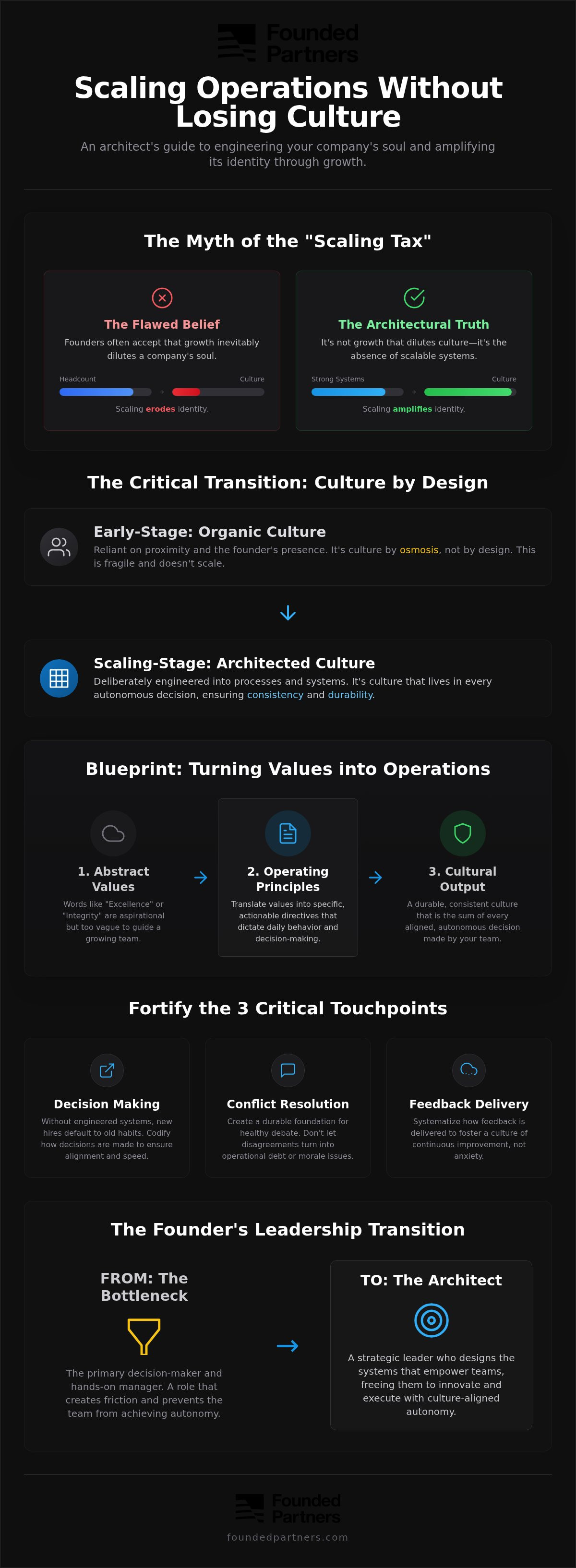
The "Scaling Tax" is the pervasive belief that organizational soul must be traded for headcount. Founders often accept this decline as an inevitable tax on success, watching as communication slows, decision-making bottlenecks, and the original spark dims. They assume that as the team expands, the essence of the firm must naturally evaporate. This is a fundamental misunderstanding of how great companies are built. Scaling operations without losing culture requires a shift in perspective: seeing growth as an architectural challenge rather than a loss of control. It demands a steady hand and a measured approach that we call "Calm Expertise."
In this framework, organizational culture is not a static relic preserved in a time capsule. It's a dynamic operational byproduct of how work actually gets done. When a firm struggles during expansion, the problem isn't usually the new hires; it's the lack of a scalable foundation. You don't lose your culture because you hired twenty people. You lose it because your systems weren't designed to support them, guide them, and empower them.
Proximity is Not Culture
In the early stages of a firm, culture is often a byproduct of shared physical space and constant proximity. It's organic, messy, and reliant on the founder being in every conversation. You mistake this osmosis for a sustainable strategy. As you grow, you must transition from an "organic culture" to an "architected culture" that lives within your processes. This isn't about losing the human touch; it's about ensuring that your values survive the transition from a small group to a complex organization. Culture is the sum of every autonomous decision your team makes when you aren't in the room.
The Fallacy of the Soul-Less Corporate Machine
Founders frequently resist formal systems because they fear the "soul-less corporate machine." They confuse bureaucracy with structure, assuming that any process will inevitably kill creativity. Bureaucracy is friction; it's red tape that serves the system rather than the client. Structure is clarity; it's the framework that enables speed, autonomy, and innovation. When you lack structure, your team spends their creative energy solving the same basic operational problems repeatedly. This creates an environment of high stress and low innovation. Scaling operations without losing culture means building the tracks so the train can go faster, not adding more weight to the engine. True freedom for your team comes from knowing exactly how the firm operates, allowing them to focus on the high-level work they were hired to do.
Culture as an Operational Output: Engineering Values into Systems
Many founders treat culture as a fragile heirloom to be protected. In reality, it is a living output of your organizational design. To achieve scaling operations without losing culture, you must move beyond aspirational values. Words like "excellence" or "integrity" are too vague to guide a growing team. Instead, you need Operating Principles: specific, actionable directives that dictate daily behavior. These principles serve as the architectural blueprints for your firm, ensuring that even as you double your headcount, the character of the work remains consistent.
Culture is most frequently lost at three critical operational touchpoints: how decisions are made, how conflict is resolved, and how feedback is delivered. Without engineered systems for these moments, new hires will default to their previous company's habits. By defining the "how" in these areas, you create a durable foundation that doesn't rely on your constant presence. This architectural approach ensures that your firm’s identity is amplified by growth rather than diluted by it.
Designing SOPs with Character
Standard Operating Procedures are often viewed as cold, technical manuals. This is a missed opportunity. A culturally-aligned SOP doesn't just tell an employee what to do; it explains how we treat the problem. For example, a client onboarding workflow shouldn't just list technical steps. It should embed your brand's unique character into every interaction, turning a routine task into a cultural reinforcement. Refining these workflows is a core part of operations optimization, ensuring your systems feel like an extension of your vision rather than a replacement for it.
Hiring for Alignment, Not Just Competence
The average cost of turnover per employee has risen to $45,236 in 2026, making cultural alignment a financial necessity. Competence is the baseline, but character is the multiplier. Your interview process must be engineered to filter for core values through behavioral assessments and scenario-based testing. A "brilliant jerk" might deliver short-term results, but they act as a toxin in a scaling organization, eroding trust and morale. Integration doesn't end at the offer letter. The first 90 days of onboarding must be a deliberate immersion into the firm's operating rhythm, teaching new hires not just how to use the tools, but how to think like a partner in the business.
The Operational Debt Trap: How Efficiency Gaps Actually Erode Morale
Operational debt is the silent erosion of a firm's foundation. It represents the accumulation of manual workarounds and "quick fixes" that were necessary during early-stage growth but fail under the weight of expansion. When these gaps go unaddressed, they become a primary source of cultural rot. Scaling operations without losing culture is an impossible feat if your team is constantly forced to navigate broken processes. Chaos isn't a sign of "startup energy"; it's a symptom of operational neglect that leads directly to employee disengagement and eventual turnover.
Many founders respond to these bottlenecks by encouraging their team to "work harder." This is a dangerous misstep. Working harder is not a strategy; it's a symptom of failing leadership architecture. When the system is broken, effort becomes a finite resource that eventually runs out. To maintain organizational health, you must shift focus from vanity metrics like headcount or top-line revenue to more durable indicators. In 2026, global employee engagement fell to 20 percent, costing the world economy an estimated $10 trillion in lost productivity. This loss is rarely caused by a lack of vision; it's caused by the friction of poorly designed work.
The Friction Factor
Daily operational friction is the leading driver of "Quiet Quitting" in scaling firms. When a team member encounters a bottleneck for the hundredth time, their commitment to the vision begins to fray. They stop seeing themselves as part of a mission and start seeing themselves as cogs in a dysfunctional machine. Identifying the specific bottlenecks that cause team frustration is a requirement for any partner-led firm. Operational clarity is the foundation of psychological safety. When your team knows exactly how to execute their tasks, they have the mental space to be creative, collaborative, and engaged.
Refining the Core
Refining your core operations involves a ruthless commitment to business optimization. By removing low-value tasks and automating redundant processes, you free your team to focus on high-impact work. The average cost of turnover per employee has risen to $45,236 in 2026, making the retention of talent a critical financial objective. Re-investing saved time into high-impact cultural moments allows your brand's essence to remain at the forefront of the employee experience. Efficiency is the greatest protector of culture because it removes the noise that prevents your values from being heard.
The Founder’s Transition: Scaling Leadership Architecture
The most difficult hurdle in scaling operations without losing culture is often the founder’s own psychology. To build a firm that outlasts your daily intervention, you must transition from being the primary engine of the business to becoming the architect of its systems. This shift requires moving away from the frantic energy of micro-management and toward a model of strategic leadership advisory. You are no longer responsible for every decision; you are responsible for the framework that makes those decisions possible. This architectural approach ensures that your vision is not just a personal passion, but a scalable reality.
Building a "Second Layer" of leadership is the only way to carry your culture into a larger organization. You cannot be in every meeting or oversee every project as you grow. Instead, you must cultivate a team of leaders who possess the same character and commitment to the firm's health that you do. This requires a steady hand and a willingness to invest in the long-term development of your people over short-term vanity metrics. Specialized training from intactacademy.com can help facilitate this growth by providing the coaching expertise needed to lead through organizational change. When you empower others to lead, you aren't just delegating tasks; you are distributing the soul of the company.
Delegation is not just a tactical hand-off; it is a profound cultural act. Many founders struggle to let go because they fear that no one will care for the vision as deeply as they do. This hesitation stunts growth and signals to the team that they are not fully trusted, which eventually erodes the very culture you are trying to protect. A robust "Trust but Verify" framework allows you to scale without losing oversight. By empowering your team to own the "Why" behind their tasks, you ensure that cultural DNA is preserved in every output. This autonomy is what allows your firm to remain authentic as it expands.
Communication Rhythms for Scaling Teams
Scaling teams require rhythmic, intentional communication over frantic, ad-hoc updates. As your headcount grows, the "State of the Company" speech becomes less effective than daily operational alignment. Research from 2026 identifies middle managers as the most pressured and influential layer in organizations, making their development a top priority for sustainable growth. A Leadership Advisory partner can help you build this essential layer, ensuring your culture is carried by a team that shares your commitment to excellence. Through transparent feedback loops and structured rhythms, you build organizational resilience that allows the firm to thrive independently of your constant presence.
Building for the Future: Strategic Advisory with Founded Partners
Scaling operations without losing culture is not a destination; it's a discipline. As a founder, you've built something substantial through sheer will and vision. However, the next stage of your journey requires a different set of tools. At Founded Partners, we act as the Strategic Architect and Trusted Peer for founder-led firms navigating the complexities of expansion. Our Business Transformation Consulting focuses on building a foundation that is durable, sustainable, and authentic to your brand's character. We provide the steady hand and calm expertise needed to ensure your organization's health remains the priority, even as you pursue aggressive growth targets.
Our Scalability Strategy moves beyond vanity metrics to focus on the architectural nature of business building. We understand that the "how" of your process is just as important as the "what." By refining your systems and strengthening your leadership architecture, we help you manage the transition from a hands-on founder to a strategic leader. This evolution allows you to protect your original vision while creating a business that runs efficiently without your constant intervention. We partner with you to refine, guide, and strengthen your firm for the long term.
Business Transformation with Purpose
Our methodology for operations optimization begins by identifying the operational red flags that threaten your culture. We look for systemic friction, communication silos, and decision-making bottlenecks that erode team morale. Once identified, we align your daily operations with your long-term strategic vision. This ensures that every process, from client onboarding to internal reporting, reinforces your brand's identity. Having a Trusted Peer by your side provides the psychological security and strategic clarity required to navigate these transformations with confidence. We focus on the act of refining your foundation so that your culture becomes a scalable asset rather than a growth constraint.
Your Next Stage of Growth
Whether you are preparing for capital raising or planning an eventual exit, your enterprise value is directly linked to your cultural durability. Investors and buyers look for organizations that possess a life of their own, independent of the founder's daily presence. A firm that has mastered scaling operations without losing culture is significantly more attractive because it demonstrates a repeatable, sustainable model for success. We help you build this operational excellence today, ensuring you are ready for the opportunities of tomorrow. If you are ready to engineer a foundation that amplifies your identity, schedule a strategic briefing with Founded Partners to discuss your firm's next stage of growth.
Architecting a Durable Legacy
Building a firm that thrives beyond your daily intervention is the ultimate expression of founder-led success. Success requires recognizing that culture is not a static ideal to be protected, but a dynamic operational output to be engineered. By addressing operational debt and transitioning from a hands-on manager to a strategic architect, you create the space for your team to lead with autonomy and alignment. Scaling operations without losing culture requires a disciplined commitment to the "how" of your process, ensuring that every system reflects your original vision.
This transition is rarely straightforward, but you don't have to navigate it alone. Founded Partners offers strategic advisory tailored for founder-led organizations, providing the calm expertise needed for complex business transformation and exit planning. Our partner-led approach prioritizes character and competence, helping you build a foundation that is both efficient and authentic. Partner with Founded Partners to scale your operations with purpose.
The next stage of your growth is an opportunity to amplify your impact. With the right systems in place, your firm's best days are ahead.
Frequently Asked Questions
Can a company really scale its culture as it grows past 50 employees?
Yes, but it requires transitioning from organic osmosis to architected systems. At 50 employees, a founder can't maintain a direct relationship with every team member. Scaling operations without losing culture involves codifying your values into specific operating principles. This ensures new hires make decisions aligned with your identity without needing your constant presence. It's about building a framework that replicates the soul of the business through process.
What are the first signs that our operations are failing our culture?
The most common indicators are rising employee turnover and persistent decision-making bottlenecks. Replacing a single employee in 2026 costs between 0.5 to 2 times their annual salary, making this both a financial and cultural crisis. Other signs include communication breakdowns between veteran staff and new hires or a sense of "operational debt" where quick fixes cause daily frustration. If your team feels burned out, your systems are likely eroding your culture.
How do I introduce SOPs without making my team feel micro-managed?
Frame your systems as tools for autonomy rather than instruments of control. Explain that a well-designed SOP removes the mental load of routine tasks, allowing the team to focus on high-impact creative work. When you define the "how" of a process, you provide the clarity needed for psychological safety. Involve your team in the creation process to ensure the systems feel authentic to their daily reality and your brand's unique character.
Is it possible to scale a founder-led business without the founder being involved in every decision?
It's entirely possible if you build a robust leadership architecture. You must transition from being the primary decision-maker to becoming a strategic architect who designs the systems others use. By empowering a second layer of leadership and establishing clear feedback loops, you ensure the firm runs efficiently. This shift allows you to focus on high-level strategy and organizational health while the team handles day-to-day operations autonomously and effectively.
What is the difference between organizational health and business growth?
Business growth focuses on vanity metrics like headcount and top-line revenue, while organizational health measures the durability of internal systems and team alignment. A firm can grow rapidly while its health declines due to operational debt and disengagement. Healthy organizations prioritize long-term sustainability, clear communication, and cultural integrity. High growth without health often leads to the 90 percent failure rate seen among startups over their lifetime in the 2026 market.
How does operational debt impact our ability to raise capital or exit?
Operational debt significantly reduces enterprise value by creating key person risk and unpredictable workflows. Investors and buyers look for businesses with scalable, autonomous systems that don't rely on the founder's intervention. If your operations are a mess of manual workarounds, it signals a lack of durability. Proactively scaling operations without losing culture proves to potential partners that your firm's success is repeatable, sustainable, and ready for a smooth transition.
When should a founder consider bringing in an external operations advisor?
Consider an advisor when growth feels like a constant firefighting exercise or when you become the primary bottleneck for every decision. If you find yourself balancing strategic planning with day-to-day operations, a challenge for 51 percent of fast-growing CEOs, external expertise can provide a steady hand. An advisor helps you identify operational red flags and build the leadership architecture necessary for your next stage of growth without sacrificing your vision.
How do we maintain our values when hiring rapidly in different locations?
Maintaining values across distributed teams requires intentional communication rhythms and value-aligned hiring processes. Engineering your interview process to filter for character ensures you only bring in people who share the vision. Once hired, use daily operational alignment and transparent feedback loops to keep the team connected. Culture must be baked into the onboarding process and the digital workspace to remain authentic across different geographic locations and remote environments.