
Speed vs Safety: The Hidden Trade Off in High Growth Companies
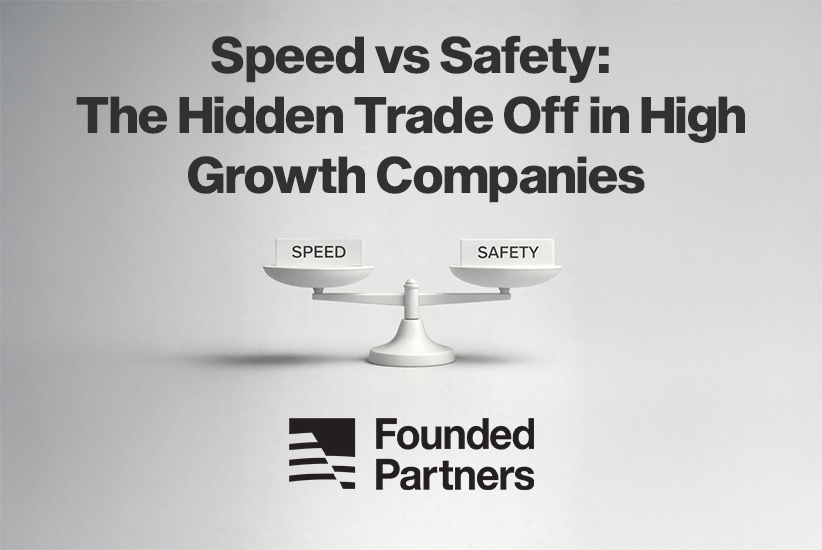
Speed is intoxicating.
In the early days of a company, speed feels like survival.
Ship fast.
Decide quickly.
Launch before competitors.
Move now, fix later.
Speed feels like ambition.
Speed feels like leadership.
Speed feels like momentum.
But as companies grow past 20 employees, something subtle begins to happen.
The cultural emphasis on speed can quietly erode decision quality, risk management, and long term resilience.
The company does not slow down.
It becomes fragile.
And fragile companies eventually break.
The Academic Backbone: Safety Culture Theory
To understand this trade off, we need to step outside startup culture and look at safety science.
In high risk industries such as aviation, nuclear power, and healthcare, researchers have studied why organizations fail despite intelligent people and good intentions.
A core concept is safety culture.
Safety culture refers to shared beliefs, norms, and behaviors around risk awareness and disciplined decision making.
If you want an overview, start here:
Safety culture explained by the UK Health and Safety Executive: https://www.hse.gov.uk/humanfactors/topics/culture.htm
Reason, J. (1997). Managing the Risks of Organizational Accidents
High Reliability Organizations overview: https://hbr.org/2011/05/creating-a-culture-of-reliab
Safety culture research shows that outcomes are not driven by individual heroics.
They are driven by the interaction of:
The individual
The job design
The organizational system
When these three are misaligned, risk increases.
Now translate that to scaling companies.
The Individual, The Job, The Organization
As a founder scales from 10 to 30 employees, culture begins to formalize.
But most founders still reward speed over structure.
Individuals are praised for hustle.
Jobs are designed for output volume.
Organizational systems lag behind growth.
This creates a predictable imbalance:
High output.
Low friction.
Weak safeguards.
Initially, this feels productive.
Over time, it creates invisible risk.
Automation, Cognitive Offloading, and “Human Not in the Loop” Risk
Another important research stream comes from human factors and automation.
As organizations automate processes, humans shift from active decision makers to supervisors of systems.
This is called cognitive offloading.
We rely on tools to think for us.
Research on automation bias shows that humans tend to over trust automated outputs, even when flawed.
See:
Automation bias overview: https://www.sciencedirect.com/topics/engineering/automation-bias
Parasuraman & Riley (1997). Humans and Automation: Use, Misuse, Disuse, Abuse.
In scaling companies this looks like:
Blind trust in dashboards.
Automated approval flows without human review.
AI generated reports accepted without scrutiny.
CRM workflows replacing judgement.
When humans are no longer actively engaged in decisions, small system flaws can compound.
This is known as human not in the loop risk.
In safety critical industries, this risk is managed intentionally.
In high growth startups, it is rarely discussed.
Founder Translation: Where Speed Quietly Erodes Safety
Let us make this real.
1. Shipping Product Fast Without Quality Controls
Founders often say:
“We will fix it in v2.”
In early stages, that may be acceptable.
But as customer count grows, each release without structured QA multiplies exposure.
Common pattern:
No regression testing.
No structured product review.
Informal sign off.
Reliance on one key engineer.
When something breaks, the blame falls on engineering.
But the real issue is cultural emphasis on speed without defined quality gates.
2. Automating Decisions Without Governance
Growth demands automation.
But automation without oversight becomes risk amplification.
Examples:
Automated discount approval thresholds.
Auto renewal billing.
Algorithmic lead scoring.
AI generated marketing content.
If no human reviews outputs periodically, small errors propagate at scale.
The system is fast.
It is not necessarily safe.
3. Over Rewarding Hustle and Under Rewarding Discipline
Look carefully at what gets celebrated internally.
Do you praise:
Late night product pushes?
Quick deal closures?
Rapid feature launches?
But rarely highlight:
Process improvements?
Risk mitigation?
Documentation quality?
Error reduction?
What you reward becomes your culture.
If hustle is heroized and discipline is invisible, resilience erodes.
4. Burnout Masked as High Performance
Founder burnout and culture are deeply linked.
See:
High speed environments create adrenaline driven performance.
But chronic cognitive load reduces:
Decision quality.
Attention to detail.
Risk detection.
Ethical sensitivity.
Burnout is not just a health problem.
It is a governance problem.
The Hidden Trade Off
Speed increases growth velocity.
Speed decreases reflection.
When reflection drops below a certain threshold, errors compound faster than learning.
That is the hidden trade off in high growth companies.
Speed without structure feels like momentum.
Until it feels like chaos.
High Growth Company Mistakes
Founders often assume that scaling without breaking is about hiring better people.
But research consistently shows that organizational structure and incentive systems shape behavior more than personality does.
Common high growth company mistakes include:
No pause points in major decisions.
No risk review before expansion.
Incentives tied only to revenue.
Informal delegation of authority.
No explicit definition of acceptable risk.
These are cultural design choices.
Not talent problems.
Actionable Steps for Founders
Here is how to balance speed and resilience.
1. Clarify What Is Truly Rewarded
Ask yourself:
What behaviors lead to promotion?
What stories are told internally?
What KPIs are publicly celebrated?
If discipline and thoughtful execution are not visible, they are not culturally reinforced.
Make risk management explicit.
2. Balance KPIs Between Growth and Resilience
Most companies track:
Revenue growth.
Pipeline.
New users.
Product velocity.
Few track:
Error rates.
Customer complaints.
Rework percentage.
Employee burnout signals.
Process cycle failures.
Balanced scorecards are not corporate bureaucracy.
They are survival tools.
For more on balanced measurement systems:
https://hbr.org/1992/01/the-balanced-scorecard-measures-that-drive-performance
3. Introduce Structured Pause Points
Speed does not require constant motion.
Introduce deliberate pauses for:
Major product releases.
Capital raises.
Market expansion.
Large hiring waves.
Automation rollouts.
Structured pause questions:
What could go wrong?
What assumptions are untested?
Who has not been consulted?
What early warning signs should we monitor?
This is pre mortem thinking.
Research on pre mortems:
https://hbr.org/2007/09/performing-a-project-premortem
4. Ensure Automation Has Human Oversight
If you automate:
Define who reviews outputs.
Set review cadence.
Create escalation triggers.
Audit edge cases.
Humans should never be completely removed from critical control loops.
Especially in finance, compliance, or customer impacting systems.
5. Protect Decision Quality as You Scale
As headcount increases, founders must shift from:
Fast decider
to
Architect of decision environments.
That means:
Clear authority boundaries.
Documented decision rights.
Transparent risk thresholds.
Defined escalation paths.
Speed is not the enemy.
Unexamined speed is.
Scaling Without Breaking
If your company has crossed 20 employees, you are at a cultural inflection point.
Informal norms are solidifying.
What you tolerate now becomes institutional memory.
Ask yourself:
Do we celebrate discipline as much as speed?
Do we know our risk tolerance?
Are we designing for resilience or only for velocity?
Would our systems survive doubling in size?
Scaling without breaking requires intentional culture design.
Not just ambition.
Founder Reflection Questions
Where has speed created hidden fragility?
Where have we automated without review?
Where is burnout disguised as dedication?
What failure would most damage trust if it happened tomorrow?
The most dangerous companies are not slow ones.
They are fast ones without guardrails.
Growth is a powerful force.
But growth without safety culture becomes erosion.
The founder’s job is not to slow momentum.
It is to design an organization that can handle it.
If your company has grown past 20 employees and you want to build a culture that balances speed with resilience, book a call with Founded Partners today. We help scaling companies between five million and fifty million in revenue design organizational systems that protect decision quality, reduce hidden risks, and create sustainable growth without sacrificing momentum.