
Fractional COO vs Operations Consultant: Which Strategic Partner Does Your Firm Need?

Scaling a founder-led business to its next stage isn't a matter of working harder. It is a matter of architecting a foundation that no longer requires your constant intervention. You've likely felt the friction of processes that worked at five employees but are now fracturing at twenty. It's exhausting to be the bottleneck for every strategic decision while trying to protect the culture you worked so hard to build. Choosing between a fractional COO vs operations consultant is often the first step toward reclaiming your role as a visionary leader.
We understand that your goal isn't just growth, but durable, sustainable expansion that increases your enterprise value. This article provides the clarity you need to decide between long-term operational leadership and targeted, project-based optimization. We will explore the distinct roles each partner plays in your firm's evolution, moving from high-level strategic concepts to specific operational outcomes. By the end, you'll know whether you need an embedded peer to manage the daily rhythm of your business or a specialist to refine a specific system. It is time to move from the chaos of rapid growth toward a sense of readiness, clarity, and organizational health.
Key Takeaways
- Distinguish between the embedded leadership of a Fractional COO and the project-specific expertise of an Operations Consultant to align your choice with your current organizational needs.
- Evaluate whether your firm faces a leadership gap requiring ongoing stewardship or a specific process bottleneck that needs targeted optimization.
- Learn how to navigate the choice of a fractional COO vs operations consultant by identifying the primary friction points in your scaling journey.
- Understand how operational durability acts as a primary driver of enterprise value, ensuring your business is ready for future capital raising or a successful exit.
- Discover the "Consult-then-COO" sequence to stabilize your systems before integrating long-term leadership into your firm’s culture.
Defining the Roles: Fractional COO vs Operations Consultant
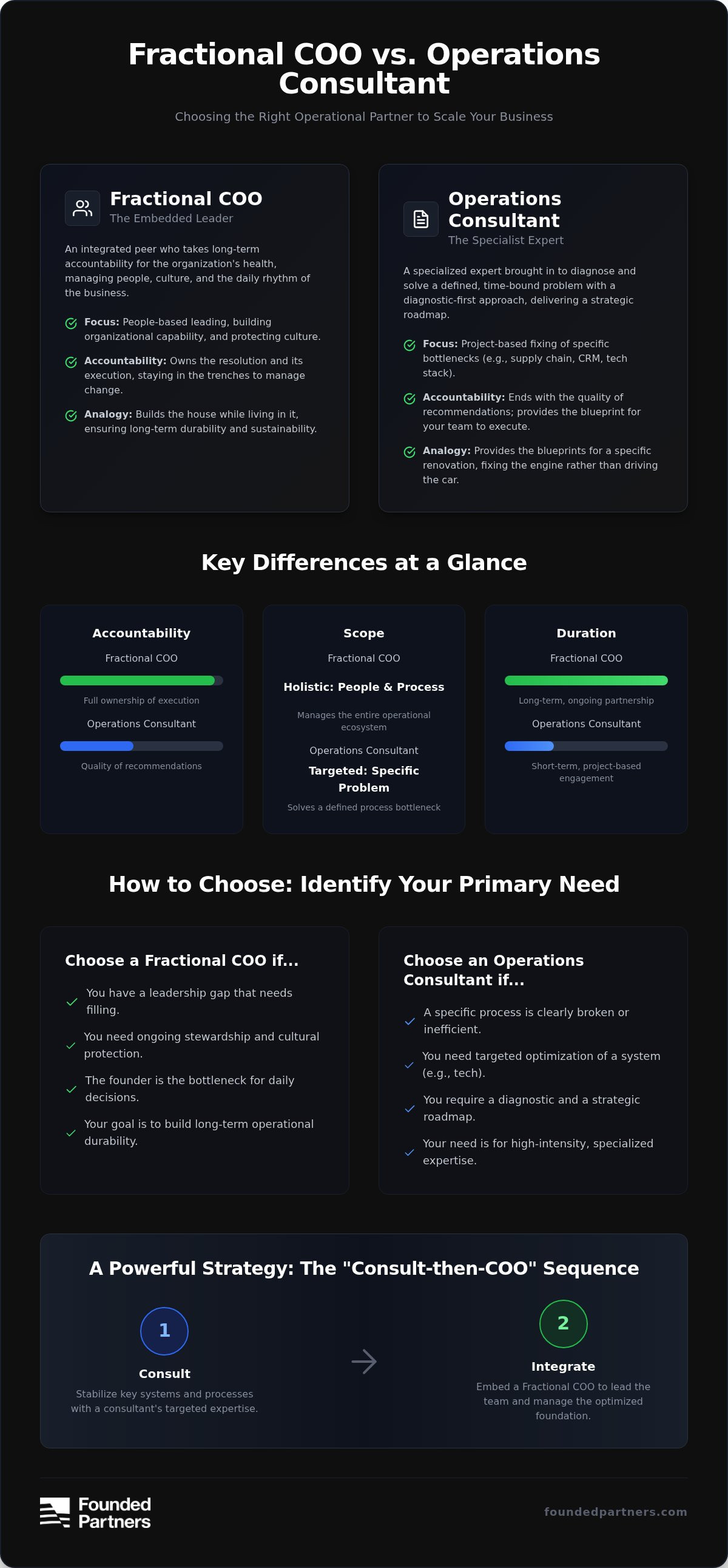
The "Founder’s Dilemma" often blurs the lines between leadership and project work. When growth feels chaotic, you simply want the friction to stop. This leads many to view the choice between a fractional COO vs operations consultant as a semantic one, but the distinction is architectural. One builds the house while living in it; the other provides the blueprints for a specific renovation. Understanding which one your firm requires is the difference between a temporary fix and a permanent foundation.
What is a Fractional COO?
A fractional COO is an embedded leader who functions as a "Trusted Peer" to the founder. They aren't just visiting; they are integrated into the leadership team to manage people, protect culture, and refine the rhythm of daily operations. As a fractional executive, they take long-term accountability for the organization's health. Their presence brings a sense of calm expertise that stabilizes the team during rapid expansion. They don't just point at a problem; they own the resolution. This role is about durability, sustainability, and the steady hand required to scale without losing the firm's DNA. They focus on the "how" of the business, ensuring that every strategic vision has a corresponding operational reality.
What is an Operations Consultant?
An operations consultant takes a diagnostic-first approach to specific bottlenecks. They are specialized experts brought in to solve a defined, time-bound problem, such as a fractured supply chain, an outdated CRM workflow, or a messy financial reporting process. Their deliverable is usually a roadmap or a blueprint for your internal team to execute. Once the strategy is delivered and the system is optimized, their engagement typically ends. They provide the high-level expertise needed for a specific transformation without the long-term commitment of an executive role. They are the mechanics who fix the engine, rather than the drivers who navigate the journey.
The core difference rests in ownership. A consultant’s accountability ends with the quality of their recommendations. A fractional COO’s accountability begins with the execution of those recommendations. One provides the "what" and the "why," while the other masters the "how" and the "who." Choosing the right partner requires you to be honest about your current needs. Do you need a specialist to refine a process, or do you need a partner to lead your people? By distinguishing between these roles, you ensure your business transformation is both intentional and effective.
Key Differences in Accountability, Scope, and Duration
The distinction between a fractional COO vs operations consultant is most visible in the "staying power" of the engagement. While both roles aim to improve the business, their structural relationship to your firm differs. An operations consultant typically operates from the outside, providing a high-level objective perspective. Conversely, a fractional COO is an embedded peer who lives within your culture. This difference in integration defines how they handle accountability, scope, and the duration of their impact.
Project-Based Fixing vs. People-Based Leading
Consultants often excel at high-intensity, project-based work. They use data to drive specific process improvements, such as optimizing a supply chain or auditing a tech stack. Their value lies in their specialization. However, a fractional COO focuses on the human element of scaling. They use leadership advisory to drive organizational change, shifting the focus from "fixing a problem" to "building a capability." While a consultant might deliver a new workflow, a fractional COO ensures your team has the discipline and character to maintain it. This transition from tactical fixing to strategic leading is what allows a founder to finally step away from the daily minutiae.
The Accountability Gap
Accountability is the true litmus test for these roles. When an implementation becomes difficult or a new system meets internal resistance, a consultant’s engagement might already be concluding. They provide the surge capacity for specific transformations but rarely stay to manage the fallout of change. A fractional COO is different. They remain in the trenches, taking direct responsibility for building organizational resilience. They manage the team, navigate interpersonal friction, and ensure the transformation sticks. They aren't just advising the leadership; they are part of it. If you are looking to refine your firm's foundation, exploring Operations Optimization can help you identify whether you need a project specialist or a long-term architect.
- Strategic Depth: Consultants optimize existing systems; Fractional COOs architect new organizational structures.
- Engagement Length: Consulting is defined by milestones; Fractional COOs provide an ongoing, steady hand.
- Integration: Consultants maintain an objective distance; Fractional COOs immerse themselves in the company culture.
- Outcome Ownership: Consultants are responsible for the quality of advice; Fractional COOs are responsible for the results of execution.
The Decision Framework: Which One Does Your Business Need?
Choosing between a fractional COO vs operations consultant is rarely a matter of budget. Instead, it is a matter of diagnosing your current organizational maturity and your own psychological readiness to delegate. Navigating this transition requires you to look past the symptoms of growth—the missed deadlines or the messy spreadsheets—and identify the root cause of the friction. If you don't, you risk hiring a specialist to fix a process when what you actually need is a partner to lead your people.
The first step in this framework is identifying the nature of your bottleneck. A process gap is technical; it's a "broken pipe" where a specific function like lead routing or financial reporting has failed. A leadership gap is architectural; it's a "clogged drain" where every decision, regardless of its importance, must flow through the founder. If your team is capable of executing but simply lacks the right technical framework, a consultant is often the correct choice. However, if your team lacks the senior oversight to function without you, an embedded leader is required to bridge that gap.
Hire an Operations Consultant When...
You should engage a consultant when you have a defined, isolated problem that requires a high-level diagnostic. This is often the case when one department is failing while others thrive, suggesting a systemic issue rather than a leadership vacuum. A specialized business transformation consultancy can provide the roadmap your internal team needs to professionalize a specific function. This approach works best when your existing staff has the capacity to implement changes but lacks the specialized expertise to design them. It's a "surge capacity" model that allows you to optimize without a permanent shift in your leadership structure.
Hire a Fractional COO When...
A fractional COO is the right choice when the founder has become the primary bottleneck for daily operations. This often happens during phases of rapid expansion or when you are preparing for capital raising for founders. In these scenarios, the business needs more than a new process; it needs a permanent bridge between your vision and the team's execution. You need someone to own the outcomes, manage the culture, and ensure the foundation remains durable as headcount increases. This partner provides the psychological security of knowing the engine is running smoothly while you focus on high-level strategy and investor relations. It's a shift from managing a business to architecting an enterprise.
Strategic Impact: Culture, Scalability, and Exit Value
Operational durability is the silent engine of enterprise value. For founder-led firms, the transition from a person-dependent to a system-dependent organization is the single greatest lever for long-term equity growth. Whether you choose a fractional COO vs operations consultant depends on whether you seek to optimize a single gear or re-architect the entire machine. A business that relies solely on the founder's intuition is a liability; a business that relies on durable systems is an asset. By professionalizing the foundation, you move beyond the "doing" and begin the act of building something that lasts.
Building for a Sustainable Exit
Clean operations reduce friction during investor due diligence. When a buyer or investor looks at your firm, they are searching for risk. They want to see that the business will continue to thrive long after you've handed over the keys. This is why exit planning for founders is a core component of operational design. By moving toward a system-dependent organization, you demonstrate that your success is repeatable, predictable, and scalable. A Fractional COO acts as the Strategic Architect who builds this resilience, ensuring your firm is always ready for capital raising or a strategic sale. They focus on the architectural nature of business building, turning your daily efforts into long-term equity.
Preserving Culture During Transformation
Rapid growth often creates a fear of losing the "Founder’s DNA." There is a delicate balance between professionalizing a firm and stifling the innovation that built it. This is the human side of business scalability consulting. It requires a sense of calm expertise to manage organizational change without triggering team burnout or cultural erosion. While a consultant might install a more efficient workflow, an embedded leader ensures that optimization doesn't come at the expense of character. They protect the values that make your firm unique while building the infrastructure that makes it durable. This ensures that as you scale, your team remains aligned, inspired, and committed to the shared journey.
To begin building a business that thrives independently of your daily presence, explore how our Scalability Strategy can transform your operations into a high-value asset. We focus on refining, guiding, and strengthening your foundation to ensure your firm is prepared for its next stage of growth, whether that involves raising capital or planning a legacy-defining exit.
Implementation: Moving Toward a Scalable Foundation
The transition from founder-led chaos to operational excellence requires a deliberate sequence. Many firms rush into a fractional COO vs operations consultant choice without considering the state of their current systems. A "Consult-then-COO" approach often proves the most effective. It allows you to clean the house, refining broken workflows and establishing baseline data, before hiring a long-term leader to manage those systems. This ensures you aren't asking an executive to do the work of a technician, protecting both your capital and your organizational health.
A strategic operational engagement follows a rhythmic, intentional flow. In the first thirty days, the focus is on a deep-dive audit of people, processes, and technology. The second month transitions into alignment, where KPIs are established to measure organizational resilience and scalability. By day ninety, the engagement moves into active implementation, where new systems are stress-tested and the team is guided through the transformation. You should expect your partner to provide clarity, stability, and a clear roadmap for the milestones ahead. This methodical pace suggests a commitment to thoroughness over shortcuts.
Finding Your Strategic Architect
Character and competence are the dual pillars of a successful partnership. In a boutique firm, the operational partner must be more than a skilled tactician; they must be a cultural steward. We utilize a diagnostic-first approach to business transformation consulting. This process identifies the specific friction points preventing your team from reaching its full potential. By moving from frantic energy to measured growth, you create the psychological space needed to lead with vision rather than reaction. This shift is essential for building a business that is both durable and investor-ready.
Next Steps for the Scaling Founder
Your journey toward a scalable foundation begins with a candid self-assessment. You must evaluate your current operational health and your team's ability to execute without senior oversight. Defining the specific outcomes you need to reach your next growth milestone is essential for choosing the right partner. Whether you need a specialist to fix a broken process or an architect to build a new leadership layer, the path forward requires intentionality and discipline. It is time to stop doing everything and start building a foundation that can stand without you.
If you are ready to reclaim your time and increase your firm's enterprise value, schedule a strategy briefing with Founded Partners to find your path forward. Together, we can refine your operations, guide your leadership team, and strengthen your organization for the journey ahead.
Architecting Your Firm's Future
Building a business that outlasts your daily involvement is a deliberate act of architecture. The choice between a fractional COO vs operations consultant rests on whether you need a specialized fix or a steady hand to guide your team through rapid expansion. While a consultant optimizes specific systems, a fractional COO becomes a trusted peer who manages the human element of your operations. Both paths aim to professionalize your firm, but only one embeds long-term leadership into your company culture.
At Founded Partners, we act as Strategic Architects for founder-led businesses. We bring a measured, long-term perspective to organizational health, ensuring your foundation is durable enough for capital raising or a successful strategic exit. By refining your processes and strengthening your leadership, we help you move from the exhaustion of "doing everything" to the clarity of true strategic focus. It's time to stop managing the friction and start leading your vision with confidence.
Partner with Founded Partners to build your scalable foundation and secure the future of your enterprise.
Frequently Asked Questions
What is the typical duration of a Fractional COO engagement?
An engagement usually lasts about 14 months, though the timeline varies based on your firm's growth stage. This duration allows the leader to architect systems, stabilize the team, and oversee the implementation of long-term strategies. Unlike a short-term project, this partnership provides the steady hand needed to navigate multiple scaling cycles. It ensures the organizational foundation is durable enough to support your vision well into the future.
Can an Operations Consultant eventually become a Fractional COO?
Yes, a consultant can transition into an embedded leadership role if the firm requires ongoing stewardship rather than a one-time fix. This often happens when a diagnostic project reveals deeper leadership gaps that a simple roadmap cannot solve. The consultant moves from providing external advice to taking direct ownership of outcomes. This shift requires a change in accountability, moving from delivering recommendations to managing the people who execute them daily.
How do I measure the ROI of hiring a Fractional COO?
ROI is measured through increased enterprise value, improved operational efficiency, and your reclaimed capacity for strategic growth. You should track specific outcomes like reduced churn, faster project delivery cycles, and lower overhead costs through optimization. The psychological security of having a seasoned advisor allows you to focus on high-level vision. This shift often leads to more successful capital raising or a higher valuation during exit planning.
Is a Fractional COO the same as a Chief of Staff?
No, the roles differ in scope and authority. A Chief of Staff primarily acts as an extension of the founder, managing their schedule, communications, and internal projects. A fractional COO is an operational architect who manages the entire organization's health and execution. While a Chief of Staff facilitates your daily workflow, a COO builds the systems and leads the people required to scale the business foundation independently of your constant intervention.
What size company typically needs a Fractional COO vs an Operations Consultant?
Firms with revenue between $2 million and $10 million often find the most value in a fractional leader. At this stage, the founder is usually the primary bottleneck and needs an embedded partner to manage rapid growth. Smaller firms under $1 million in revenue might benefit more from a specialized operations consultant to fix specific technical gaps. The choice between a fractional COO vs operations consultant depends more on your leadership capacity than headcount alone.
How does a Fractional COO help with capital raising?
They prepare your firm for investor due diligence by professionalizing operations and ensuring financial reporting is transparent. By building a system-dependent organization, they reduce the risk for potential investors who want to see a business that thrives without your constant oversight. This operational durability is a primary driver of enterprise value. They act as a strategic architect, aligning daily performance with the requirements of future capital raising rounds.
What are the red flags to watch for when hiring an operations partner?
Watch for partners who offer generic templates rather than a diagnostic-first approach. A significant red flag is a lack of focus on organizational culture or an inability to explain the "how" behind their recommendations. If they avoid accountability for results or don't understand the link between operations and exit value, they aren't the right fit. You need a partner who values character and commitment as much as technical competence.
Does a Fractional COO manage my existing team or bring their own?
They primarily manage and strengthen your existing team, acting as a mentor to internal leaders. Their goal is to refine your current talent and build a culture of accountability without requiring a complete overhaul of your staff. While they may suggest strategic hires to fill specific gaps, their focus is on improving the collective performance of the people who already understand your firm's DNA. They guide your team toward operational excellence.