
Why Copying Successful Companies Is Dangerous Advice
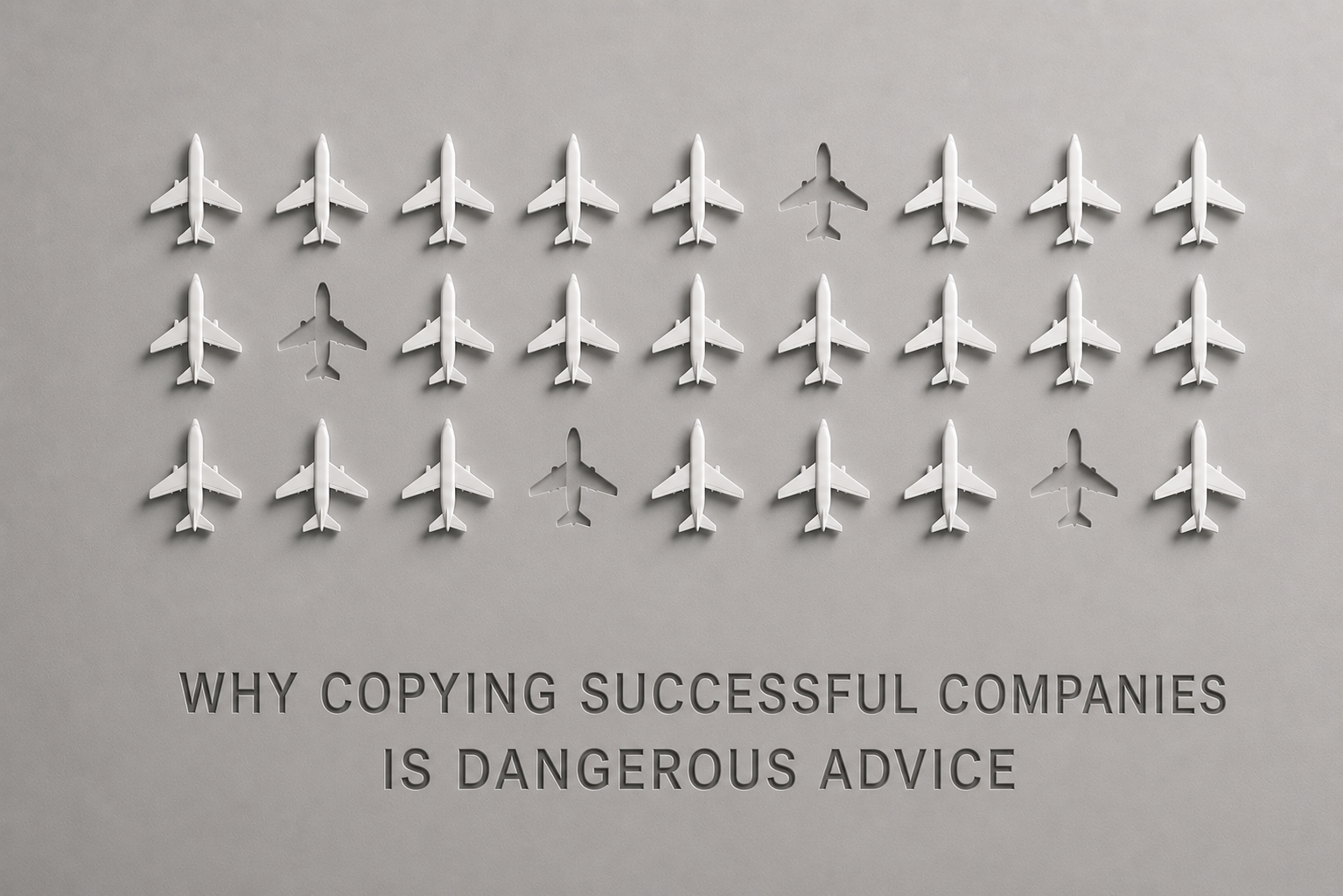
In 1943, with American bombers being shot out of the sky over Europe, the US military brought a simple question to a group of statisticians at Columbia University. They had carefully mapped the bullet holes on the planes that came back from missions, and the damage clustered heavily on the wings, the fuselage, and the tail, while the engines were comparatively clean. Armor is heavy, so you cannot cover the whole aircraft, and the obvious move was to reinforce the areas that were clearly taking the most fire. One member of the group, a Hungarian refugee named Abraham Wald, told them they had it exactly backwards.
Wald pointed out that they were only looking at the planes that made it home. The bullet holes on those survivors showed all the places a bomber could be hit and still fly. The engines looked clean not because they were rarely struck, but because the planes hit in the engines were lying at the bottom of the sea, absent from the data entirely. The armor, Wald argued, belonged precisely where the returning planes showed no damage, because that was the damage no one survived to show you. By studying only the winners, the military had been about to reinforce all the wrong parts of the plane.
This is survivorship bias, and once you see it you start finding it everywhere, because it is the default way human beings learn. We study the successes because they are the ones still standing to be studied, and the failures, who very often did many of the same things, are simply invisible. The list of habits of billionaire founders, the playbook of the company that grew tenfold, the morning routine of the person who got the outcome you want, all of it is assembled from survivors, and it quietly leaves out the equally large crowd who followed the identical playbook straight into the ground. You are reading the bullet holes on the planes that came back.
For a founder this is not an abstract bias, it is one of the most expensive mistakes you can make, because almost all the advice you are given is survivor advice. Do what this famous company did. Copy the growth tactic that worked for them. Raise the way they raised, hire the way they hired, price the way they priced. The problem is that for every company that won by moving fast and breaking things, there is a quiet graveyard of companies that moved fast and simply broke, and you never hear from them, so the tactic looks far more dependable than it actually is. Success stories are good at telling you what is possible. They are close to useless at telling you what is repeatable, because they cannot show you everyone who did the same thing and lost.
It gets subtler, because the same bias distorts how you read your own company. You study your best customers to understand why people buy, while the prospects who quietly evaluated you and walked away, the ones who would teach you the most, never make it into the room. You analyze the deals you won and miss the pattern hiding in the deals you lost. You double down on the strategy that worked last year without asking how much of that was strategy and how much was luck you cannot count on again. The data that is easiest to gather is almost always the survivor data, and the survivor data is precisely the data most likely to lead you astray.
The discipline that counters survivorship bias is deliberately going looking for the missing planes. It means asking, of every success you are tempted to copy, who else tried this and failed, and what was different about them. It means studying your losses as carefully as your wins, interviewing the customers who left rather than only the ones who stayed, and treating any advice that arrives wrapped in a single triumphant story with healthy suspicion. Most of all it means resisting the pull of the generic playbook, because the right move for your company depends on your specific stage, market, and constraints, none of which the survivor whose story you are copying actually shares with you.
This is one of the most valuable things an experienced outside perspective can offer, because a good advisor does not hand you the survivor's playbook, they help you reason from your own situation, including the parts of it that are invisible to you. Founder Advisory at Founded Partners gives you exactly that, a confidential relationship with Adam Miron, a serial entrepreneur with three exits including a unicorn and a background in business psychology, who has seen enough of both the wins and the failures to help you tell which lessons genuinely transfer to your company and which are simply someone else's luck dressed up as a formula. If you keep reaching for what worked for someone else because you are not sure what is right for you, that is the moment an independent perspective earns its keep.
See how Founder Advisory works at foundedpartners.com/founder-advisory, or learn more about the founders we help.