
The Strategic Role of a Business Transformation Consultant in 2026

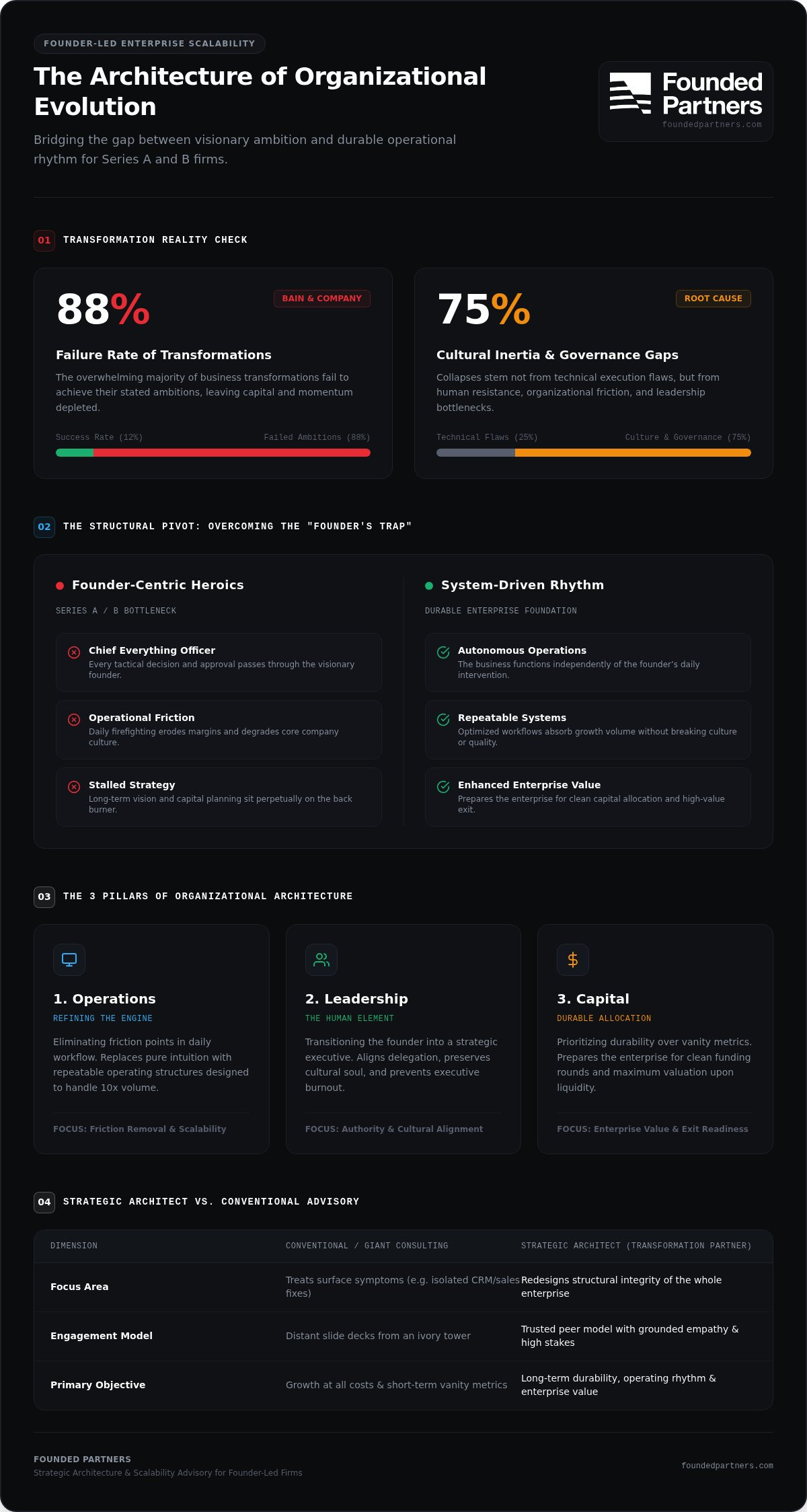
Research from Bain & Company indicates that 88% of business transformations fail to achieve their stated ambitions. Perhaps more telling is that 75% of these collapses stem not from technical flaws, but from cultural inertia and governance gaps. For a founder-led firm at the Series A or B stage, these statistics reflect a painful reality: the same hands-on energy that built the company often becomes the very bottleneck that prevents it from scaling. You're likely feeling the weight of being too deep in the weeds, watching operational friction erode your margins and your culture while your long-term strategy sits on the back burner.
A seasoned business transformation consultant serves as a strategic architect to solve this specific tension. By bridging the gap between your initial vision and a durable operational foundation, they help you transition from founder-centric heroics to a system-driven operating rhythm. This article explores how to refine your leadership structure, strengthen your operational health, and build an enterprise that operates independently of your daily intervention. You'll discover how to reclaim your time, clarify your strategic direction, and significantly improve enterprise value for a future exit.
Key Takeaways
- Distinguish between surface-level coaching and holistic transformation to ensure your organization evolves across people, processes, and purpose.
- Identify how operations optimization serves as the architectural foundation for leadership clarity and sustainable capital allocation.
- Discover why a boutique business transformation consultant provides the grounded empathy and specialized expertise that global consulting giants often lack.
- Learn to spot the "Series A Stall" and other critical red flags that indicate your current systems have reached their structural limits.
- Transition from frantic daily firefighting to a disciplined, system-driven operating rhythm that protects your culture while increasing enterprise value.
Defining the Business Transformation Consultant for Founder-Led Firms
Business transformation isn't a simple pivot or a software upgrade. It's a fundamental alignment of your people, your processes, and your core purpose. In 2026, the market has matured beyond the "growth at all costs" mindset. Investors and founders alike now prioritize durability over vanity metrics. A business transformation consultant helps you build a company that doesn't just grow, but matures. This involves moving beyond surface-level changes to implement a business transformation framework that alters how the organization functions at its root.
While a business coach might focus on personal mindset or individual performance, a transformation consultant focuses on the architecture of the enterprise. They don't just ask how you feel about your goals; they design the systems that make those goals inevitable. The core objective is to build a foundation that supports scalability without the typical operational chaos that stalls Series A and B firms. It's about creating a business that breathes on its own.
Beyond General Consulting: A Strategic Architect
Many consultants treat symptoms. They might fix a broken sales process or suggest a new CRM, but these are often band-aids on a fractured core. A strategic architect looks at the structural integrity of the entire business. As a dedicated partner in refining organizational health, the consultant ensures every component of the firm supports the long-term vision. This is where the "Trusted Peer" model becomes vital. Instead of a distant advisor delivering a slide deck from an ivory tower, you gain a partner who understands the high stakes of founder-led growth and values character as much as competence.
Why Founders Specifically Need This Partnership
Founder-led firms often fall into the "Founder's Trap." This occurs when the visionary becomes the primary bottleneck; every decision, from strategic direction to minor operational approvals, must pass through them. This hero-centric model is unsustainable and leads to leadership burnout. Transformation advisory helps you step away from tactical survival and toward strategic leadership. By building durable systems, you prepare the firm for future milestones, whether that involves capital raising support or planning for a high-value exit. It's the difference between running a business and owning a valuable asset that operates with disciplined precision.
The Architecture of Organizational Evolution
Evolution isn't a destination; it's a structural necessity. In the 2026 market environment, business success depends on a firm's ability to absorb volatility without losing its cultural soul. A business transformation consultant approaches this by balancing three distinct pillars: Operations, Leadership, and Capital. When these pillars align, the business gains the durability to scale without the frantic energy that leads to burnout. This "always-on" approach to transformation ensures that your organization remains agile enough to pivot while staying grounded in its core purpose.
The role of scalability strategy here is to future-proof the enterprise. It involves looking beyond next month's targets to see how the business will function when it's ten times its current size. By designing systems today that can handle tomorrow's volume, you prevent the structural failures that often plague rapid growth. If you feel your organization is hitting a ceiling, a strategic architect can provide the external perspective needed to redesign your foundation.
Operations Optimization: Refining the Core
Scaling often generates chaos because existing systems weren't designed for the weight of increased volume. Operations optimization is the disciplined process of identifying and removing friction points in your daily workflow. It shifts the business away from founder intuition toward repeatable systems. This transition is a core component of business scalability consulting, where the goal is to build an engine that runs independently. When your operations are refined, you create the "breathing room" necessary for strategic growth rather than just tactical survival. You stop firefighting and start building.
Leadership Advisory: Managing the Human Element
Even the best systems fail if the human element is neglected. Leadership advisory addresses the psychological and cultural hurdles inherent in growth. Founders often struggle to shift from "Chief Everything Officer" to a strategic leader who delegates authority. This transition frequently meets internal resistance from long-standing teams who fear losing the original culture. Research into why organizational transformation efforts fail highlights that a lack of clear governance and executive misalignment are primary culprits. By establishing clear governance and refining leadership roles, you build organizational resilience that survives the founder's daily involvement.
Boutique Strategic Advisory vs. Global Consulting Giants
Choosing the right partner for organizational change defines a company's trajectory for years. While global consulting giants offer a sense of security through their sheer scale, they often suffer from the "Ivory Tower" problem. In these massive firms, senior partners sell the engagement, but the actual work is frequently delegated to junior analysts who lack real-world operational experience. For a founder-led firm, this disconnect is dangerous. A business transformation consultant from a boutique advisory firm offers a different path: one rooted in transparency, shared values, and a deep understanding of private company dynamics.
Success in these engagements isn't about the size of the consulting team. It's about the quality of the architectural guidance. McKinsey's research on enterprise transformations reveals that value is often leaked during the planning and execution phases due to a lack of disciplined strategic governance. Boutique firms like Founded Partners avoid this leakage by providing a "steady hand" throughout the entire journey. You aren't just another project in a vast portfolio; you're a partner in a shared mission to build something durable.
The Value of Grounded Empathy
A strategic architect must understand the psychological stakes of a founder's journey. It's one thing to look at a balance sheet; it's another to understand the weight of responsibility for a culture you built from the ground up. The boutique approach favors a composed, long-term perspective over the frantic, high-pressure energy found in many startup consulting models. This reliability creates a sense of psychological security. You don't need a consultant who breaks things for the sake of change. You need a peer who values character and integrity, ensuring the transformation strengthens your firm's identity rather than diluting it.
Specialized vs. Generalist Transformation
Generic advice fails when it meets the specific nuances of mid-market growth. A generalist might understand broad market trends, but they often struggle with the intricacies of capital raising for founders or the complexities of exit planning. Partners like Adam and Matt at Founded Partners bring a level of expertise that comes from having seen the pitfalls firsthand. As a dedicated business transformation consultant, the boutique advisor aligns their success directly with your vision. They ensure every operational refinement serves your ultimate goal. This specialized focus transforms the consultant role from a service provider into a trusted peer who prioritizes the health of your organization over vanity metrics.
4 Operational Red Flags Signaling It’s Time to Transform
Growth often feels like an uphill struggle, but there's a difference between healthy expansion and structural failure. When a founder-led firm hits a ceiling, the friction isn't just a byproduct of hard work; it's a signal that the current operating model has reached its limit. Recognizing these red flags early allows you to engage a business transformation consultant before the damage becomes permanent. In 2026, the cost of ignoring these signals is higher than ever, as market volatility leaves little room for inefficient governance.
- The Series A Stall: You've secured funding, but your top-line growth has plateaued because your internal systems can't handle the new volume.
- Founder Burnout: You're still the primary decision-maker for minor tactical tasks, leaving no time for high-level strategy.
- Cultural Erosion: The original vision that drove your early success feels diluted as new hires struggle to connect with the company's "why."
- Exit Anxiety: You realize that the business is so dependent on your daily involvement that its enterprise value would plummet without you.
The 'Series A Stall' and Operational Red Flags
Scaling requires more than just capital; it requires a foundation capable of supporting that capital. Many firms discover a painful gap between having the funds to grow and having the infrastructure to execute. This stall often stems from a lack of integrated systems, where departmental tools act as disconnected silos. Effectively measuring business transformation success begins with identifying these specific operational red flags and acknowledging that heroics are no longer a substitute for systems.
Preparing for the Next Stage
Transformation isn't a distraction from your next major transaction; it's the preparation for it. Whether you're eyeing a Series B round or a full acquisition, investors look for durability. A business transformation consultant helps you decouple your personal identity from the company's operations, which is a critical step in exit planning for founders. Waiting to "fix it later" is a strategy for failure. In a disciplined market, architectural integrity is the primary driver of enterprise value. If your business can't run without you, it isn't a scalable asset yet.
If you're ready to move from firefighting to strategic architecture, partner with a strategic advisor to rebuild your foundation.
Partnering with a Strategic Architect for Long-Term Durability
Scaling a founder-led organization requires a fundamental shift in perspective. You must move from the frantic energy of survival to the composed discipline of architectural scaling. Durable growth isn't accidental; it's designed. When you choose a business transformation consultant, you aren't just hiring a service provider. You're selecting a strategic architect who will help you build a legacy. This partnership relies on a balance of character, competence, and commitment. Without shared values and deep operational expertise, transformation efforts often stall before they yield results. A partner should provide the psychological security and technical precision needed to navigate complex growth cycles.
The first steps in any engagement are assessment and alignment. You cannot refine what you haven't truthfully measured. This process involves looking past the surface to evaluate the structural integrity of your enterprise. It requires a willingness to address the "Founder's Trap" and build systems that operate independently of your daily heroics. By viewing your business through a new lens of sustainability, you move toward a model where revenue growth generates enterprise value rather than operational chaos.
The Founded Partners Engagement Model
Adam and Matt lead Founded Partners with a focus on the human side of organizational evolution. They understand that a capital strategy is only as strong as the operations that support it. Their model integrates leadership advisory with rigorous operations optimization to ensure your firm is ready for its next consequential transition. They prioritize the "how" of a process just as much as the "what." This methodical approach ensures that changes are integrated, sustainable, and respected by the existing team. By refining governance alongside capital allocation, they help founders reclaim their time while strengthening the firm's architectural core.
Taking the First Step Toward Transformation
The journey toward a durable organization begins with a candid conversation about organizational health. This isn't about checking boxes or celebrating vanity metrics like top-line revenue. It's about building a substantial enterprise that can withstand market volatility. A dedicated business transformation consultant helps you move beyond tactical firefighting to focus on long-term strategic direction. By starting this conversation today, you begin the work of building a foundation that outlasts the present moment. If you're ready to secure your company's future, it's time to refine your systems, strengthen your leadership, and prepare for the scale you've envisioned.
Securing the Future of Your Enterprise
Scaling a business requires a deliberate shift from frantic growth to composed architecture. By recognizing the red flags of operational friction and choosing a partnership-oriented approach, you ensure your organization remains durable through market shifts. A dedicated business transformation consultant bridges the gap between your visionary goals and the repeatable systems necessary to achieve them. This transition isn't just about efficiency; it's about protecting the culture you've built while preparing for the next stage of evolution.
Founded Partners provides specialized advisory for founder-led organizations, integrating expertise in capital raising and transaction advisory with operational refinement. Whether you're preparing for a new funding round or an eventual exit, our team focuses on building a foundation that operates with disciplined precision. We prioritize the health of your enterprise over vanity metrics, offering a steady hand as you navigate consequential transitions. It's time to step away from the daily firefighting and focus on your role as a strategic leader. Refine your foundation with the Strategic Architects at Founded Partners.
Frequently Asked Questions
What is the difference between a business coach and a business transformation consultant?
A business coach primarily focuses on the development of the individual leader, addressing mindset and personal performance. In contrast, a business transformation consultant focuses on the architecture of the entire organization. They refine systems, optimize operations, and align governance structures to ensure the business can scale independently of the founder. While coaching is about the "who," transformation is about the "how" of building a durable and substantial enterprise foundation.
How long does a typical business transformation engagement last?
Transformation is a methodical process rather than a quick fix. Depending on the complexity of the organizational health assessment, engagements typically span between three and twelve months. Shorter projects might focus on specific operations optimization, while comprehensive architectural shifts require a longer horizon to ensure cultural alignment and system durability. This steady pace allows for thorough implementation and prevents the frantic energy often associated with poorly executed change.
When is the right time for a founder to hire a transformation advisor?
The ideal time is when your current operating model reaches its structural limit, often signaled by a "Series A Stall." If you find yourself trapped in tactical firefighting or if growth is generating operational chaos instead of value, an advisor is necessary. Hiring a business transformation consultant early prevents burnout and ensures your foundation is strong enough to support the weight of new capital or increased market demand.
How does business transformation impact the value of my company during an exit?
A business transformation consultant increases enterprise value by decoupling the business from the founder's daily intervention. Sophisticated buyers look for operational durability and repeatable systems that can survive ownership changes. By refining your governance and optimizing your operations, you prove that the company is a scalable asset rather than a personality-led venture. This architectural integrity often leads to higher valuation multiples and a more seamless transaction process during an exit.
Can a transformation consultant help with capital raising support?
Yes, Founded Partners provides expert capital raising support as a core part of the transformation journey. A consultant ensures your operational foundation is robust enough to attract high-quality investment. They assist in identifying the right capital to fuel your strategic objectives while ensuring your leadership and systems are prepared for the scrutiny of due diligence. This integrated approach ensures that growth is both funded and structurally sustainable.
What are the most common mistakes founders make during organizational change?
The most frequent error is taking a technology-only approach while ignoring cultural inertia and governance gaps. Many founders also wait too long to address operational red flags, hoping to "fix it later" once they reach a certain revenue milestone. Another mistake is failing to delegate real authority, which keeps the founder as a bottleneck. Successful transformation requires a holistic focus on people, processes, and purpose to build long-term durability.