
Why Strategy Isn’t Sticking
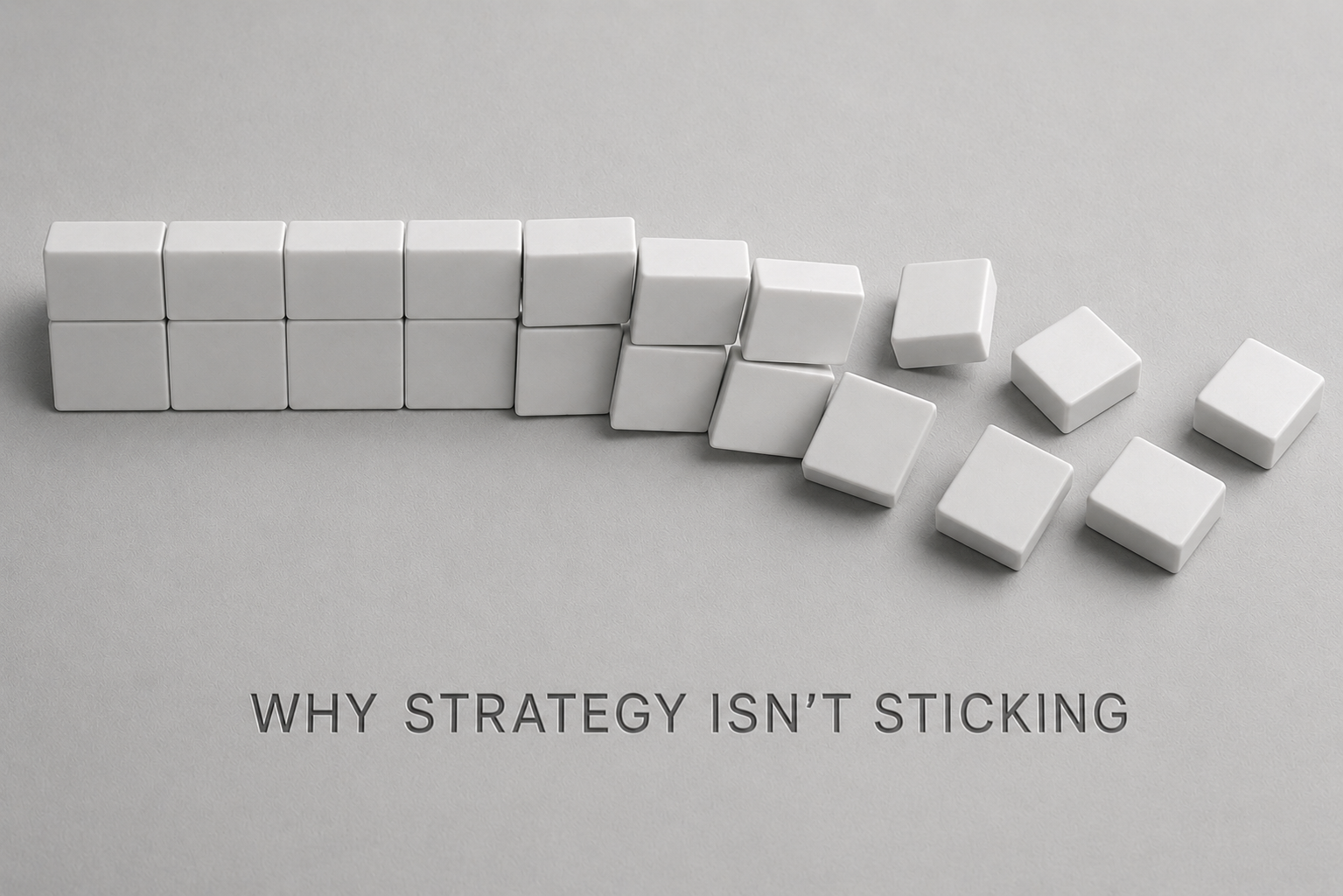
A founder I worked with recently described a moment that captures something most leaders quietly experience.
She had spent three days at an offsite with her leadership team mapping out the company's strategy for the year ahead.
Everyone left aligned. Everyone agreed on the priorities.
Two weeks later, she sat in a product review and listened to her team debate a feature decision using none of the framing they had built together.
Not one reference to the strategic priorities.
Not one mention of the tradeoffs they had agreed on.
It was as if the offsite had never happened. Her instinct, like most founders in this situation, was to assume the team was not paying attention.
But the real explanation is more interesting and more useful, because it tells us something about how strategy actually fails inside growing companies. Most strategies do not fail because they are wrong. They fail because they are not retained. And the gap between communicating a strategy and having a team genuinely understand it is wider than almost any founder realizes.
Decades of cognitive research by Fergus Craik and Robert Lockhart on what is called the levels of processing effect show that information is remembered based on how deeply it is processed at the moment of learning.
Shallow processing, which includes reading slides, hearing bullet points, and passively listening to a presentation, produces weak memory traces that fade quickly. Deep processing, which involves meaning, story, emotional relevance, and active interpretation, produces memory that sticks.
When a founder presents a strategy through a 40 slide deck at an offsite, the team is almost entirely in shallow processing mode.
They are absorbing information, not constructing meaning. So when they walk back into their actual work two weeks later, there is very little for them to retrieve.
This is compounded by something we have written about before, which is the working memory research from George Miller and Nelson Cowan showing that people can only hold about four items in active memory at one time. Your team is already operating at the edge of cognitive capacity every day.
When strategy is delivered as an abstract concept without strong meaning attached, it gets discarded almost immediately to make room for the operational reality competing for that same mental space.
Founders often mistake communication for understanding.
A deck presentation is not memory. A town hall is not alignment. A strategy document is not execution.
And here is the test that exposes the gap.
If your people cannot explain the strategy simply and consistently in their own words, they do not truly understand it.
The most common founder response to execution drift is to repeat the strategy more often. More all hands meetings.
More slack updates. More reminders. The problem is that repetition without meaning creates familiarity, not understanding.
People can recite phrases they cannot actually apply, which is why so many companies have employees who can name the strategic pillars but cannot tell you what those pillars mean for the decision they made yesterday. What actually sticks in human memory is context and narrative.
Jerome Bruner's work on narrative psychology, along with more recent research on how stories activate broader regions of the brain than bullet points, shows that humans remember meaning far better than disconnected facts. Teams remember why a strategy matters, what problem it solves, what changes because of it, and what tradeoffs it requires.
They do not remember buzzwords, generic mission language, or abstract strategic pillars. There is also a translation problem that compounds everything. Founders understand strategy deeply because they built it.
They lived inside the debates, the rejected alternatives, the constraints that shaped each decision. By the time that strategy reaches middle managers it has been compressed into a summary.
By the time it reaches frontline teams the meaning has been stripped out and only the conclusions remain. Priorities blur. Tradeoffs disappear. Operational drift begins, and it begins quickly.
So how do you actually build a strategy that gets retained and executed? Start by reducing it to a simple narrative. If your strategy requires 40 slides to explain, it is too cognitively heavy for any human team to carry. Your people need a clear story, a clear direction, and a clear set of tradeoffs.
They do not need a comprehensive document. Then explain the why, not just the what. Saying "we are focusing on enterprise clients" is shallow processing. Explaining why now, why this matters, what changes operationally, and what you are deliberately giving up creates the meaning that allows people to retrieve and apply the strategy weeks later. Make the tradeoffs explicit.
People remember contrast far better than they remember positive statements. "We are prioritizing depth over speed this year" lands harder than "we are committed to quality." Tradeoffs create the mental anchors that allow teams to make consistent decisions when you are not in the room. Test understanding rather than attendance. The wrong question is whether everyone attended the strategy session.
The right question is whether people can explain the strategy simply, in their own words, and apply it to the actual decisions they are making this week. That is the only real measure of alignment. And finally, connect the strategy to daily decisions. Abstract concepts get forgotten.
Decisions, behaviors, priorities, and constraints get remembered because they are operationalized. Your strategy needs to show up in how a salesperson decides which leads to chase, how a product manager prioritizes the backlog, and how a hiring manager screens candidates. If it does not change the texture of daily work, it will not be retained no matter how many times you communicate it.
The core line worth holding onto is this. A strategy that is not retained is indistinguishable from no strategy at all. The work of getting a leadership team aligned is not the work of running an offsite. It is the work of building a shared understanding that survives contact with the operational reality your team navigates every day.
At Founded Partners we work directly with founders and leadership teams in the lower middle market to translate strategy into operational clarity. We help align leadership around shared understanding, simplify strategic communication, and turn abstract priorities into executable systems. We pressure test whether your team actually understands the strategy, not whether they attended the meeting where it was presented.
This is not branding work and it is not generic offsite facilitation. It is operational alignment and execution support for founder led companies between five million and fifty million in annual revenue who are ready to stop watching their strategy disappear two weeks after the leadership meeting ends. If your team cannot explain your strategy simply, we should talk.